Showing posts with label music. Show all posts

Sunday, December 7, 2025

Musical Intent


Music things happen all the time in the world of science.

Computational musicology: Tracking the changing sound of bands
Jul 2025, phys.org

It is often believed that the older a musician gets, the more they start producing slower, more mellow material, but this is not what this study found. Variations in sound and rhythm continued to occur at different stages of the artists' music careers.

In the study, Radiohead were consistently more diverse than Coldplay harmonically, but not necessarily timbrally.

Overall, R.E.M. were generally the least adventurous in their musical style with Coldplay becoming increasingly part of the pop mainstream over time.

This research is part of a growing field called computational musicology, where computers are used to study music in new ways. By analyzing sound files directly, researchers can get a better understanding of how artists grow and change.

via Durham UniversityDepartment of Music: Nick Collins, Recording artist career comparison through audio content analysis, Royal Society Open Science (2025). DOI: 10.1098/rsos.241647


Audio of Adam Driver and Scarlett Johansson arguments from Marriage Story used to scare off wolves in the US
Aug 2025, The Guardian

His teams employ “drone cowhands, whose quadcopters have thermal cameras that can reveal any wolf lurking in the darkness”. The predator is then spotlit and treated to audio blasted over a loudspeaker. Aside from Baumbach-scripted acid insults, tracks include fireworks, gunshots and AC/DC’s Thunderstruck.


Study maps the happiest and saddest national anthems from around the globe
Sep 2025, phys.org

Using machine learning and music information retrieval (MIR) on 176 national anthems, the team predicted the emotional profile of each anthem and identified clear global patterns.

  • anthems from the Americas were generally more tense and less positive than those from other regions
  • hierarchical (high power distance) cultures had more energetic anthems
  • individualistic cultures had anthems that were more tender and less tense

via University of Jyväskylä: Petri Toiviainen et al, The emotional geography of National anthems, Scientific Reports (2025). DOI: 10.1038/s41598-025-08956-6


The older we get, the fewer favorite songs we have, study shows
Sep 2025, phys.org

  • Younger users listen to a wide range of contemporary popular music and follow trends in popular culture.
  • In the transition from adolescence to adulthood, music habits broaden - more artists and genres are explored, and listening becomes increasingly varied. 
  • With age, this spectrum narrows, while music choices become more personal and influenced by previous experiences.


The study is based on Last.fm data spanning 15 years and covering more than 40,000 users. The data contained over 542 million plays of more than 1 million different songs.

via University of Gothenburg, Jönköping University and University of Primorska: Arsen Matej Golubovikj et al, Soundtracks of Our Lives: How Age Influences Musical Preferences, Adjunct Proceedings of the 33rd ACM Conference on User Modeling, Adaptation and Personalization (2025). DOI: 10.1145/3708319.3733673


Global study shows why the songs from our teens leave a lasting mark on us
Oct 2025, phys.org

Every wedding dj knows this; but also there's the "25 year bump" as well, which for me doesn't hold up actually:

The "Reminiscence Bump" - our most emotionally resonant music tends to come from our teenage years, peaking around age 17; but men closer to 16 and women closer to 19

The "Cascading Reminiscence Bump" - both men and women often form deep connections to music released decades before they were born—typically from about 25 years earlier

On genres - Men often gravitate toward intense, rebellious genres that fuel teenage identity and independence—a phase that peaks early. Women, however, tend to engage with a wider spectrum of music, from pop to soul to classical, often using it also as a tool for strengthening social bonds. 

via University of Jyväskylä Finland: Iballa Burunat et al, Memory bumps across the lifespan in personally meaningful music, Memory (2025). DOI: 10.1080/09658211.2025.2557960


'Audible enclaves' could enable private listening without headphones
Mar 2025, phys.org

"We use two ultrasound transducers paired with an acoustic metasurface, which emit self-bending beams that intersect at a certain point. The person standing at that point can hear sound, while anyone standing nearby would not. This creates a privacy barrier between people for private listening."

via Pennsylvania State University College of Engineering: un, Audible enclaves crafted by nonlinear self-bending ultrasonic beams, Proceedings of the National Academy of Sciences (2025). DOI: 10.1073/pnas.2408975122.

Saturday, February 8, 2025

How Humans Work


Having been human for some time now, there's lots of quirks of human behavior that have been explained, and the world is a less confusing place as a result.

Yet there are some that remain. Such as - when you're driving in traffic and look at a person in another car, but in such a way that there's no way they could see you looking at them, and yet they somehow know, and stare right back at you. Or when you get caught looking at someone and try to avert your eyes, but you can tell you got caught. Or the reverse, just as common. How on earth do we do this? ESP? That's been my only explanation, which is to say, I've got no explanation. Until now:

Team succeeds in determining the exact moment when the brain detects another person's gaze direction
Jul 2024, phys.org

They succeeded in determining with unprecedented precision the exact moment at which the direction of gaze is detected using an electroencephalogram (EEG) and machine learning.

The brain first perceives the more global visual cues, i.e. the orientation of the head, before focusing on the more local information. Hierarchical organization then allows for integration of eye region and head orientation information.

(And this is why "side eye" is a creepy, uncanny valley thing; it's a mismatch of head direction and eye direction.)

via University of Geneva: Domilė Tautvydaitė et al, The Timing of Gaze Direction Perception: ERP Decoding and Task Modulation, NeuroImage (2024). DOI: 10.1016/j.neuroimage.2024.120659


Study links social and non-social synchrony to romantic attractiveness
Jul 2024, phys.org

Some people are super synchronizers, and super synchronizers are consistently rated as more attractive.

The ability to synchronize stems from fundamental sensorimotor abilities and that this adaptability might be perceived as beneficial in romantic contexts. ("Romantic Contexts")

Synchronized physiological states between two people can facilitate the regulation of bodily systems, ultimately enabling more fulfilling interactions between them.

The researchers first carried out an initial online experiment involving 144 participants. These participants were asked to watch short videos in which a male and a female actor interacted with each other, exhibiting either a low or high physiological and behavioral synchrony.

After watching this video, they were asked to rate the attractiveness of the male and female actors. The researchers found that greater synchrony between the actors in the videos increased the attractiveness ratings provided by the study participants. 

In a follow up experiment, some participants were asked to interact with potential partners in a speed dating experiment, and complete a tapping task designed to measure their synchronization, while using a wearable device called the Empatica E4 wristband which measured the activation of the sympathetic nervous system, the secretion of sweat and changes in electrodermal activity.

via Hebrew University: M. Cohen et al, Social and nonsocial synchrony are interrelated and romantically attractive, Communications Psychology (2024). DOI: 10.1038/s44271-024-00109-1


The Big 5 is a Lie! And now we're all rethinking the effectiveness of surveillance advertising; it's quite possible that someone is lying to us.

Team uncovers the complex social life of rats, with potential implications for human psychiatry
Oct 2024, phys.org 

I'm only here for this:

Another unexpected result was that there was relatively little correlation between the "personality" traits defined in standard personality and social tests (commonly used in drug or behavioral research) and the actual behavior observed within the real groups.

via Department of Biological Physics and Department of Ethology at Eötvös Loránd University: Máté Nagy et al, Long-term tracking of social structure in groups of rats, Scientific Reports (2024). DOI: 10.1038/s41598-024-72437-5

Wednesday, January 15, 2025

Bodying in the 21st Century


Disney investigating massive leak of internal messages
Jul 2024, BBC News

Disney has confirmed it is investigating an apparent leak of internal messages by a hacking group, which claims it is "protecting artists' rights".

The group, Nullbulge, said it had gained access to thousands of communications from Disney employees and had downloaded "every file possible".

Nullbulge's website says the group targets anyone it believes is harming the creative industry by using content generated by artificial intelligence (AI), which it describes as "theft".

Nullbulge describes itself as "a hacktivist group protecting artists' rights and ensuring fair compensation for their work".

Partially related image credit: This is an image taken from an nj.com article on porch pirates in 2024, and is just a great example of terrible staged photos, which is what happens when we don't give the arts the respect it deserves.

Phantom data could show copyright holders if their work is in AI training data
Jul 2024, phys.org

"Taking inspiration from the map makers of the early 20th century, who put phantom towns on their maps to detect illicit copies, we study how injection of 'copyright traps'—unique fictitious sentences—into the original text enables content detectability in a trained LLM."

via Imperial College London: Matthieu Meeus et al, Copyright Traps for Large Language Models, arXiv (2024). DOI: 10.48550/arxiv.2402.09363

Public Service Announcement: "AI companies are increasingly reluctant to share any information about their training data. While the training data composition for GPT-3 and LLaMA (older models released by OpenAI and Meta AI respectively) is publicly known, it is no longer the case for the more recent models GPT-4 and LLaMA-2."


Video game strike - Online games could be first to be hit
Aug 2024, BBC News

Members of union SAG-Aftra, which represents approximately 160,000 performers, recently staged a picket outside the offices of Warner Bros, one of 10 game companies negotiating with the union.
They say their offer gives workers "meaningful protections" but SAG-Aftra disagrees.

"AI technology lets these companies put your face, your voice, your body into something that you may not even have agreed to," says Duncan.


FBI busts musician’s elaborate AI-powered $10M streaming-royalty heist
Sep 2024, Benji Edwards for Ars Technica but originally reported from New York Times

Smith's scheme, which prosecutors say ran for seven years, involved creating thousands of fake streaming accounts using purchased email addresses. He developed software to play his AI-generated music on repeat from various computers, mimicking individual listeners from different locations. In an industry where success is measured by digital listens, Smith's fabricated catalog reportedly managed to rack up billions of streams.

To avoid detection, Smith spread his streaming activity across numerous fake songs, never playing a single track too many times. He also generated unique names for the AI-created artists and songs, trying to blend in with the quirky names of legitimate musical acts. Smith used artist names like "Callous Post" and "Calorie Screams," while their songs included titles such as "Zygotic Washstands" and "Zymotechnical."

...2018 when he partnered with an as-yet-unnamed AI music company CEO and a music promoter to create a large library of computer-generated songs.


New tool makes songs unlearnable to generative AI
Oct 2024, phys.org

Reminder: 
"Most of the high-quality artworks online are copyrighted, but these companies can get the copyrighted versions very easily. Maybe they pay $5 for a song, like a normal user, and they have the full version. But that purchase only gives them a personal license; they are not authorized to use the song for commercialization."

Companies will often ignore that restriction and train their AI models on the copyrighted work. 
...

HarmonyCloak - makes musical files unlearnable to generative AI models without changing how they sound to humans. [link

"Our idea is to minimize the knowledge gap [between new information and their existing knowledge] ourselves so that the model mistakenly recognizes a new song as something it has already learned. That way, even if an AI company can still feed your music into their model, the AI 'thinks' there is nothing to learn from it."

via Department of Electrical Engineering and Computer Science at University of Tennessee at Knoxville and Lehigh University: They will present their research at the 46th IEEE Symposium on Security and Privacy (S&P) in May 2025.

Monday, August 19, 2024

Music is the Math of Feelings


Whether you're a scientist or a musician, there's something semi-sacrilegious about studying the science of music. Music is spiritual, it's secretive, it's a folk art encompassing amateurs and experts alike. It's not supposed to be a bunch of cold hard math or esoteric entropic distribution matrices, that kind of takes the fun out of it. On the other hand, it's irresistible to think you could find laws of human behavior hiding in there, even laws of the universe! 

Music found to cause similar emotions and bodily sensations across cultures
Jan 2024, phys.org

  • Happy and danceable music was felt in the arms and legs
  • Tender and sad music was felt in the chest
  • Music with a clear beat was found happy and danceable
  • Dissonance in music was associated with aggressiveness

via University of Turku and University of Aalto in Finland and the University of Electronic Science and Technology of China: Vesa Putkinen et al, Bodily maps of musical sensations across cultures, Proceedings of the National Academy of Sciences (2024). DOI: 10.1073/pnas.2308859121

Mostly unrelated image credit: AI Art - Graffiti Typography - 2024 And is that f*cking "pinterest watermark"??


Live music emotionally moves us more than streamed music, show researchers
Feb 2024, phys.org

  • Live performances trigger a stronger emotional response than listening to music from a device.
  • Concerts connect performers with their audience, which may also have to do with evolutionary factors.
  • A pianist changed the live music he or she was playing to intensify the emotional reactions in the amygdala.
  • Researchers used magnetic resonance imaging to measure the activity in the amygdala of 27 listeners as well as the performer in real time.
  • Based on these measurements, the pianist then immediately adapted his performance to intensify the audience's emotions further.
  • Listeners were played a recording of the same music performed by the same musician but without the neurofeedback loop.
  • Pleasant and unpleasant emotions performed as live music elicited much higher and more consistent activity in the amygdala than recorded music. 
  • The live performance also stimulated a more active exchange of information in the whole brain, which points to strong emotional processing in the affective and cognitive parts of the brain.
  • A strong synchronization between subjective emotional experience and the auditory brain system was only observed when the audience was listening to the live performance.
  • Only live music showed a strong and positive coupling between features of the musical performance and brain activity.

via University of Zurich: Trost, Wiebke et al, Live music stimulates the affective brain and emotionally entrains listeners in real time, Proceedings of the National Academy of Sciences (2024). DOI: 10.1073/pnas.2316306121.


Song lyrics have become simpler and more repetitive since 1980, study finds
Mar 2024, phys.org

They analyzed the lyrics of 12,000 English-language rap, country, pop, R&B, and rock songs (2,400 songs per genre) released between 1980 and 2020, with additional analyses of 12,000 song lyrics on the online song lyric platform Genius:

  • Lyrics have become simpler and easier to understand over time
  • The number of different words used within songs has decreased
  • The number of words with three or more syllables has increased in rap songs since 1980
  • General increases in the repetitiveness of lyrics may have led to lyrics becoming simpler overall
  • Lyrics have tended to become more emotional and personal over time
  • Both emotionally positive and negative words increased in rap songs
  • Emotionally negative lyrics increased for R&B, pop and country songs
  • All genres showed an increase in the use of anger-related words
  • The lyrics of older rock songs tend to be viewed more than those of newer rock songs
  • The lyrics of newer country songs tend to be viewed more than those of older country songs

via Department of Music Pedagogy at Nuremberg University of Music, Department of Computer Science at University of Innsbruck, Human-centered AI Group at Linz Institute of Technology, Austrian Research Institute for Artificial Intelligence: Eva Zangerle, Song lyrics have become simpler and more repetitive over the last five decades, Scientific Reports (2024). DOI: 10.1038/s41598-024-55742-x.


Why some types of music make people want to dance more than others
Mar 2024, phys.org

They discovered what they believe to be the mechanism in the brain that controls the desire to dance when prompted by music.

60 adult volunteers listened to 12 melodies with different degrees of syncopation and rated each based on their desire to get up and dance.

They found that melodies with a medium degree of syncopation caused the strongest desire to dance.

29 adults wore magnetoencephalography helmets while they listened to different kinds of music. 

The researchers found that the auditory cortex primarily focused on rhythm, while the dorsal auditory pathway appeared to match the rhythm to the beat.

This, the researchers suggest, indicates that the music-prompted desire to dance likely happens within that pathway, from which it is then passed on to motor areas that act on the impulse.

Final thought - The researchers suggest their work cumulatively shows that the sudden desire to dance prompted by music with a medium amount of syncopation is the brain's attempt to anticipate beats among the syncopation — it causes the body to literally lean forward repeatedly. (You mean like Rain Man?)

via Aix Marseille Université in France and the University of Connecticut: Arnaud Zalta et al, Neural dynamics of predictive timing and motor engagement in music listening, Science Advances (2024). DOI: 10.1126/sciadv.adi2525


Body mapping links responses to music with degree of uncertainty and surprise
Apr 2024, phys.org

Researchers asked 527 participants to map where they felt sensations in their bodies and the emotions they had while listening to 92 unique chord progressions with varying degrees of uncertainty and surprise.

"Prediction and uncertainty affect heart and abdominal sensations"
  • Certain chord progressions sparked sensations in the heart while others were felt more in the stomach
  • Certain chords evoked aesthetic appreciation, leading to a decline in negative emotions of awkwardness and anxiety
  • More predictable chord progressions brought on feelings of calmness, relief, satisfaction, nostalgia, and empathy

I wonder what chord progressions they're looking at, but they created an algorithm for chord progression, and as an untrained musician, it doesn't translate for me, although someone with a better understanding might get it.

Here's the algorithm:

These chord progressions were generated using a statistical-learning model to compute the Shannon information content and entropy, based on transitional probabilities of each chord using a corpus of 890 pop songs from the US Billboard.

Here's two samples of their chord progressions:

(1) sLuL-sLuL sequence (Figure 1A) representing the condition where the 1st–3rd chords have low surprise and uncertainty and the 4th chord has low surprise and uncertainty.

(2) sLuL-sHuL sequence (Figure 1B) representing the condition where the 1st-3rd chords have low surprise and uncertainty and the 4th chord has high surprise and low uncertainty.

(There are 8 progressions in total, with variations on this theme)

On entropy, from the paper itself:

Entropy gauges the perceptual uncertainty a listener feels in predicting an “upcoming” chord based on prior chords, while information content quantifies the surprise experienced upon hearing the actual chord.
^This is the old Anatomy of a Joke formula.

via University of Tokyo: Bodily Maps of Uncertainty and Surprise in Musical Chord Progression and the Underlying Emotional Response, iScience (2024). DOI: 10.1016/j.isci.2024.109498.


Sad music study tests the direct effect hypothesis of 'pleasurable negative emotion'
Apr 2024, phys.org

Yeah this is weird

Participants were asked to imagine if their sadness could be "removed" when listening to the music - which the majority self-reported they could do.

"We know that many people are quite apt when it comes to thought experiments, so it's a reasonable approach to use and, at worst, it should produce no results"

After the imagined removal of sadness, participants were asked if they liked the piece of music any differently: 82% said that removing the sadness reduced their enjoyment of the music.

"Experiencing a wide range of emotions in a more or less safe environment could help us learn how to deal with what we encounter in the world."

"Previous studies refer to an 'indirect effect hypothesis,' which means that people may experience sadness, but it is something else they enjoy - being moved."

via University of New South Wales: Emery Schubert et al, Liking music with and without sadness: Testing the direct effect hypothesis of pleasurable negative emotion, PLOS ONE (2024). DOI: 10.1371/journal.pone.0299115

Sunday, December 8, 2019

Music Science


Dubstep artist Skrillex could protect against mosquito bites
Aug 2019, BBC News

Mosquitos use low frequencies to have sex, or to find mates. Something about bass drops and mosquito sex. When you interfere, or add noise to this frequency, it can entrain them, or hypnotize them, because they are so sensitive to it. They get hypnotized and don't sting as much.

Why music makes us feel, according to AI
Nov 2019, phys.org

Contrast made this one part of the brain light up a lot, like a change in loudness, or introduction of a new instrument. "Dynamic variability".

In fact, for each new instrument, there was a spike in palm sweat (aka galvanic skin response).

But the most stimulating moments happened from heightened complexity; as you add more instruments and as you approach crescendo, you experience the whole autonomic response on at the highest level.

And emotional response?

"That award goes to the raised 7th note of the minor scale. The study found the note F# in a song in the G minor key positively correlated with high sadness ratings.
-A Multimodal View into Music's Effect on Human Neural, Physiological, and Emotional Experience

image source: Jason Mowry, Black and Green Music Equalizer

Post Script
Chimpanzees spontaneously dance to music
Dec 2019, phys.org
"dance-like music" (?)
Rachmaninoff the most innovative composer according to network science
Feb 2020, phys.org

Comparing Western and Chinese classical music using deep learning algorithms
Mar 2020, phys.org
"While previous music studies mainly use models based on music, we were curious about whether a model trained on general soundscape can be used for analyzing music and how they are different for Chinese and Western classical music," Fan explained. "Therefore, we tried using two models built on general sound: a sound event detection model and a soundscape emotion recognition model."
...
The researchers also observed that their deep learning classifier recognized soundscape recordings as Chinese classical music. This suggests that soundscape recordings typically share more similarities with Chinese classical music than with Western classical music.

Monday, June 4, 2018

Musicology Again


Lone Wolf is a one man band; he can do everything; too bad he's also not a woman

Science now says that  hit songs are sung by women and more danceable, although I'm not sure what that means. Also, despite this, sad songs have increased in the past 30 years. Granted, the research database was for 500,000 songs released in Britain 1985-2015. So at first glance, I wonder how much of the world's hip hop, which is the dominant musical form, comes from Britain.

And don't forget this - "A previous study covering 1980-2007 found that music lyrics have become more self-centred, with increased use of the words "me" and "I", fewer social words such as "we", and more anti-social ones such as "hate" and "kill"."

Notes

Happiness makes hit songs: study
May 2018, phys.org

Musical trends and predictability of success in contemporary songs on and off the top charts, Royal Society Open Science, doi

Other Posts About Music

More Musicological Synchronicity

Musical Memetics

Justify My Heart - The Readymade Mashup

Wednesday, July 19, 2017

Musical Memetics


Genetic Data Tools Reveal How Pop Music Evolved In The US
The Physics arXiv Blog, 2015. link
Source document:
The Evolution of Popular Music: USA 1960–2010
arxiv.org, 2015. link

I was into this article anyway, because it puts art and science together. Perhaps predictable for some - rap eventually takes over, dance music peaked in the 90's, country is NOT making a comeback (depends how they classify this, is there such a thing as 'new' country?).

But at the end, memetics rears its multi-headed head. Because the authors of this study used genetics-data analysis tools to do all this. Listen to all this memetalk:

"Musicians copy, repeat and modify song styles they like, this leads to a clear pattern of evolution over time. So it should come as no surprise that techniques developed for the analysis of genetic data should work on music data as well. “The selective forces acting upon new songs are at least partly captured by their rise and fall through the ranks of the charts,” they say."

Tuesday, January 3, 2017

Nature Nature Everywhere


Van Gogh's starry swirls are generally known to be formed according to Levy distributions, which are mathematical formulae, and can be found in turbulent water and other natural phenomena

Musical melodies obey same laws as foraging animals
phys.org, Jan 2016

"The researchers found that the distribution of melodic intervals in two classical concertos and two folk songs can be modeled by a Lévy distribution... [which] describes many other diverse scenarios, such as the turbulent motion of a particle in a liquid or gas, the changes in the price of a stock, earthquake activity, and the foraging paths of wild animals."

It really makes you wonder natural vs artificial, and free will etc.

Did Van Gogh really put those lines there, or was he just following his animal instinct. Debussy?

POST SCRIPT

Music, the Arts and Ideas
Leonard B. Meyer, U. of Chicago, 1967

“It is impossible to stand outside of culture, for the models and categories we use on conceptualizing and ordering the world are necessarily limited to, if not determined by, those which are provided by our particular culture.” (viii)

“A culture, like a musical style, is a learned probability system.” (p17, footnote 21)

Culture as Learned Probability System
Network Address, 2012

Sunday, June 23, 2013

Justify My Heart

The Readymade Mashup


INSTRUCTIONS
- take Alicia Keys' "Listen to Your Heart" and Madonna's "Justify My Love"

-- (I have one open in a media player, the other in youtube, and toggle between them w a keyboard controller, as one shuts off, the other starts)

--- start Alicia Keys and have them both ready to toggle by 0:21 seconds, AK time (Alicia Keys)

---- at AK 0:28, switch to Madonna, and let it run for a bit
-------- at MD 0.27, switch
---- at AK 0.39
-------- at MD 0.37
---- at AK 0.48
-------- at MD 0.56
---- at AK 0.58
-------- at MD 1.15

- if done right, the Madonna 1:15 switch to Alicia Keys 0.58 comes out as "Justify My Heart"

Thursday, March 7, 2013

Seeker to Uploader Ratios and Botsites


Sandra -psychosandra- Holmbom

It's tough sometimes to transpose tabs for the uke, believe it or not the majority of uke tabs for certain tunes are software-generated and often wrong. Something about the different ratios of uke-playing uploaders to uke-learning tab-seekers.

Is it because advertisers are more likely to generate botsites for services with higher seeker-to-uploader ratios?


I play the guitar. I also play the ukulele. I don't have much of an idea what I'm doing when I'm trying to figure out how to play a song that I like, as I've always been able to reference a guitar magazine, or because I've always tried to play pretty easy songs with simple chords.

Nowadays, I like to play the uke, and I like to play 7th chords, 9th chords, etc. When I want to learn a song on my uke, I look for online tabs, as I'm sure everyone does. In so doing, I've found that, for certain kinds of songs - typically older songs, like prior to the rise in popularity of the uke (~2010's) - the tabs that can be sourced-up are way off, if not totally wrong. What I usually end up doing, is to look for guitar tabs, and transpose them (which isn't very easy for someone like myself who never really learned music properly). Luckily, I learned some basic music theory in my initial years of guitar playing, and it's been relatively easy to augment that learning, at least enough to meet my needs of detecting the accuracy of my own transpositions.

*The ukulele, though it is a stringed instrument and it looks exactly like a small guitar, requires a different tablature than guitar. The strings are GCEA, not EADGBE, which makes the fingerings of the chords completely different.

Ukulele Makers, fiddle and uke playing robot

There's something about the guitar that makes it easy to seem like you know what you're doing, even if you don't. And the same goes for the uke, even moreso (simply because it has less strings). The uke rose to popularity only recently, and therefore after the rise of the internet and the death of hard-won knowledge (if I had the internet of today when I was learning guitar twenty years ago, I would never have tried to figure out songs by myself, and I would have understood much less of music theory because of it.) Players learning the uke today (and looking for or potentially uploading tabs), then would be less likely to have to learn as much to get by as a guitar-player of twenty years ago.

So the ukulele is somewhat easier to play due to both it's lesser number of strings, but also because of the means with which to learn new songs on it (which expands playing-availability to a wider audience of non-musically-trained players).

Finally, the guitar is a more widespread instrument than the uke, which brings with it more players who might know what they're doing, and tabulate and upload songs for others to learn from.

I speculate that these things make it less likely that a uke-player would be as equipped to decode songs as compared to a guitar player, and that this leads to less songs being tabulated and uploaded. Pound-for-pound, the numbers would be way off, but taken as a ratio of (real) uploaders to people searching for uploads, the uke ratio must look way different than that of the guitar. Also, for some reason, I say that a guitar player would be less likely to run a simple search rather than going to a trusted source (due to being more of a professional player? serious speculation here based on loose ideas of the comparative profiles of guitar-vs-uke players, I understand).

Mike and Jarvis' reggae-playing Ukulego robots 

Overall, when looking at the cyber-uke-sphere, it just smells like fertile soil for a place like a tab-generating robot to entice hapless players.

And though I may not know music very well, and I don't know how to actually program a robot, it can't be that hard to make a botsite that restates your search via a songtitle-corrector, a lyric-matcher, and a cache of chord names and respective key groupings.

It's just too bad they can't figure out how to actually decode the songs for us instead of just pretending to do it.

One day, Leonard B. Meyers will be proud...
Music, the Arts and Ideas, Leonard B. Meyers, 1967: Music as a Learned Probability System


Sandra -psychosandra- Holmbom

POST-POST SCRIPT
...something else about the chronologically stipulated evolution of the instruments respective to that of the internet...kind of like what happened to the ampersand in English vs. French, but not really.

Technologically-mediated cultural artifacts of both the ampersand and tab-generator software, see below.
The Ampersand
October 2012

Tuesday, November 27, 2012

The Anatomy of a Joke


Describing Meaning and Information
as a Function of Probability

-what makes a joke funny

“Meaning is when stimulus does not fit expectation.”
–Leonard B. Meyers

The funniness of a joke exists within an antecedent-consequent relationship, where expectedness of the consequent (the punchline) is plotted against both the ambiguity/clarity of the antecedent, and the time delay between the antecedent and the consequent.

The longer one waits to hear the punchline, the more possible punchlines one predicts. The longer one waits, then, the higher the probability that they will already have predicted the punchline, or something similar, rendering the joke less effective.

The more unexpected the punchline, the less the probability that one will guess it beforehand. This distance between what we expect, and what we get is what we might call the funniness of the joke.

Note: One can heighten the tension, or draw contrast by modulating the clarity or ambiguity of the antecedent, but this aspect of the dynamics of meaning will differ in a system of iteration, such as knock-knock jokes, or ‘inside’ jokes (internet memes/macro image series’), where one has “heard this joke before”.

For example:
“What happened when Chuck Norris got stabbed in a dark alley?” [antecedent]
“He punched his assailant in the face.” [consequent, highly probable]
--this is a reasonable outcome; it could have been predicted easily
“The knife bled to death.” [consequent, less probable]
--this is unexpected
--note the difference in effect, however, if one is already familiar with Chuck Norris jokes, as it changes the probability of prediction.

-something music 


IN MUSIC, a system of repetition, the interplay between antecedent and consequent is much more developed, but still derives the intensity of its meaning from the modulation of ambiguity/clarity of the antecedent, expectedness of the consequent, and the time delay between the two. Music can act as a very accessible entrypoint into thinking about information and meaning.

-something information network interaction
source: 
Ebon Fisher, Media Rituals, 1990-2000?

FROM INFORMATION,

Meaning is the difference between expectation and actual.”
(Meyers, p9-10)

“If we want to explain this absence of meaning [caused by the cognitive semiotic] and with it the emergence of a specifically human sense of reality, of time, space, and self, we have to assume that human cognition is based upon a very peculiar system of representation (or ‘pattern matching’) which allows us to process what is seen and heard at the same time, both in terms of stable patterns and of global, concrete and necessarily ‘fuzzy’ patterns. This double processing generates a difference between the stable pattern, which corresponds to what we have called memory, on the one hand, and an instable, always changing pattern corresponding to what one could name the ‘here and now’ or the ‘present’, on the other hand. In a conscious human mind the two patterns never merge completely.”
(Cognitive Semiotics, p122)

Deviation requires meaning, or more specifically, active creation of ‘new’ meaning.”
(Meyers, p9-10)

Aside: Between the passages immediately referenced above, we can begin to see the interplay of the past, the present and the future, and how they work to construct our world. Out of the double-processing of the past and the present, we create the present; and out of the simultaneous processing of all possible futures, we create the future. I would interject here furthermore, for there must be something said about the individual vs. the collective. The individual has the most power over the present, and the least over the future. The collective, though it conditions individual behavior (absolutely, though?) and helps to solidify the past (without any say from an independent self?), is largely more responsible for creating the future. Individuals cancel each other as they move forward, each on their own way. You can create your present, you can modify your past, but you cannot create your future, unless, of course, you are not.

TO ENTROPY,

Information is measured by the randomness of the choices possible in a given situation.
[does this read as ‘lack of connections’ between the choices?]

If a situation is highly organized and the possible consequents in the pattern process have a high degree of probability, the information (or entropy) is low.
[can this read as a ‘dense network’?]

If, however, the situation is characterized by a high degree of shuffledness so that the consequents are more of less equi-probably, then information (or entropy) is high.
[what is the relationship between network density and entropy?]

(Meyers, p11)

EPILOGUE,

“Both are looking at the world, and what they look at has not changed. But in some area, they see different things and they see them in different relations to one another. […] The transition between competing paradigms [^expectations] cannot be made one step at a time [via the left brain], but forced by logic and neutral experience. Like the gestalt switch, it must occur all-at-once [the right brain] or not at all.”
(Kuhn, p150), (“all-at-once”: Mass Transference Device, p50, p74)

NOTES:

Music, the Arts and Ideas
Leonard B. Meyers, 1967

Cognitive Semiotics
“Dealing with Difference: From cognition to semiotic cognition”, Barend van Heusden
Issue 4 (Spring 2009), pp. 116–132

The Structure of Scientific Revolutions
Thomas S. Kuhn, 1962

Mass Transference Device
2012

Bursts
A.L. Barabasi, 2010

Saturday, October 6, 2012

More Musicological Synchronicity

aka Musical Synchoesthesia


Not only is it basically the same song as Part Time Lover*, Maneater also finds its way into Walking on a Dream, if you like to see it that way.

*though I hear "One is in B Minor, the other in B Flat Minor." -the internet

--Hall and Oats, "Maneater", 1:13
--Empire Of The Sun, "Walking On A Dream", 0:53

But more importantly,

--Empire of the Sun, "Walking on a Dream", 0:53
--Billy Ocean, "Carribbean Queen", 1:00
the melody is the same, the lyrics sound the same, and they occur at almost the same point in the song.

"...and our hearts can beat as one, no more love on the run."

And more recently discovered,
snap to the bridge:

--Stevie Wonder, "Ngicuela Es Una Historia - I am Singing" (1976)
1:35 - 1:59
--Quadron, "LFT" (2013)
0:55 - 1:10

Post Script
Beck's "The Golden Age" (2000)
Black Prairie's "What You Gave Me" (2011)
same song basically

"In Transit", Albert Hammond Jr., 1:11
"Some Guys Have All the Luck", Rod Stewart, 0:19

Post Post Script, music-recognizing algorithms
Moodbar
Moodbar is a computer visualization used for navigating within a piece of music. This is done with a horizontal bar that is divided into vertical stripes. Each stripe has a colour showing the "mood" within a short part of the song. The colour can depend on spectrum and/or rhythmic features of the part of the song. The parts of the song (intro, choruses, solos, accents etc.) as well as musical changes (dynamics, rhythm, texture, playing instruments) are clearly visible on the bar

Wood, Gavin; O'Keefe, Simon (2005). "On Techniques for Content-Based Visual Annotation to Aid Intra-Track Music Navigation and Fin-de-Siècle Predilections". Retrieved 2007-12-14.

Music Genome Project
A given song is represented by a vector (a list of attributes) containing approximately 400 "genes" (analogous to trait-determining genes for organisms in the field of genetics). Each gene corresponds to a characteristic of the music, for example, gender of lead vocalist, level of distortion on the electric guitar, type of background vocals, etc. proprietary, for Pandora

Acoustic Fingerprinting
mostly for song recognition/identification (for use with copyright bots, for example, or Shazam), not for visualizational or relational data use

MusicBrainz
MusicBrainz captures information about artists, their recorded works, and the relationships between them. Recorded works entries capture at a minimum the album title, track titles, and the length of each track. These entries are maintained by volunteer editors who follow community written style guidelines. Recorded works can additionally store information about the release date and country, the CD ID, cover art, acoustic fingerprint, free-form annotation text and other metadata. As of 19 April 2013, MusicBrainz contained information about 750,000 artists, 1 million releases, and 12 million recordings.
"Database Statistics". MusicBrainz. Retrieved 2013-04-19.

Moodagent is a commercial service from Syntonetic that combines digital signal processing and AI techniques to create music profiles that incorporate characteristics such as mood, emotion, genre, style, instrument, vocals, orchestration, production, and beat/tempo

links:
Justify My Heart, the readymade mashup instructions for Madonna's "Justify my Love" and Alicia Keys "Listen to Your Heart"

Artificial intelligence identifies the musical progression of the Beatles
July 2014, phys.org

...computer scientists at Lawrence Technological University have developed an artificial intelligence algorithm that can analyze and compare musical styles, enabling research into the musical progression of the Beatles.

The algorithm works by first converting each song to a spectrogram – a visual representation of the audio content. That turns an audio analysis task into an image analysis problem, which is solved by applying comprehensive algorithms that turn each music spectrogram into a set of almost 3,000 numeric descriptors reflecting visual aspects such as textures, shapes and the statistical distribution of the pixels. Pattern recognition and statistical methods are then used to detect and quantify the similarities between different pieces of music.

The automatic placement of the albums by the algorithm was in agreement with the chronological order of the recording of each album, starting with the Beatles' first album, "Please, Please Me," and followed by the subsequent early albums, "With the Beatles," "Beatles for Sale" and "A Hard Day's Night." 

Friday, August 17, 2012

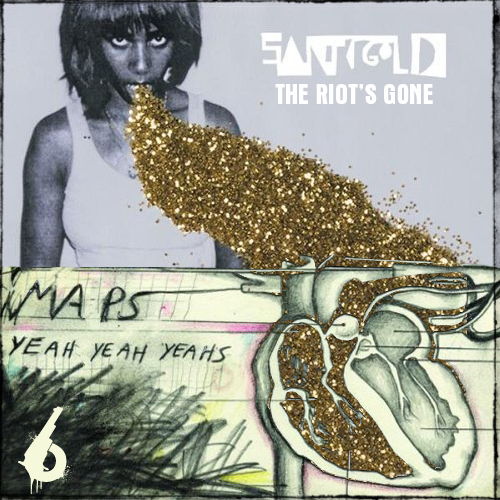
The Map's Gone


image taken from http://soundcloud.com/6gun/the-maps-gone

Can't help it, this was bugging me for a while, and I don't see much about it, so I'd like to clear it up, and then make a mess of it again.

"The Riot's Gone" off Santigold's album Master of My Make Believe, 2012

@3:07, Santigold sounds exactly like Karen O. in "Maps" by the Yeah Yeah Yeahs.

I'm listening to pandora, hear Maps, and I finally realize the match. I knew Karen O. was on the album, she's sings in the song "Go!", what I didn't know was that she also sings for the Yeah Yeah Yeahs. I should've known, because the guitars are actually lifted right from "Maps" (besides the fact that Nicholas Zinner guitarist for the Yeah Yeah Yeahs did production work for the album).

For another 'no man behind the curtain' anecdote, see this story about microchip patterns and romanticism.

Anyway, this is where it gets funny. Find this guy 6gun on soundcloud, he notices the same parallel, and mashes up the 2 songs.

So, if Riot is originally a mashup of Maps, and then 6gun mashes the two together, is that like breaking a kind of idea-incest rule? What do we call that?