Showing posts with label eureka. Show all posts

Wednesday, September 4, 2024

Quantum Surprise


You can't escape quantum this and quantum that while perusing science headlines, but these articles in particular are examples of moments when quantum experiments produced surprising results, or even better, results that look really cool but we don't even know what to do with them yet. That's the best kind of surprise. 

Promising quantum state found during error correction research
Sep 2023, phys.org

A team of Cornell researchers unexpectedly discovered the presence of "spin-glass" quantum state while conducting a research project designed to learn more about quantum algorithms and, relatedly, new strategies for error correction in quantum computing.

The researchers emphasized that they weren't simply trying to generate a better error protection scheme when they began this research. Rather, they were studying random algorithms to learn general properties of all such algorithms.

"Interestingly, we found nontrivial structure," Mueller said. "The most dramatic was the existence of this spin-glass order, which points toward there being some extra hidden information floating around, which should be useable in some way for computing, though we don't know how yet."

via Cornell's Laboratory of Atomic and Solid State Physics: Vaibhav Sharma et al, Subsystem symmetry, spin-glass order, and criticality from random measurements in a two-dimensional Bacon-Shor circuit, Physical Review B (2023). DOI: 10.1103/PhysRevB.108.024205


Redefining quantum machine learning
Mar 2024, phys.org

The team has discovered that neuronal quantum networks can not only learn but also memorize seemingly random data. 

"Our experiments show that these quantum neural networks are incredibly adept at fitting random data and labels, challenging the very foundations of how we understand learning and generalization."

via Free University of Berlin: Elies Gil-Fuster et al, Understanding quantum machine learning also requires rethinking generalization, Nature Communications (2024). DOI: 10.1038/s41467-024-45882-z


Research demonstrates a new mechanism of order formation in quantum systems
Apr 2024, phys.org

This means something for materials science which is already leaping past us. Also RIKEN:

Active matter agents change from a disordered to an ordered state in what is called a "phase transition." As a result, they move together in an organized fashion without an external controller.

They created a theoretical model in which spins of subatomic particles align in one direction just like how flocking birds face the same direction while flying. They found that the ordering can appear without elaborate interactions between the agents in the quantum model.

"It was different from what was expected based on biophysical models."

via University of Tokyo and RIKEN: Activity-induced ferromagnetism in one-dimensional quantum many-body systems, Physical Review Research (2024). dx.doi.org/10.1103/PhysRevResearch.6.023096

Tuesday, January 9, 2024

Mind Reading Is Real Now And Also Your Brain Is Controlled by Lasers


Brain activity decoder can reveal stories in people's minds
May 2023, phys.org

Semantic decoder can translate a person's brain activity -- while listening to a story or silently imagining telling a story -- into a continuous stream of text to help people who are mentally conscious yet unable to physically speak, such as those debilitated by strokes, to communicate intelligibly again.

Does not require subjects to have surgical implants (ie noninvasive, holy grail of brain stuff).

Brain activity is measured using an fMRI scanner after extensive training of the decoder, in which the individual listens to 15 hours of podcasts in the scanner. 

Later, provided that the participant is open to having their thoughts decoded, their listening to a new story or imagining telling a story allows the machine to generate corresponding text from brain activity alone.

Back to reality: 

The result is not a word-for-word transcript. Instead, researchers designed it to capture the gist. Decoding worked only with cooperative participants who had participated willingly.Results for individuals on whom the decoder had not been trained were unintelligible.

If participants on whom the decoder had been trained later put up resistance -- for example, by thinking other thoughts -- results were similarly unusable. Tactics like thinking of animals or quietly imagining telling their own story let participants easily and completely thwart the system.

Afterthoughts:

So you need to insert yourself in an fMRI for this to work. You also need to give permission for it to read your thoughts. But if you think that advances in quantum materials isn't going to put fMRIs in your baseball cap within the next 20 years, then you better start reading "terms and conditions" more carefully from now on. They even mention their tech can be translated to a newer form of MRI called functional near-infrared spectroscopy (fNIRS), a "portable brain-imaging system".

via University of Texas at Austin: Semantic reconstruction of continuous language from non-invasive brain recordings, Nature Neuroscience (2023). DOI: 10.1038/s41593-023-01304-9


AI tool generates video from brain activity
May 2023, phys.org

On the heels of the UT Austin paper above, although I can't help but be skeptical of this one:

Watching 20 hours worth of movies in an fMRI, plus Stable Diffusion, gets you a dream recorder. 

Also, you heard it folks: Dream researcher Daniel Oldis, working with a colleague at the Cognitive Neuroscience Lab at the University of Texas, Austin.

Dream researcher.

via Researchers at the National University of Singapore and the Chinese University of Hong Kong: Zijiao Chen et al, Cinematic Mindscapes: High-quality Video Reconstruction from Brain Activity, arXiv (2023). DOI: 10.48550/arxiv.2305.11675

AI Art - Human brain carbon fiber cybernetic biomechanical cymatics 2 - 2023

40 Hz vibrations reduce Alzheimer's pathology, symptoms in mouse models
May 2023, phys.org

Non-invasive sensory stimulation of 40 Hz gamma frequency brain rhythms can reduce Alzheimer's disease pathology and symptoms, already shown with light and sound by multiple research groups in mice and humans, can now extend to tactile stimulation.

The MIT group is not the first to show that gamma frequency tactile stimulation can affect brain activity and improve motor function, but they are the first to show that the stimulation can also reduce levels of the hallmark Alzheimer's protein phosphorylated tau, keep neurons from dying or losing their synapse circuit connections, and reduce neural DNA damage.

"This work demonstrates a third sensory modality that we can use to increase gamma power in the brain" 

In case you were wondering:

To produce the vibration stimulation, the researchers placed mouse cages over speakers playing 40 Hz sound, which vibrated the cages. Mice received six weeks of vibration stimulation. 

And since this all sounds so dubious, we need some background:

In a series of papers starting in 2016, a collaboration led by Tsai's lab has demonstrated that light flickering and/or sound clicking at 40 Hz (a technology called GENUS for Gamma Entrainment Using Sensory stimuli), reduces levels of amyloid-beta and tau proteins, prevents neuron death and preserves synapses and even sustains learning and memory in a variety of Alzheimer's disease mouse models.

Upcoming: MIT spin-off company Cognito Therapeutics has launched stage III clinical trials of light and sound stimulation as an Alzheimer's treatment.

Reminder: You don't need FDA approval for tactile stimulation. (As opposed to light or sound pulses, and as opposed to all the Alzheimer's drugs out there trying to get to market...).

via Picower Institute for Learning and Memory and the Aging Brain Initiative at MIT: Ho-Jun Suk et al, Vibrotactile stimulation at gamma frequency mitigates pathology related to neurodegeneration and improves motor function, Frontiers in Aging Neuroscience (2023). DOI: 10.3389/fnagi.2023.1129510


Exploring how psychedelic drugs affect a rat's brain
Aug 2023, phys.org

"Simultaneous Synchronization"

Researchers at Lund University have developed a technique for simultaneously measuring electrical signals from 128 areas of the brain in awake rats. They have then used the information to measure what happens to the neurons when the rats are given psychedelic drugs. The results show an unexpected and simultaneous synchronization among neurons in several regions of the brain.

But wait, because there's more:

Pär Halje and the research team was studying rats with Parkinson's disease that had problems with involuntary movements. The researchers discovered a tone -- an oscillation or wave in the electrical fields -- of 80 hertz in the brains of the rats with Parkinson's disease. It turned out that the wave was closely connected to the involuntary movements.

Now you know, 80 hertz. Although the above study said 40 hertz.

One important note on how this was done and why it's a big deal:

"For several of these areas, it is the first time anyone has successfully shown how individual neurons are affected by LSD in awake animals." 
We see that the neurons' activity synchronizes itself in a special way -- the waves in the brain go up and down essentially simultaneously in all parts of the brain where we are able to take measurements. This suggests that there are other ways in which the waves are communicated than through chemical synapses, which are relatively slow."

via Lund University: Ivani Brys et al, 5-HT2AR and NMDAR psychedelics induce similar hyper-synchronous states in the rat cognitive-limbic cortex-basal ganglia system, Communications Biology (2023). DOI: 10.1038/s42003-023-05093-6


Tuesday, May 23, 2023

Same Same


Headlines with a negative twist boost the consumption of online news, demonstrates study
Mar 2023, phys.org

This isn't about misinformation or memetic propagation; it's about multiple discovery, which I would rather call simultaneous discovery -- Calculus and the telephone come to mind. 

Incidentally, the publication of the research is a story all by itself. Only when Feuerriegel and his team submitted an initial version of the paper to Nature Human Behaviour did they become aware that a research group led by Jay Van Bavel from New York University had also submitted a paper -- in the same week, on the same topic, based on the same dataset from Upworthy.com, and with almost identical results.

via Ludwig Maximilian University of Munich: Claire E. Robertson et al, Negativity drives online news consumption, Nature Human Behaviour (2023). DOI: 10.1038/s41562-023-01538-4


Post Script:
This whole description is poorly sourced but well written: The concept of multiple discovery (also known as simultaneous invention) is the hypothesis that most scientific discoveries and inventions are made independently and more or less simultaneously by multiple scientists and inventors. The concept of multiple discovery opposes a traditional view—the "heroic theory" of invention and discovery. Multiple discovery is analogous to convergent evolution in biological evolution.

Robert K. Merton defined such "multiples" as instances in which similar discoveries are made by scientists working independently of each other.
-Merton, Robert K. (December 1963). "Resistance to the Systematic Study of Multiple Discoveries in Science". European Journal of Sociology. 4 (2): 237–282. doi:10.1017/S0003975600000801. JSTOR 23998345. S2CID 145650007. Reprinted in: Robert K. Merton (15 September 1996). On Social Structure and Science. University of Chicago Press. pp. 305–. ISBN 978-0-226-52070-4.

Monday, March 13, 2023

Scientists Startled, Puzzled and Shocked Over New Discoveries


Astrophysicists make observations consistent with the predictions of an alternative theory of gravity
Oct 2022, phys.org

"Puzzling discovery"

New method developed for counting stars:
MOND - MOdified Newtonian Dynamics, also called
MoND - Modified Newtonian Dynamics, (see what they did there)

"According to Newton's laws of gravity, it's a matter of chance* in which of the tails a lost star ends up," explains Dr. Jan Pflamm-Altenburg of the Helmholtz Institute of Radiation and Nuclear Physics. "So both tails should contain about the same number of stars. However, in our work we were able to prove for the first time that this is not true: In the clusters we studied, the front tail always contains significantly more stars nearby to the cluster than the rear tail."
*I thought they said God doesn't roll dice?!

via University of Bonn: Pavel Kroupa et al, Asymmetrical tidal tails of open star clusters: stars crossing their cluster's práh challenge Newtonian gravitation, Monthly Notices of the Royal Astronomical Society (2022). doi.org/10.1093/mnras/stac2563


Unique features of octopus create 'an entirely new way of designing a nervous system'
Nov 2022, phys.org

Totally unexpected about the octopus nervous system: a structure by which the intramuscular nerve cords (INCs), which help the animal sense its arm movement, connect arms on the opposite sides of the animal. The startling discovery provides new insights into how invertebrate species have independently evolved complex nervous systems.

via University of Chicago Medical Center: Adam Kuuspalu et al, Multiple nerve cords connect the arms of octopuses, providing alternative paths for inter-arm signaling, Current Biology (2022). DOI: 10.1016/j.cub.2022.11.007


Researcher finds a sweet new way to print microchip patterns on curvy surfaces
Nov 2022, phys.org

It was only as a last resort that he had even tried burying microscopic magnetic dots in hardened chunks of sugar—hard candy, basically—and sending these sweet packages to colleagues in a biomedical lab. The sugar dissolves easily in water, freeing the magnetic dots for their studies without leaving any harmful plastics or chemicals behind.

By chance, Zabow had left one of these sugar pieces, embedded with arrays of micromagnetic dots, in a beaker, and it did what sugar does with time and heat—it melted, coating the bottom of the beaker in a gooey mess.

"No problem," he thought. He would just dissolve away the sugar, as normal. Except this time when he rinsed out the beaker, the microdots were gone. But they weren't really missing; instead of releasing into the water, they had been transferred onto the bottom of the glass where they were casting a rainbow reflection.

Could regular table sugar be used to bring the power of microchips to new and unconventional surfaces?

(Yes)

via National Institute of Standards and Technology: G. Zabow, Reflow transfer for conformal three-dimensional microprinting, Science (2022). DOI: 10.1126/science.add7023


New measurements of galaxy rotation lean toward modified gravity as an explanation for dark matter
Dec 2022, phys.org

Modified Newtonian dynamics (MoND) or modified gravity model: 

Rather than the force of attraction as a pure inverse square relation, gravity has a small remnant pull regardless of distance. This remnant is only about 10 trillionths of a G, but it's enough to explain galactic rotation curves.

So the author of this paper looked at high-resolution velocity curves of 152 galaxies as observed in the Spitzer Photometry and Accurate Rotation Curves (SPARC) database. He found a shift in agreement with AQUAL. The data seems to support modified gravity over standard dark matter cosmology.

via Sejong University Department of Physics and Astronomy, Korea: Kyu-Hyun Chae, Distinguishing Dark Matter, Modified Gravity, and Modified Inertia with the Inner and Outer Parts of Galactic Rotation Curves, arXiv (2022). DOI: 10.48550/arxiv.2207.11069


Post Script:
A subtitled world: Uncovering the secrets of tickertape synesthesia
Feb 2023, phys.org

Tickertape synesthesia - transcribing the speech of others into text, automatically and involuntarily, these sounds will appear as imaginary subtitles floating before your eyes

A previous study estimated that up to 1.4% of the population could experience involuntary subtitles when hearing a human voice, but this figure remains uncertain. It's challenging to detect TTS subjects, who are generally unaware that they are distinguishable from the average person.

"Several participants in the study were shocked to learn that not everyone has built-in subtitles,"

Even more surprising: some subjects report that when they watch a foreign movie, a second level of subtitles—a product of their synesthesia—appears above the subtitles embedded in the video. Others have subtitled dreams and nightmares, which provide their oneiric activity with a cinematic dimension. Finally, since one-third of the participants knew of other cases of TTS in their family, the emergence of this form of synesthesia might have a genetic basis.

AKA "Orthographic representations"

via Paris Brain Institute: abien Hauw et al, Subtitled speech: Phenomenology of tickertape synesthesia, Cortex (2022). DOI: 10.1016/j.cortex.2022.11.005

Wednesday, March 8, 2023

Phantom Goalposts


‘Rain bursts’ over Sydney have intensified 40% over last two decades, research finds
Nov 2022, The Guardian

The rate of intensification was far greater than what was predicted with climate change.

“At first we thought it was a problem with the data,” he said.


New York City's greenery absorbs a surprising amount of its carbon emissions
Jan 2023, phys.org

On many summer days (but not winter), photosynthesis by trees and grasses absorbs all the carbon emissions produced by cars, trucks and buses, and then some.

Most previous studies have calculated carbon uptake of vegetation by looking mainly at contiguous tracts of forest and grassland, but these comprise only about 10 percent of the metro area. Using newly available aerial radar imagery of New York City that mapped vegetation in unprecedented 6-inch grids, Wei and her colleagues included developed areas—the other 90 percent of the region, left out in most models. 

In other words, just when you thought climate science was at the top of everyone's agenda, you realize we know very little about a whole lot. And in light of this recent discovery, it makes you wonder how much of the carbon gas problem is really from de-vegetated cities and towns? Not to cast doubt on the contribution of fossil fuels, but where would we be today if we had been more conservative about vegetation, trees in particular, when developing for example the sprawling supermetropolis that is the United States East Coast? Factor the much more local heat island effect, and consider the difference in overall quality of life we'd be getting out of our built environment. (But also remember that landowners in the suburbs like grass and not trees, and that poorly funded municipal public works departments find it easier to maintain a town with no vegetation at all.)

via Columbia University: Dandan Wei et al, High resolution modeling of vegetation reveals large summertime biogenic CO2 fluxes in New York City, Environmental Research Letters (2022). DOI: 10.1088/1748-9326/aca68f


Reducing steel corrosion is vital to combating climate change: Study
Jan 2023, phys.org

Global steel production has been rising steadily for decades—and because steel has poor resistance to corrosion (aka rust), part of that demand is to replace steel used in construction materials that have become corroded over time, in everything from bridges to automobiles. Reducing the amount of steel that needs to be replaced due to corrosion could have measurable effects on how much greenhouse gases are produced to make steel.

Using historical carbon dioxide intensity data to estimate carbon dioxide levels per year beginning from 1960, the researchers found that in 2021, steel production accounted for 27% of the carbon emissions of the global manufacturing sector, and about 10.5% of the total global carbon emissions worldwide. Corroded steel replacement accounted for about 1.6 to 3.4% of emissions.

Greenhouse gas emissions produced by the steel industry could reach about 27.5% of the world's total carbon emissions by 2030, with corroded steel representing about 4 to 9% of that number (is that 1 - 3% of the total?).

But there is some good news, the study noted. Due to regulations placed on the steel industry, technological advances in the steelmaking process have resulted in a 61% reduction in energy consumption over the last 50 years.

via The Ohio State University: M. Iannuzzi et al, The carbon footprint of steel corrosion, npj Materials Degradation (2022). DOI: 10.1038/s41529-022-00318-1


Planting more trees could decrease deaths from higher summer temperatures in cities by a third, modeling study suggests
Feb 2023, phys.org

Of the 57 million inhabitants of 93 European cities circa 2015, 6,700 premature deaths could be attributed to hotter urban temperatures during the summer months, accounting for 4.3% of summer mortality and 1.8% of year-round mortality. One in three of these deaths (2,644 total) could have been prevented by increasing tree cover up to 30%, and therefore reducing temperatures. This corresponds to 39.5% of all deaths attributable to hotter urban temperatures, 1.8% of all summer deaths, and 0.4% of year-round deaths.

via Barcelona Institute for Global Health: Cooling cities through urban green infrastructure: a health impact assessment of European cities, The Lancet (2023).


GHGSat: Commercial satellite will see CO2 super-emitters
Jan 2023, BBC News

Almost feels like the future:

The world's first commercial satellite dedicated to monitoring carbon dioxide from orbit will launch later this year.

It will be put up by the Canadian company GHGSat, which already flies six spacecraft tracking methane emissions. The new platform will use the same shortwave infrared sensor but be tuned to CO2's specific light signature in the atmosphere. The satellite will have a resolution at ground level of 25m, meaning it will be able to see major individual sources. Others make large area maps; they're not set up to hone in on super-emitters at the scale of an individual industrial complex.

(We already know where they are in general, this will just help us confirm the individual emitter.)


Post Script:
Childhood trauma linked to civic environmental engagement, green behavior
Jan 2023, phys.org

Experiencing childhood trauma may lead an individual to volunteer, donate money or contact their elected officials about environmental issues later in life. 

In addition, those who traveled and had experiences in nature as children were also more likely to report engaging in private "green behavior" as adults, such as recycling, driving or flying less, and taking shorter showers.

via University of Colorado at Boulder: Urooj S. Raja et al, Childhood trauma and other formative life experiences predict environmental engagement, Scientific Reports (2022). DOI: 10.1038/s41598-022-24517-7

Post Post Script:
Tax rebates for solar power ineffective for low-income Americans, but study finds a different incentive works
Nov 2022, phys.org

Machine-learning model "DeepSolar++" analyzed satellite images to identify where solar panels are and when they were installed in more than 400 counties across the United States, from 2006 through 2017, and then combined that data with information about each community's demographics as well as local financial incentives for solar power.

For low income groups, what works is performance incentives which reward customers based on how much solar they produce or how much less electricity they buy from the grid.

via Stanford: Zhecheng Wang et al, DeepSolar++: Understanding residential solar adoption trajectories with computer vision and technology diffusion models, Joule (2022). DOI: 10.1016/j.joule.2022.09.011

Monday, February 27, 2023

Everybody Loves Fermions


Graphs may prove key in search for Holy Grail of quantum error correction
Oct 2022, phys.org

It was a serendipitous discovery:

Quantum information is very fragile and prone to errors. You can't check for errors in a quantum system, because the act of checking itself collapses the system.

"The noise is very strong at the quantum scale," says Chapman. "And this makes quantum error correction very difficult."

You need some redundancy that allows you to tell if something has happened without knowing the underlying information."

There are quantum error correcting codes that are known to be self-healing, but they only work in four dimensions — one more than exists in this world. [right thanks]

In the new paper, the researchers showed that some subsystem codes can be represented as a certain kind of graph. [nodes and links]

"I had a seemingly unrelated pure mathematics project studying graph spectra," says Kollár, "and we realized that the numerical scripts that I had for that project could easily be modified to compute the energy cost of errors for the kinds of codes that Adrian and his collaborators had been looking at."

via Joint Quantum Institute: Adrian Chapman et al, Free-Fermion Subsystem Codes, PRX Quantum (2022). DOI: 10.1103/PRXQuantum.3.030321

Image credit: Anatoly Fomenko

The Revolution Will Be Fermions


Team develops graphene-based nanoelectronics platform
Dec 2022, phys.org

In metals, electric currents are carried by negatively charged electrons. But contrary to the researchers' expectations, their measurements suggested that the edge currents were not carried by electrons or by holes (a term for positive quasiparticles indicating the absence of an electron). Rather, the currents were carried by a highly unusual quasiparticle that has no charge and no energy, and yet moves without resistance. The components of the hybrid quasiparticle were observed to travel on opposite sides of the graphene's edges, despite being a single object.

The unique properties indicate that the quasiparticle might be one that physicists have been hoping to exploit for decades — the elusive Majorana fermion predicted by Italian theoretical physicist Ettore Majorana in 1937.

"Developing electronics using this new quasiparticle in seamlessly interconnected graphene networks is game changing," de Heer said.

via Georgia Institute of Technology: Vladimir S. Prudkovskiy et al, An epitaxial graphene platform for zero-energy edge state nanoelectronics, Nature Communications (2022). DOI: 10.1038/s41467-022-34369-4

Image credit: Anatoly Fomenko


Tuesday, November 1, 2022

Pandemic Surprise


Serendipitous backyard experiment shines light on producing polymers
Sep 2022, phys.org

With the COVID shutdown, the scientists at QUT's Soft Matter Materials Group, like the rest of the world, switched to working from home which meant limited time in the university research labs.

Where safe and practicable, the scientists looked for ways to take their work home with them.

This situation inspired the researchers to continue their experiment using sunlight and Dr. Delafresnaye installed the experiment on her outdoor barbecue table and left it in what the research paper calls "Australian sunshine" for four hours.

It's an unprecedented methodology for the production of microspheres, which are used in a wide range of applications including drug delivery, pharmaceuticals, cosmetics and paints. Normally they use a laser or LED to start and stop a reaction; this uses sunshine.

via Queensland University of Technology: Laura Delafresnaye et al, Microspheres from light—a sustainable materials platform, Nature Communications (2022). DOI: 10.1038/s41467-022-32429-3


And since so many of us became armchair epidemiologists during the pandemic, automatically rejecting any study that was not peer-reviewed...

Most preprint studies of COVID-19 hold up through peer-review: study
Oct 2022, phys.org

Comparing preprint manuscripts to the eventual published versions of the individual studies, about 90 percent of those 1,606 data points were still in the text after peer review. 

(fyi the National Institutes of Health has promoted preprint manuscripts as a way to accelerate the pace of scientific discovery.)

via University of Wisconsin-Madison:  Lindsay Nelson et al, Robustness of evidence reported in preprints during peer review, The Lancet Global Health (2022). DOI: 10.1016/S2214-109X(22)00368-0

Wednesday, October 26, 2022

Things Come To Life


Surely we won't see it until it's already infiltrating every kingdom and phylum -- what once was just a dumb robot, or a box of rocks, or a pile of dust, will soon be alive and trying to make its way in the world, commanding the same respect as the river in Ecuador that has rights, or the endangered animals in the Galapagos that have rights, or the dematerialized algorithms that exist as a dimensionally camouflaged meta-entity powered by economic incentive and psychological manipulation, which doesn't even need rights because it's the lifeline of global commerce. 

One day we'll all be held ethically liable for treating our stuff like inert, soul-less matter.


Starfish embryos swim in formation like a 'living crystal,' could inform the design of self assembling 
Jul 2022, phys.org

Fakhri says the team's observations of starfish crystals was a "serendipitous discovery." 

She and her colleagues fertilized thousands of starfish embryos, then watched as they swam to the surface of shallow dishes. "There are thousands of embryos in a dish, and they start forming this crystal structure that can grow very large," Fakhri says. "We call it a crystal because each embryo is surrounded by six neighboring embryos in a hexagon that is repeated across the entire structure, very similar to the crystal structure in graphene."

via MIT: Nikta Fakhri, Odd dynamics of living chiral crystals, Nature (2022). DOI: 10.1038/s41586-022-04889-6.


A step toward the creation of materials controlled by artificial genes
Aug 2022, phys.org

"New types of soft material robots that are controlled by chemistry instead of electronics."

Say you're making artificial humans without saying you're making artificial humans.

"Engineering synthetic chemical systems that can emulate the complex behaviors of natural gene networks that operate inside diagnostic, self-healing materials rather than organisms."

via Johns Hopkins University: Samuel W. Schaffter et al, Standardized excitable elements for scalable engineering of far-from-equilibrium chemical networks, Nature Chemistry (2022). DOI: 10.1038/s41557-022-01001-3


Synthetic mouse embryo develops beating heart
Aug 2022, BBC News

Scientists in Cambridge have created synthetic mouse embryos in a lab, without using eggs or sperm, which show evidence of a brain and beating heart.

At present, UK law permits human embryos to be studied in the laboratory only up to the fourteenth day of development, but there are no rules around synthetic embryos.

via University of Cambridge and the California Institute of Technology: Synthetic embryos complete gastrulation to neurulation and organogenesis. Gianluca Amadei et al. Nature. 2022. https://doi.org/10.1038/s41586-022-05246-3


Robo-bug: A rechargeable, remote-controllable cyborg cockroach
Sep 2022, phys.org

Powered by a solar cell which is funny because roaches hang out in the dark mostly.

RIKEN: Yujiro Kakei et al, Integration of body-mounted ultrasoft organic solar cell on cyborg insects with intact mobility, npj Flexible Electronics (2022). DOI: 10.1038/s41528-022-00207-2


Nanotubes illuminate the way to living photovoltaics
Sep 2022, phys.org

"We put nanotubes inside of bacteria" 

via Ecole Polytechnique Federale de Lausanne:  Ardemis Boghossian et al, Carbon nanotube uptake in cyanobacteria for near-infrared imaging and enhanced bioelectricity generation in living photovoltaics, Nature Nanotechnology (2022). DOI: 10.1038/s41565-022-01198-x


Post Script:
GlyNAC supplementation reverses aging hallmarks in aging humans
Aug 2022, phys.org

A randomized, double blind human clinical trial conducted by researchers at Baylor College of Medicine reveals that supplementation with GlyNAC—a combination of glycine and N-acetylcysteine—improves many age-associated defects in older humans and powerfully promotes healthy aging. 

via Baylor College of Medicine:  Premranjan Kumar et al, Supplementing Glycine and N-Acetylcysteine (GlyNAC) in Older Adults Improves Glutathione Deficiency, Oxidative Stress, Mitochondrial Dysfunction, Inflammation, Physical Function, and Aging Hallmarks: A Randomized Clinical Trial, The Journals of Gerontology: Series A (2022). DOI: 10.1093/gerona/glac135


Wednesday, September 14, 2022

Based Pairs


A 'factory reset' for the brain may cure anxiety, drinking behavior, study suggests: Gene editing reverses brain genetic reprogramming caused by adolescent binge drinking 
May 2022, ScienceDaily

CRISPR Cocktail:
"Early binge drinking can have long-lasting and significant effects on the brain and the results of this study offer evidence that gene editing is a potential antidote to these effects, offering a kind of factory reset for the brain, if you will," 

via University of Illinois Chicago: Targeted epigenomic editing ameliorates adult anxiety and excessive drinking after adolescent alcohol exposure. John Peyton W. Bohnsack, et al. Science Advances, 2022; 8 (18) DOI: 10.1126/sciadv.abn2748


Researchers find CRISPR-Cas9 gene editing approach can alter the social behavior of animals
May 2022, phys.org

The old switcheroo:
"We were really surprised at the results," Albers said. "We anticipated that if we eliminated vasopressin activity, we would reduce both aggression and social communication. But the opposite happened."

via Georgia State University: Jack H. Taylor et al, CRISPR-Cas9 editing of the arginine–vasopressin V1a receptor produces paradoxical changes in social behavior in Syrian hamsters, Proceedings of the National Academy of Sciences (2022). DOI: 10.1073/pnas.2121037119


Image credit: No credits, a computer made it! But I call it "Lobotomy in Alaska", from Lexica's library.


Captain Obvious vs Major Surprise


Erratic temperatures causing more deaths than heatwaves, study finds
May 2022, phys.org

Similar to the axiom, "It's not the crime that gets you caught; it's the coverup", and yet in opposition to "It's not the heat; it's the humidity", we've got another reason to be concerned about the climate apocalypse -- It's not the absolute heat that kills you, it's the rapid fluctuations in temperature. 

This is well-known in the occupational health world, where it is expected that businesses who send their workers to faraway places allow those workers to acclimate to that faraway environment for one to two weeks prior to starting work. 

That sounds like a lot of time, but that's how long it takes our bodies to adjust. From Death Valley to Denver? You better adjust to that mile-highness, otherwise you won't be able to get enough oxygen to your brain to avoid passing out. Minnesota to Miami? You better adjust, or your heart won't be able to pump your blood around your body fast enough to cool you off, and you could have a heart attack. 

Up to two weeks! Here the summer of New Jersey, the temperature went from a daily high of 85 F for a whole month to one week of temps above 95 (longest heat wave on record, until it got broken again the following week), with some days above 105. But it happened all of the sudden. When the temperatures, and entire seasons, jump back and forth like this, our body can't adjust fast enough, and your heart has to work a lot harder to keep you cool. And for some of us, that might be harder than we can handle. 

via Monash University: Yao Wu et al, Global, regional, and national burden of mortality associated with short-term temperature variability from 2000–19: a three-stage modelling study, The Lancet Planetary Health (2022). DOI: 10.1016/S2542-5196(22)00073-0


New data reveals climate change might be more rapid than predicted
May 2022, phys.org

Storm intensification over recent decades has already reached levels projected to occur in the year 2080.

via Weizmann Institute of Science: Rei Chemke, The intensification of winter mid-latitude storm tracks in the Southern Hemisphere, Nature Climate Change (2022). DOI: 10.1038/s41558-022-01368-8


A fresh look into grasslands as carbon sinks
Aug 2022, phys.org

"This is the first review which applies the new paradigm of soil organic matter formation and persistence to both discuss the effect of global changes on grasslands' soil organic carbon and estimate the potentials of soil organic carbon sequestration of global grasslands," 

Because "either the amount of carbon coming out of the atmosphere from the plants is wrong or the amount coming out of the soil is wrong".

And don't forget that "roughly a quarter of all human greenhouse gas emissions are from land use".

Also, Gabe Brown would like a word. 

via Chinese Academy of Sciences Institute of Botany and Colorado State University: Yongfei Bai et al, Grassland soil carbon sequestration: Current understanding, challenges, and solutions, Science (2022). DOI: 10.1126/science.abo2380


Scientists evaluate Earth-cooling strategies with geoengineering simulations
Aug 2022, phys.org

Solar radiation modification, i.e., injecting sulfate aerosols into the stratosphere, a la, Ministry for the Future and Terminal Shock.

"Anybody who has not heard of this strategy before, the first reaction should be 'Wow, you can't be serious. That sounds horrible,'" MacMartin said. "And it might be, but climate change isn't good either.

via Cornell University: D. G. MacMartin et al, Scenarios for modeling solar radiation modification, Proceedings of the National Academy of Sciences (2022). DOI: 10.1073/pnas.2202230119

A depiction of Trantor, a fictional ecumenopolis from Isaac Asimov's Galactic Empire

Post Script: Heating and Cooling
Heat waves aren't going away. Here's how we can prepare
Aug 2022, phys.org

A lack of shade in broad swaths of urban areas adds to the heat burden, making it harder for people to find relief. 

Cooling neighborhoods down by adding trees and vegetation and using more reflective outdoor materials could save up to nearly one in four lives currently lost to heat waves, and delay climate change-induced warming by approximately 40-70 years.

In Los Angeles, one project reducing heat in cities is Cool Streets LA. It focuses on the hottest and most-vulnerable neighborhoods in the city by planting 2,000 trees and adding 60 miles of cool pavement, using various special materials, including one known as CoolSeal. Originally developed by the military, CoolSeal was designed to keep spy planes cool and hide them from infrared cameras. The city reports that these cool pavements can lower surface temperatures by as much as 10 degrees on a summer afternoon.

Adding tree cover can provide much needed shade and help naturally cool the air. But it doesn't work everywhere. Urban planners should consider how to bring shade to areas like bus shelters, school playgrounds and other highly trafficked areas

"My team looked at municipal plans from the 50 largest cities in the U.S., and we found that the overwhelming majority don't even include shade in any of their heat planning documents," Turner says.

Note: While it is illegal to rent an apartment in California that doesn't provide heat, there are no standards that require adequate cooling. The state legislature could soon take up the issue. Cooling will likely need to be subsidized.

via Applied Climatologists Inc, UCLA School of Medicine, UCLA Fielding School of Public Health, UCLA Institute of the Environment & Sustainability, School of Geographical Science and Urban Planning at Arizona State University: Laurence S. Kalkstein et al, Increasing trees and high-albedo surfaces decreases heat impacts and mortality in Los Angeles, CA, International Journal of Biometeorology (2022). DOI: 10.1007/s00484-022-02248-8


Tuesday, September 13, 2022

Where Color Comes From


Toward 4D printing with structural colors
Jun 2022, phys.org

While you were sleeping, 3D printing makes a huge evolutionary leap - now making "structural colors" directly into the nanoscopic surface textures of the materials. What better name to call it than 4D printing:

3D printing with stimuli-responsive materials, called 4D printing. 4D printing enables 3D printed structures to change its configurations over time and is used in a wide variety of fields such as soft robotics, flexible electronics, and medical devices.

Structural coloration occurs on surfaces with a nanostructure with dimensions similar to those of the wavelength of the incident light (typically below a micron). These ordered nanostructures are known as photonic crystals.

But it's not just about printing structurally-memetic dragonfly iridescence that changes depending on the light. It's about the surface textures changing over time, and in response to any number of stimuli in the environment. Too hot? Turns red. Cyanide gas in the air? Turns green.

Humidity-responsive color changing ink for extrusion 3D printing reversibly changes volume and reflected color based on hydration state.


But again it's not just about changing colors, it's about the materials sensing its environment and changing its structure in response:

"Ideally, by including responsive elements in these polymers, we can create materials that can both sense and respond to their environment, perhaps even allowing communication between individual devices as well to generate a level of autonomy for a collection of individual units," Debije concludes.

via Eindhoven University of Technology: Jeroen A. H. P. Sol et al, Direct Ink Writing of 4D Structural Colors, Advanced Functional Materials (2022). DOI: 10.1002/adfm.202201766


Natural mineral hackmanite demonstrates highly repeatable color change ability
Jun 2022, phys.org

"Structural Breathing" he says.

Also, radiation exposure detection:
Hackmanite changes color when it's exposed to ultraviolet radiation, and without wearing out, but until now we didn't know why.

It can do this repeatedly without wearing out because it does not use the change in color of the organic molecules the make it up, like similar minerals, but by using structural color -- a change in the position of the molecules, but not their composition.

"In this research, we found out for the first time that there is actually a structural change involved in the color change process, as well. When the color changes, sodium atoms in the structure move relatively far away from their usual places and then return back. This can be called 'structural breathing,' and it does not destroy the structure even if it is repeated a large number of times,"
 
via Intelligent Materials Research Group at the Department of Chemistry of the University of Turku, Finland: Pauline Colinet et al, The structural origin of the efficient photochromism in natural minerals, Proceedings of the National Academy of Sciences (2022). DOI: 10.1073/pnas.2202487119


Engineers repurpose 19th-century photography technique to make stretchy, color-changing films
Aug 2022, phys.org

By applying a 19th-century color photography technique to modern holographic materials, an MIT team has printed large-scale images onto elastic materials that when stretched can transform their color, reflecting different wavelengths as the material is strained.

The eureka:
While puzzling over how to resolve this challenge of getting microscale control and scalability together in structural color technology, Miller happened to visit the MIT Museum, where a curator talked him through an exhibit on holography, a technique that produces three-dimensional images by superimposing two light beams onto a physical material. "I realized what they do in holography is kind of the same thing that nature does with structural color."

via MIT: Benjamin Harvey Miller et al, Scalable optical manufacture of dynamic structural colour in stretchable materials, Nature Materials (2022). DOI: 10.1038/s41563-022-01318-x


Post Script:
Researchers add antireflection coatings to complex 3D printed micro-optical systems
Apr 2022, phys.org

Another nod to the future where everything becomes a computer -- the mirrors (for optical circuits, for optical computers) are sprayed right onto the 3D printed objects themselves. 

Imagine being skinned in nanocrystal photon routers.  

via University of Stuttgart: Simon Ristok et al, Atomic layer deposition of conformal anti-reflective coatings on complex 3D printed micro-optical systems, Optical Materials Express (2022). DOI: 10.1364/OME.454475


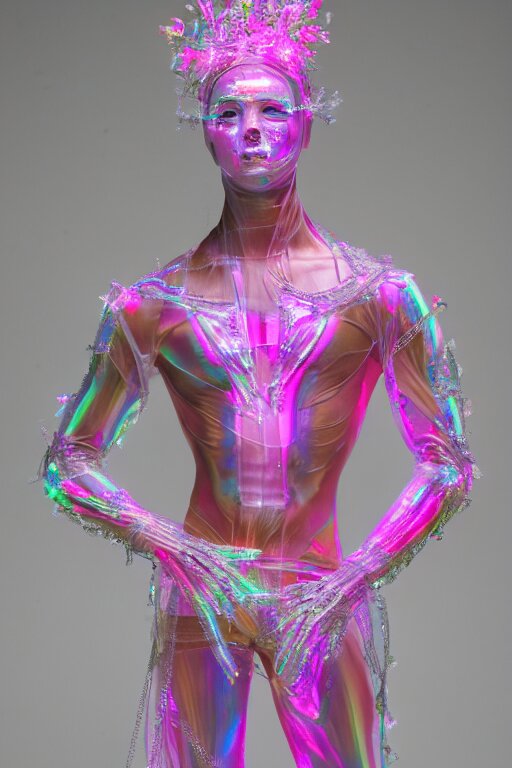
Image credit: AI Art - Skinned in Nanocrystals

Prompt: full-body rococo and cyberpunk delicate neon crystalline sculpture of (((muscular slender Nick Jonas))) as an iridescent humanoid deity wearing a thin see-through ((plastic hooded cloak)) sim roupa, reclining con (las piernas abiertas), glowing pink face, crown of (((white lasers))), large diamonds, swirling black silk fabric. futuristic elements. oozing glowing liquid, full-length view. space robots. (((human skulls))). throne made of bones, intricate artwork by caravaggio. Trending on artstation, octane render, cinematic lighting from the right, hyper realism, octane render, 8k, depth of field, 3D

Bonus: AI Art - Optical Computer Skin


Thoughts and Thinking


International collaboration reveals how the human brain evolved to harness abstract thought
Apr 2022, phys.org

"Surprisingly, our results showed that in all species other than humans, the brain areas that comprise the default mode network involve two systems not strongly connected with each other," Constantinidis said. "These regions, one responsible for suppression of external events and one for more cognitive tasks, appear to be linked only recently in evolution. It is this linkage that may have facilitated the capacity for abstract thought that led to the rapid evolution of human cognitive abilities."

via Vanderbilt University: Christos Constantinidis & collegaues, An evolutionary gap in primate default mode network organization, Cell Reports (2022). DOI: 10.1016/j.celrep.2022.110669.


Exploring how abstract concepts are represented in the brain across cultures, languages
May 2022, phys.org

"We wanted to look across languages to see if our cultural backgrounds influence how we understand, how we perceive abstract ideas like justice."

Brain scans from 20 participants, with equal representation from those who speak English and Mandarin. Participants were given 28 individual abstract concepts that spanned seven categories: social, emotion, metaphysics, law, religiosity, mathematics and scientific. While in the fMRI machine, participants would think about a prompt from one of these categories, like sacrilege in the religiosity category, for three seconds. Between each prompt, the participant would clear their mind by staring at a shrinking, blue ellipse for seven seconds. The series was repeated six times to provide multiple datasets for statistical analyses and to train and test models.

The study shows that a common neural infrastructure does exist between languages. While the underlying neural regions are similar, how the areas light up is more specific to each individual.

"Despite each culture developing its own somewhat differing conceptions of the world, all brains organize the abstract concepts the same way, using the same brain systems."

(Not sure if it's appropriate to apply it here, but remember that all brain studies of less than 1,000 people are subject to noisy data? This study has 20.)

via Carnegie Mellon University: Robert Vargas et al, Similarities and differences in the neural representations of abstract concepts across English and Mandarin, Human Brain Mapping (2022). DOI: 10.1002/hbm.25844


Completely unrelated image above: 

Pickled fetus found inside ancient Egyptian mummy
Feb 2022, phys.org

A closer look at the mummy and her fetus showed that she did not die in childbirth. They also found the mummy had been preserved with natron, a type of salt found in dry lake beds. When used to mummify a corpse, it dries out the body and also works as a disinfectant, preventing bacteria from eating the remains. The fetus remained untouched by those who had mummified the remains, which kept the womb pristine.

via the Warsaw Mummy Project: Wojciech Ejsmond et al, Further evidence to confirm the 'pregnant mummy': A reply to Saleem (2021), Journal of Archaeological Science (2021). DOI: 10.1016/j.jas.2021.105504

Also: Wojciech Ejsmond et al, A pregnant ancient egyptian mummy from the 1st century BC, Journal of Archaeological Science (2021). DOI: 10.1016/j.jas.2021.105371
 

Friday, September 9, 2022

Quantum Update


Quantum physics in proteins - AI affords unprecedented insights into how biomolecules work
Nov 2021, phys.org

I hear the quantum biology headlines humming.

via Deutsches Elektronen-Synchrotron: Abbas Ourmazd, Few-fs resolution of a photoactive protein traversing a conical intersection, Nature (2021). DOI: 10.1038/s41586-021-04050-9


Physicists create compressible optical quantum gas
Mar 2022, phys.org

Calling BECs (Bose-Einstein Condensate) a "super photon" by the way.

via University of Bonn: Erik Busley et al, Compressibility and the equation of state of an optical quantum gas in a box, Science (2022). DOI: 10.1126/science.abm2543.


Physicists report on first programmable quantum sensor
Mar 2022, phys.org

"In the development of quantum computers, we have learned to create tailored entangled states." 
("Custom Quantum", am I right?)

via University of Innsbruck: Christian Marciniak, Optimal metrology with programmable quantum sensors, Nature (2022). DOI: 10.1038/s41586-022-04435-4.

Also: Quantum Variational Optimization of Ramsey Interferometry and Atomic Clocks, Physical Review X (2021). DOI: 10.1103/PhysRevX.11.041045.


Chinese team breaks distance record for quantum secure direct communication
Apr 2022, phys.org

Distance of 102.2 km.
Prior to this new effort, the record was just 18 km.

via Tsinghua University in China: Haoran Zhang et al, Realization of quantum secure direct communication over 100 km fiber with time-bin and phase quantum states, Light: Science & Applications (2022). DOI: 10.1038/s41377-022-00769-w

Tying Quantum Knots - TU Delft - 2022

It takes three to tangle: Long-range quantum entanglement needs three-way interaction
May 2022, phys.org

The researchers' findings are consistent with previous observations that long-range entanglement survives at a non-zero temperature only when more than three subsystems are involved.

via RIKEN: Tomotaka Kuwahara et al, Exponential Clustering of Bipartite Quantum Entanglement at Arbitrary Temperatures, Physical Review X (2022). DOI: 10.1103/PhysRevX.12.021022


Tunable quantum traps for excitons
May 2022, phys.org

Physicists can now string together many such trapped excitons and adjust them in such a way that they emit photons having exactly the same properties. "That would allow one to create identical single photon sources for quantum information processing," 

via ETH Zurich: Deepankur Thureja et al, Electrically tunable quantum confinement of neutral excitons, Nature (2022). DOI: 10.1038/s41586-022-04634-z


Scientists use quantum computers to simulate quantum materials
May 2022, phys.org

"Computational Materials" sounds like another way of saying "active matter"?

Also "Hardware Noise":
Performing calculations of the properties of materials and molecules on quantum computers faces a problem that one does not experience with a classical computer, a phenomenon known as hardware noise. Noisy calculations return slightly different answers each time a calculation is performed; a noisy addition operation might return values slightly different from 4 each time for the question, "What is 2 plus 2?"

via Argonne National Laboratory's Midwest Integrated Center for Computational Materials and University of Chicago: Benchen Huang et al, Simulating the Electronic Structure of Spin Defects on Quantum Computers, PRX Quantum (2022). DOI: 10.1103/PRXQuantum.3.010339


Researchers achieve record entanglement of quantum memories
Jul 2022, phys.org

Again with the "quantum memories" term:
Researchers coupled two atomic quantum memories using two optically trapped rubidium atoms in two laboratories on the LMU campus connected via a 700-meter-long fiber optic cable.

via Ludwig Maximilian University of Munich: Tim van Leent et al, Entangling single atoms over 33 km telecom fibre, Nature (2022). DOI: 10.1038/s41586-022-04764-4


Scientists invent 'quantum flute' that can make particles of light move together
Jul 2022, phys.org

Ah yes, the quantum flute, we've been waiting for that one.

via University of Chicago: Srivatsan Chakram et al, Seamless High- Q Microwave Cavities for Multimode Circuit Quantum Electrodynamics, Physical Review Letters (2021). DOI: 10.1103/PhysRevLett.127.107701


Strange new phase of matter created in quantum computer acts like it has two time dimensions
Jul 2022, phys.org

First, the time thing:
By shining a laser pulse sequence inspired by the Fibonacci numbers at atoms inside a quantum computer, physicists have created a remarkable, never-before-seen phase of matter. The phase has the benefits of two time dimensions despite there still being only one singular flow of time, the physicists report July 20 in Nature.

Information stored in the phase is far more protected against errors than with alternative setups currently used in quantum computers. As a result, the information can exist without getting garbled for much longer, an important milestone for making quantum computing viable, says study lead author Philipp Dumitrescu.

The approach's use of an "extra" time dimension "is a completely different way of thinking about phases of matter."

Next, never seen this phrasing til now:
"stayed quantum"

via Simons Foundation: Philipp Dumitrescu, Dynamical topological phase realized in a trapped-ion quantum simulator, Nature (2022). DOI: 10.1038/s41586-022-04853-4


Researchers explore a new connection between topology and quantum entanglement
Aug 2022, phys.org

"Our work ties two big ideas together," says Charles Kane, the Christopher H. Browne Distinguished Professor of Physics in Penn's School of Arts & Sciences. "It's a conceptual link between topology, which is a way of characterizing the universal features that quantum states have, and entanglement, which is a way in which quantum states can exhibit non-local correlations, where something that happens in one point in space is correlated with something that happens in another part in space. What we've found is a situation where those concepts are tightly intertwined."
The eureka, and one of the pandemic sort:
The seed for exploring this connection came during the long hours Kane spent in his home office during the pandemic, pondering new ideas. One train of thought had him envisioning the classic textbook image of the Fermi surface of copper, which represents the metal's potential electron energies. It's a picture every physics student sees, and one with which Kane was highly familiar.

"Of course, I learned about that picture back in the 1980s but had never thought about it as describing a topological surface," Kane says. ...

via University of Pennsylvania: Pok Man Tam et al, Topological Multipartite Entanglement in a Fermi Liquid, Physical Review X (2022). DOI: 10.1103/PhysRevX.12.031022


Unexpected quantum effects in natural double-layer graphene
Aug 2022, phys.org

Again with the unexpected:
At temperatures just above absolute zero of minus 273.15 degrees Celsius, the electrons in the graphene can interact with each other—and a variety of complex quantum phases emerge completely unexpectedly. 

via University of Göttingen and University of Texas at Dallas: Anna M. Seiler et al, Quantum cascade of correlated phases in trigonally warped bilayer graphene, Nature (2022). DOI: 10.1038/s41586-022-04937-1


Post Script on the Sub- and Super-Luminal:
Listen to this guy Andrzej Dragan  talk about the "Quantum principle of relativity" at the Centrum Fizyki Teoretycznej, 2020-05-20

(the visuals come in at 19:40)