Showing posts with label internet of everything. Show all posts

Monday, March 31, 2025

Does It Compute


AKA All Computers All the Time

Right now a computer is a box that sits on your desk. It's plugged in. Maybe it's a little box, one you keep in your pocket. That one's not plugged in, but it does need power. Soon, the computer will not be a thing. Instead, all things will be a computer. Maybe it's better to say that all things will compute. And like instead of saying 'there's an app for that' we might hear instead 'does it compute'? Like, "Can you pass me the paper towel?" "Does it compute?" Or, "Hey I just got a new haircut." "But does it compute?" 

First - The Fiber Computer:

Fiber computer allows apparel to run apps and 'understand' the wearer
Feb 2025, phys.org

It's an autonomous programmable computer in the form of an elastic fiber.

The fiber computer contains a series of microdevices, including sensors, a microcontroller, digital memory, Bluetooth modules, optical communications, and a battery, making up all the necessary components of a computer in a single elastic fiber.

"Our bodies broadcast gigabytes of data through the skin every second in the form of heat, sound, biochemicals, electrical potentials, and light, all of which carry information about our activities, emotions, and health. Unfortunately, most, if not all, of it gets absorbed and then lost in the clothes we wear."

via MIT, RISD, Brown, Stanford, Soldier Nanotechnologies: Yoel Fink, A single-fibre computer enables textile networks and distributed inference, Nature (2025). DOI: 10.1038/s41586-024-08568-6. 


Materials can remember a sequence of events in an unexpected way
Jan 202,5 phys.org

Material memory is like wrinkles on a crumpled piece of paper. These memories are stored in disordered solids in which the arrangement of particles seems random but actually contains details about past deformations. Materials should not be able to form return-point memory when the force only occurs in one direction. For example, a bridge might sag slightly as cars drive over it, but it doesn't curve upwards once the cars are gone.

The researchers boiled down the components of the system—such as the particles in a solid or the microscopic domains in a magnet—into abstract elements called hysterons. "Hysterons are elements of a system that may not immediately respond to external conditions, and can stay in a past state."

The hysterons in the model interact either in a cooperative way, where a change in one encourages a change in the other, or in a non-cooperative "frustrated" way, where a change in one discourages a change in the other. Frustrated hysterons are the key to forming and recovering a sequence in a system with asymmetric driving.

"We think this is a way to design artificial systems with this special kind of memory, starting with the simplest mechanical systems not much more complicated than a bendy straw, and hopefully working up to something like an asymmetrical combination lock."

via Penn State: Chloe Lindeman et al, Generalizing multiple memories from a single drive: The hysteron latch, Science Advances (2025). DOI: 10.1126/sciadv.adr5933


Soap's maze-solving skills could unlock secrets of the human body
Jan 2025, phys.org

"Surfactants—the molecules found in soap—can naturally find its way through a maze"

We're talking about things acting like people. Imagine discovering that chairs can figure out how to best position themselves in a theater. Or the straps on your backpack can figure out the best length for positioning the pack on your back depending on the weight and the way you walk etc. Your pencil can figure out how to write a better sentence for convincing your roommate to do the dishes. I'm just trying to imagine what this all means.  

"When we put soap into a liquid filled maze, the natural surfactants already present in the liquid interact, creating an omniscient view of the maze, so the soap can intuitively find the correct path, ignoring all other irrelevant paths. This behavior occurs due to very subtle but powerful physics where the two types of surfactants generate tension forces that guide the soap to the exit."

Yes, they called soap bubbles omniscient. 

via Department of Mathematics at the University of Manchester: Richard Mcnair et al, Exogenous–Endogenous Surfactant Interaction Yields Heterogeneous Spreading in Complex Branching Networks, Physical Review Letters (2025). DOI: 10.1103/PhysRevLett.134.034001

Friday, January 10, 2025

Everything is Everywhere All of the Sudden


I usually don't post artist renderings like this, but this is what I see when imagining everything made of computers, using ambient energy like light to control different particles each designed to take it and do different things with it but all in one jumble of matter, like an intelligent matter: Above image: An artistic depiction of a wavelength-multiplexed diffractive optical processor for 3D quantitative phase imaging. Credit: UCLA Engineering Institute for Technology Advancement [link]

On what could be called "ubiquitous computing", a legend of artificial intelligence (Hinton) describes it really well:
(What's next in computing?) My last years at Google I was thinking about analog computing ... run these big language models in analog hardware ... if you're gonna use that low power analog computation, every piece of hardware is gonna be a bit different. And the idea is that the learning is gonna make use of the specific properties of that hardware.
--Geoffrey Hinton interview, "On Working w Ilya, Choosing Problems, and the Power of Intuition", July 2024 30min?

Researchers use 'smart' rubber structures to carry out computational tasks
May 2024, phys.org

"We now know how to design simple materials so they can process information."

The research team created a rubber computer that can act as a two-bit binary counter using slender rubber elements as mechanical bits, and assembling multiple bits together in a metamaterial.

Note: The title of their demonstration video is "Can Rubber Compute?" and I now see it all as a series of experiments like the Will It Blend series, where they just do it to everything - can crystals compute? (Yes, we already know that) Can light compute? (Yes we already know that too) Can slime mold compute? But can salt compute? (Actually yes, like in a gradient of fresh water and salt water, but I was talking about a pile of table salt.) Can my sneakers compute? (I mean obviously) Can my front door compute? (Also obvious, its whole thing is to open and close like 1/0) I'm not talking about a computer screwed on top of my doorknob, I mean the door itself, the whole thing, is a computer, just by the way its materials are put together.  The garbage can? Definitely garbage cans will compute. 

via Leiden University and AMOLF: Jingran Liu et al, Controlled pathways and sequential information processing in serially coupled mechanical hysterons, Proceedings of the National Academy of Sciences (2024). DOI: 10.1073/pnas.2308414121


Using DNA origami, researchers create diamond lattice for future semiconductors of visible light
May 2024, phys.org

With headlines like that, there is no further explanation. 

via Ludwig Maximilian University of Munich: Gregor Posnjak et al, Diamond-lattice photonic crystals assembled from DNA origami, Science (2024). DOI: 10.1126/science.adl2733

Also: Hao Liu et al, Inverse design of a pyrochlore lattice of DNA origami through model-driven experiments, Science (2024). DOI: 10.1126/science.adl5549


Mechanical computer relies on kirigami cubes, not electronics
Jun 2024, phys.org

It's a mechanical computer, one that doesn't use electronics. Is that all we need to call it? A mechanical computer?

Historically, these mechanical components have been things like levers or gears. But cubes can have five or more different states. Theoretically, that means a given cube can convey not only a 1 or a 0, but also a 2, 3 or 4.

When any of the cubes are pushed up or down, this changes the geometry—or architecture—of all of the connected cubes. This can be done by pushing up or down on one of the cubes with a magnetic field. These 64-cube functional units can be grouped together into increasingly complex metastructures that allow for storing more data or for conducting more complex computations.

The cubes are connected by thin strips of elastic tape. To edit data, you have to change the configuration of functional units. That requires users to pull on the edges of the metastructure, which stretches the elastic tape and allows you to push cubes up or down. When you release the metastructure, the tape contracts, locking the cubes—and the data—in place.

"One potential application for this is that it allows for users to create three-dimensional, mechanical encryption or decryption"

via North Carolina State University: Yanbin Li et al, Reprogrammable and reconfigurable mechanical computing metastructures with stable and high-density memory, Science Advances (2024). DOI: 10.1126/sciadv.ado6476 , www.science.org/doi/10.1126/sciadv.ado6476


New material paves the way to on-chip energy harvesting
Jul 2024, phys.org

They utilize the waste heat generated during operation and convert it back into electrical energy, called "on-chip energy harvesting", and it works because they put tin in the germanium (Ge+Sn). 

via Forschungszentrum Jülich and IHP—Leibniz Institute for High Performance Microelectronics in Germany, University of Pisa, University of Bologna, University of Leeds: Omar Concepción et al, Room Temperature Lattice Thermal Conductivity of GeSn Alloys, ACS Applied Energy Materials (2024). DOI: 10.1021/acsaem.4c00275


A first physical system to learn nonlinear tasks without a traditional computer processor
Jul 2024, phys.org

They made a contrastive local learning network where components evolve on their own based on local rules without knowledge of the larger structure, similar to how neurons in the human brain don't know what other neurons are doing and yet learning emerges.

"It can learn, in a machine learning sense, to perform useful tasks, similar to a computational neural network, but it is a physical object."

(Physical object, that's the key)

"Because the way that it both calculates and learns is based on physics, it's way more interpretable. You can actually figure out what it's trying to do because you have a good handle on the underlying mechanism. That's kind of unique because a lot of other learning systems are black boxes where it's much harder to know why the network did what it did.

via University of Pennsylvania: Sam Dillavou et al, Machine learning without a processor: Emergent learning in a nonlinear analog network, Proceedings of the National Academy of Sciences (2024). DOI: 10.1073/pnas.2319718121

The optical era of science reporting where every picture has rainbows in it: Artistic depiction of diffractive information processing - Ozcan Lab at UCLA - Jul 2024

Scientists demonstrate chemical reservoir computation using the formose reaction
Jul 2024, phys.org

Good explanation by the writeup author here, Tejasri Gururaj: The field of molecular computing interests researchers who wish to harness the computational power of chemical and biological systems. In these systems, the chemical reactions or molecular processes act as the reservoir computer, transforming inputs into high-dimensional outputs. ...

The formose reaction is the only example of a self-organizing reaction network with a highly non-linear topology, containing numerous positive and negative feedback loops.

The researchers used a continuous stirred tank reactor (CSTR) to implement the formose reaction. The input concentrations of four reactants—formaldehyde, dihydroxyacetone, sodium hydroxide, and calcium chloride—are controlled to modulate the reaction network's behavior.

The output molecule is identified using a mass spectrometer, which allows them to track up to 106 molecules. 

This setup can be used to do calculations, with the reactant concentrations being the input value to any function that needs to be computed.

The team showed that it could predict the behavior of a complex metabolic network model of E. coli, accurately capturing both linear and nonlinear responses to fluctuating inputs across various concentration ranges.

Furthermore, the system demonstrated the ability to forecast future states of a chaotic system (the Lorenz attractor), accurately predicting two out of three input dimensions several hours into the future.

via Institute for Molecules and Materials at Radboud University: Mathieu G. Baltussen et al, Chemical reservoir computation in a self-organizing reaction network, Nature (2024). DOI: 10.1038/s41586-024-07567-x

Monday, August 5, 2024

Ambient Computing


In addition to the noticeable drop in "wearables" papers released sometime around the pandemic, "ambient energy harvesting" seemed to have the same thing. There wasn't as much papers on this, so it wasn't as noticeable as "wearables". It's like all the papers on these two topics just disappeared for at least a year, maybe two. But now we're getting back into it, so here's a few circa 2024.

The first one is an example of the way The Internet of Everything is going to work. This device can do very (very) basic voice recognition with nothing resembling what we would today call a computer. It just measures the sound energy vibrations when you say the word. Actual things, like coffee cups, pencils, windows and park benches, will be like this, so that everything computes. And it's using ambient energy like sound waves, temperature differences, your own body's electricity, or light, so it doesn't need a power source or maybe even a battery. It would be very hard to convince a person from 1920 that in 2020 the internet would exist, or video chat, or the International Space Station. So for us to think of a world where everything, the matter itself, is a computer, it's hard to imagine, but it's coming, and this is it right here. 


Sound-powered sensors stand to save millions of batteries
Jan 2024, phys.org

"The sensor works purely mechanically and doesn't require an external energy source. It simply utilizes the vibrational energy contained in sound waves"

This energy is then sufficient to generate a tiny electrical pulse that switches on an electronic device that has been switched off.

But it's better than you think - 

It can distinguish between the spoken words "three" and "four." Because the word "four" has more sound energy that resonates with the sensor compared to the word "three," it causes the sensor to vibrate, whereas "three" does not. That means the word "four" could switch on a device or trigger further processes. Nothing would happen with "three."

Newer variants of the sensor should be able to distinguish between up to twelve different words, such as standard machine commands like "on," "off," "up" and "down." 

It's a metamaterial but not one made of rare earths; instead it's made of silicon plates connected to each other via tiny bars that act like springs.

"Our sensor consists purely of silicone and contains neither toxic heavy metals nor any rare earths, as conventional electronic sensors do" 

via ETH Zurich: Tena Dubček et al, In‐Sensor Passive Speech Classification with Phononic Metamaterials, Advanced Functional Materials (2024). DOI: 10.1002/adfm.202311877


Dual-energy harvesting device could power future wireless medical implants
Feb 2024, phys.org

The new device can harvest energy from magnetic field and ultrasound sources simultaneously, converting this energy to electricity to power implants; it can generate 300% higher power than the current state-of-the-art devices.

via Pennsylvania State University: Sumanta Kumar Kumar Karan et al, Magnetic field and ultrasound induced simultaneous wireless energy harvesting, Energy & Environmental Science (2024). DOI: 10.1039/D3EE03889K


This device gathers, stores electricity in remote settings
Apr 2024, phys.org

Novel type of battery called a pyroelectrochemical cell, which uses a composite material of porous polyvinylidene fluoride and barium titanate nanoparticles. This material's electrical properties change as it's heated or cooled, which decreases or increases the polarization of the pyroelectric separator. It's charged by changing temperatures in the surrounding environment, whether it's inside a car or aircraft or just under the soil in an agricultural environment. 

via University of Utah: Tim Kowalchik et al, Direct conversion of thermal energy to stored electrochemical energy via a self-charging pyroelectrochemical cell, Energy & Environmental Science (2024). DOI: 10.1039/D3EE03497F


Salt battery harvests osmotic energy where the river meets the sea
Apr 2024, phys.org

Salt gradients and osmotic energy are sort of ambient energy harvesting.

(Estuaries are where freshwater rivers meet the salty sea; I think any gradient is a reservoir of ambient energy harvesting.)

via School of Chemistry and Chemical Engineering at Guangxi University China: Decoupled Ionic and Electronic Pathways for Enhanced Osmotic Energy Harvesting, ACS Energy Letters (2024). DOI: 10.1021/acsenergylett.4c00320

Wednesday, July 10, 2024

Everything Is A Computer If You Try Hard Enough


You walk into a room, and it's empty, but you enter, and without hesitation, you sit down into mid air, and before you land, a chair materializes itself to catch you. The actual matter, the particles that make up the chair, have been engineered to become chairs. They have "chair" written not into their DNA, but into their fundamental physics. They have no power source because they take their energy from light waves, sound waves, vibrations, even gradients like in between high temperatures and lows, or saltwater and fresh, or whatever that means, since it could be an information gradient (could it?). They have no battery because they don't use more than they need in real time. Every particle of this special form of matter is a computer, with wireless communication, with sensors, all of it built into the physics of the particles themselves. It will know you're in the room, who you are and what you want. And that's why all you have to do is want to sit, and the chair materializes. It's still too hard to explain what it means when everything is a computer, but here is an introduction:  

Photonic chip that 'fits together like Lego' opens door to semiconductor industry
Dec 2023, phys.org

Chiplets - The chip is built using an emerging technology in silicon photonics that allows the integration of diverse systems on semiconductors less than 5 millimeters wide; it's like fitting together Lego building blocks, where new materials are integrated through advanced packaging of components, using electronic "chiplets."

via University of Sydney Nano Institute:  Matthew Garrett et al, Integrated microwave photonic notch filter using a heterogeneously integrated Brillouin and active-silicon photonic circuit, Nature Communications (2023). DOI: 10.1038/s41467-023-43404-x

Unexpected AI fingers image credit: AI Art - AI Fingers at Work on a Circuitboard - 2023


Study suggests that physical processes can have hidden neural network-like abilities
Jan 2024, phys.org

Natural molecular processes can do complex calculations that rival a simple neural network. On the face of it, the initial steps in the act of freezing - called 'nucleation' in physics - do not resemble 'thinking'. But the new study shows that the act of freezing can "recognize" subtly different chemical combinations - e.g., the smell of oatmeal raisin cookies versus chocolate chip - and build different molecular structures in response.

The work points at a new view of computation that does not involve designing circuits, but rather designing what physicists call a phase diagram. For example, for water, a phase diagram might describe the temperature and pressure conditions in which liquid water will freeze or boil, which are 'muscle'-like material properties. But this work shows that the phase diagram can also encode 'thinking' in addition to 'doing,' when scaled up to complex systems with many different kinds of components.

via University of Chicago, California Institute of Technology, and Maynooth University: Constantine Glen Evans et al, Pattern recognition in the nucleation kinetics of non-equilibrium self-assembly, Nature (2024). DOI: 10.1038/s41586-023-06890-z

 
International research team develops new hardware for neuromorphic computing
Feb 2024, phys.org

In the eye, the visual information is pre-processed by hundreds of millions of the retina's photoreceptors and converted into electrical signals that are transmitted by the optic nerve to the brain. This process greatly reduces the amount of data processed in the brain by the visual cortex.

(The nose is far, far crazier in what it does, by the way)

Inspired by eyesight, this on-chip phonon-magnon reservoir for neuromorphic computing maps input signals into a multidimensional reservoir space. The reservoir is made of acoustic waves (phonons) and spin waves (magnons), and is not trained but only expedites recognition by a simplified artificial neural network, resulting in enormous reduction of computational resources and training time.

(Wait until they get inspired by the nose)

via Technische Universität Dortmund, Loughborough University, V. E. Lashkaryov Institute of Semiconductor Physics in Kyiv, University of Nottingham: Dmytro D. Yaremkevich et al, On-chip phonon-magnon reservoir for neuromorphic computing, Nature Communications (2023). DOI: 10.1038/s41467-023-43891-y


A low-cost system to collect EEG measurements during VR experiences
Feb 2024, phys.org

Everything gets it's own chip, just like this

NeuroVista, the new system proposed by the researchers, utilizes KS1092, a cost-effective biological potential measurement chip. The prototype of the device created by the researchers is comprised of this chip, along with a set of electrodes, and a lithium battery.

via South China University of Technology: Zhiyuan Yu et al, A low-cost, wireless, 4-channel EEG measurement system used in virtual reality environments, HardwareX (2024). DOI: 10.1016/j.ohx.2024.e00507.
 

Giant leap toward neuromorphic devices: High-performance spin-wave reservoir computing
Mar 2024, phys.org

It's a high-performance spin wave reservoir computing that uses spintronics. It works with a randomly generated network called the "reservoir" which enables the memorization of past input information and its nonlinear transformation, allowing physical systems to perform tasks for sequential data.

via Tohoku University Advanced Institute for Materials Research: Satoshi Iihama et al, Universal scaling between wave speed and size enables nanoscale high-performance reservoir computing based on propagating spin-waves, npj Spintronics (2024). DOI: 10.1038/s44306-024-00008-5

Wednesday, January 10, 2024

Make Everything a Computer Again


AKA The Atoms Themselves Are Computers Part 2

Tiny device mimics human vision and memory abilities
Jun 2023, phys.org

There won't be any computers one day. Somehow things will compute by themselves because of the way they're designed. Each thing will compute differently because it will be made of different things and arranged in different ways. There won't be all-purpose computers anymore; some things will see, some will hear, some will count, maybe some will smell.

A neuromorphic vision device -- a single chip enabled by a sensing element, doped indium oxide,  thousands of times thinner than a human hair and requires no external parts to operate, captures, processes and stores visual information.

The device mimics a human eye's ability to capture light, pre-packages and transmits information like an optical nerve, and stores and classifies it in a memory system like the way our brains can.

via Royal Melbourne Institute of Technology RMIT, Deakin University and University of Melbourne: Aishani Mazumder et al, Long Duration Persistent Photocurrent in 3 nm Thin Doped Indium Oxide for Integrated Light Sensing and In‐Sensor Neuromorphic Computation, Advanced Functional Materials (2023). DOI: 10.1002/adfm.202303641


Physicists design metamaterials with built-in frustration for mechanical memory
Jun 2023, phys.org

The future of computing where everything is a computer -- "metamaterials are materials whose responses are determined by their structure rather than their chemical composition"

But this metamaterial now has memory -- To construct a metamaterial with mechanical memory, they realized that its design needs to be "frustrated," and that this frustration corresponds to a new type of order, which they call non-orientable order. These materials naturally want to be ordered, but something in their structure forbids the order to span the whole system and forces the ordered pattern to vanish at one point or line in space. There is no way to get rid of that vanishing point without cutting the structure, so it has to be there no matter what.

(A simple example of a non-orientable object is a Möbius strip)

via University of Amsterdam: Xiaofei Guo, Non-orientable order and non-commutative response in frustrated metamate, Nature (2023). DOI: 10.1038/s41586-023-06022-7


New type of computer memory could greatly reduce energy use and improve performance
Jun 2023, phys.org

Processes data in a similar way as the synapses in the human brain, and based on hafnium oxide.

"In conventional computing, there's memory on one side and processing on the other, and data is shuffled back between the two, which takes both energy and time."

Conventional memory devices are capable of two states: one or zero. A functioning resistive switching memory device however, would be capable of a continuous range of states

At the atomic level, hafnium oxide has no structure, with the hafnium and oxygen atoms randomly mixed, making it challenging to use for memory applications.

However, the researchers found that by adding barium to thin films of hafnium oxide, some unusual structures started to form (and which allow electrons to pass through), perpendicular to the hafnium oxide plane, in the composite material.

via University of Cambridge: Markus Hellenbrand et al, Thin-film design of amorphous hafnium oxide nanocomposites enabling strong interfacial resistive switching uniformity, Science Advances (2023). DOI: 10.1126/sciadv.adg1946

AI Art - Nanotechnology Activated by a Frequency in the Human Body - 2023

The catch-22s of reservoir computing: Researchers find overlooked weakness in powerful machine learning tool
Sep 2023, phys.org

Sante Fe Institute is always far out:

Reservoir computing is effective in predicting the trajectory of chaotic systems after seeing very little training data, and can even determine where the system would end up just from its initial conditions.

"In a sense, you have this kind of information sneaked in before the training begins," he says. And if they perturbed the model? "Generally, it performed really poorly," Zhang says. That suggests that the model cannot make accurate predictions unless key information about the system being predicted was already built in. For RC, the duo observed that in order to correctly predict the system, the model requires a lengthy "warm-up" time that's almost as time-consuming as the dynamic movements of the magnet itself.

via Santa Fe Institute and Toronto Metropolitan University: Yuanzhao Zhang et al, Catch-22s of reservoir computing, Physical Review Research (2023). DOI: 10.1103/PhysRevResearch.5.033213


New 'assembly theory' unifies physics and biology to explain evolution and complexity
Oct 2023, phys.org

Assembly Theory - developing as empirically validated approach to life detection, with implications for the search for alien life and efforts to evolve new life forms in the laboratory.

In prior work, the team assigned a complexity score to molecules called the molecular assembly index, based on the minimal number of bond-forming steps required to build a molecule. They showed how this index is experimentally measurable and how high values correlate with life-derived molecules.

The new study introduces mathematical formalism around a physical quantity called "assembly" that captures how much selection is required to produce a given set of complex objects, based on their abundance and assembly indices.

"Assembly theory provides a completely new lens for looking at physics, chemistry and biology as different perspectives of the same underlying reality," explained lead author Professor Sara Walker, a theoretical physicist and origin of life researcher from Arizona State University.

via University of Glasgow and Arizona State University: Leroy Cronin, Assembly theory explains and quantifies selection and evolution, Nature (2023). DOI: 10.1038/s41586-023-06600-9. 

Monday, May 15, 2023

Origami Moments


Researchers detail never-before-seen properties in a family of superconducting Kagome metals
Feb 2023, phys.org

Superconductors that can operate at close to room temperature are considered the holy grail of condensed-matter physics because of the tremendous technological opportunities they would open in power efficiency, including in electricity transmission, transportation and quantum computing.

The new study focuses on superconductor RbV3Sb5, which is made of the metals rubidium vanadium and antimony. The material earns its namesake because of its peculiar atomic structure, which resembles a basketweave pattern that features interconnected star-shaped triangles. Kagome materials fascinate researchers because of the insight they provide into quantum phenomena, bridging two of the most fundamental fields of physics—topological quantum physics and condensed matter physics.

They showed that the structure moves from a 2x2x1 pattern with a signature Star of David pattern to a 2x2x2 pattern. This happens because the Kagome lattice inverts in on itself when the temperature gets extremely frigid. The new lattice it transitions into is made up largely of separate hexagons and triangles, the researchers showed. They also showed how this pattern connects when they take one plane of the RbV3Sb5 structure and rotate it, ''gazing '' into it from a different angle. [Sounds like magical kagome nano sandwiches to me.]

via Brown University: Jonathan Frassineti et al, Microscopic nature of the charge-density wave in the kagome superconductor RbV3Sb5, Physical Review Research (2023). DOI: 10.1103/PhysRevResearch.5.L012017


Origami-inspired robots can sense, analyze and act in challenging environments
Apr 2023, phys.org

Origami about to have its moment:

By embedding flexible and electrically conductive materials into a pre-cut, thin polyester film sheet, the researchers created a system of information-processing units, or transistors, that can be integrated with sensors and actuators. They then programmed the sheet with simple computer analogical functions that emulate those of semiconductors. Once cut, folded and assembled, the sheet transformed into an autonomous robot that can sense, analyze and act in response to their environments with precision. The researchers named their robots "OrigaMechs," short for Origami MechanoBots.

via UCLA Wenzhong Yan et al, Origami-based integration of robots that sense, decide, and respond, Nature Communications (2023). DOI: 10.1038/s41467-023-37158-9


Building Intelligence


Temperature-sensing building material changes color to save energy
Jan 2023, phys.org

Chameleon-like building material that changes its infrared color—and how much heat it absorbs or emits—based on the outside temperature. On hot days, the material can emit up to 92 percent of the infrared heat it contains, helping cool the inside of a building. On colder days, however, the material emits just 7 percent of its infrared, helping keep a building warm.

Non-flammable "electrochromic" building material that contains a layer that can take on two conformations: solid copper that retains most infrared heat, or a watery solution that emits infrared. At any chosen trigger temperature, the device can use a tiny amount of electricity to induce the chemical shift between the states by either depositing copper into a thin film, or stripping that copper off.

via University of Chicago's Pritzker School of Molecular Engineering: Chenxi Sui et al, Dynamic electrochromism for all-season radiative thermoregulation, Nature Sustainability (2023). DOI: 10.1038/s41893-022-01023-2

Also: Radiative electrochromism for energy-efficient buildings, Nature Sustainability (2023). DOI: 10.1038/s41893-022-01030-3 , www.nature.com/articles/s41893-022-01030-3


Using mushroom skin as a base for computer chips
Nov 2022, phys.org

The skin of the Ganoderma lucidum mushroom can be used as a biodegradable base for computer chips.

The team developed a means for depositing metal electronic circuitry components onto the skin using physical vapor deposition, which was followed up with an ablated laser.  

via Johannes Kepler University: Doris Danninger et al, MycelioTronics: Fungal mycelium skin for sustainable electronics, Science Advances (2022). DOI: 10.1126/sciadv.add7118


Farewell radiators? Testing out electric infrared wallpaper
Feb 2023, BBC News

"It has two copper strips down each side of it and then a graphene layer, and when it's powered [with electricity] the graphene emits infrared, which is like the heat you get from the sun."

The graphene material he refers to is a thin layer of carbon atoms that can conduct electricity, first discovered by researchers at Manchester University. The version in Hull, which has also been used in other parts of Europe, like Scandinavia, uses a carbon paste layer to similar effect.

Image credit: AI Art - Pantheons of Grass - 2022

Thursday, May 4, 2023

MOF-Mania


Nothing says synthetic biology, artificial life, or humanoid biobots like metal-organic frameworks (MOFs). It's in the name. 


Designing the perfect membrane for clean separation of gases
Jun 2022, phys.org

MMOF - mixed-matrix metal-organic framework (MOF nanosheets in a polymer matrix)

via King Abdullah University of Science and Technology: Shuvo Jit Datta et al, Rational design of mixed-matrix metal-organic framework membranes for molecular separations, Science (2022). DOI: 10.1126/science.abe0192. www.science.org/doi/10.1126/science.abe0192


Researchers use biomolecule-loaded metal-organic frameworks nanopatterns to aid artificial stem cell differentiation
Jun 2022, phys.org

MOFs, or metal organic frameworks, are hybrid crystalline porous materials constructed using metal ions and organic ligands. Due to their porous nature, MOFs are excellent for trapping and releasing molecules of interest over a long period of time. This gave the team the idea to use MOFs for storing and releasing from nanopit arrays biocompatible nanoparticles necessary for stem cell differentiation.

via Chung-Ang University, Republic of Korea: Yeon-Woo Cho et al, Single metal-organic framework–embedded nanopit arrays: A new way to control neural stem cell differentiation, Science Advances (2022). DOI: 10.1126/sciadv.abj7736


GTUB3 is the first microporous, metal-organic solid that is both conductive and photoluminescent
Dec 2022, phys.org

The problem to date is that the majority of MOFs are very poor conductors of electricity. The new material created by the researchers, called GTUB3, is both a good conductor as well as chemically and thermally extremely stable. What makes it unique is that it is also photoluminescent, meaning that it glows when irradiated with light. As a result, it could also be used in optoelectronic applications and solar cells.

via Technical University of Berlin: Yunus Zorlu et al, Electrically Conductive Photoluminescent Porphyrin Phosphonate Metal–Organic Frameworks, Advanced Optical Materials (2022). DOI: 10.1002/adom.202200213


New AI model transforms understanding of metal-organic frameworks
Mar 2023, phys.org

"We pre-trained the MOFTransformer with a million hypothetical MOFs to learn their essential characteristics, which we represented as a sentence. The model was then trained to complete these sentences to give the MOF's correct characteristics."

via Ecole Polytechnique Federale de Lausanne and KAIST: Jihan Kim, A multi-modal pre-training transformer for universal transfer learning in metal–organic frameworks, Nature Machine Intelligence (2023). DOI: 10.1038/s42256-023-00628-2.


Friday, December 16, 2022

Wearing the Future


Encrypted, one-touch, human-machine interface technology unveils user physiology
Sep 2022, phys.org

"Cryptographic bio-human machine interface," or CB-HMI, uses thin hydrogel-coated chemical sensors to collect and detect particular circulating molecules on the skin through natural perspiration.

via UCLA and Stanford: Shuyu Lin et al, A touch-based multimodal and cryptographic bio-human–machine interface, Proceedings of the National Academy of Sciences (2022). DOI: 10.1073/pnas.2201937119


First electronic skin with a mesh structure for long-term attachment with no discomfort
Oct 2022, phys.org

World's first nanomesh-structured electronic skin device (organic field-effect transistor) that can measure and process bio-signals for a prolonged period.

via Daegu Gyeongbuk Institute of Science and Technology: Gihyeok Gwon et al, An All‐Nanofiber‐Based Substrate‐Less, Extremely Conformal, and Breathable Organic Field Effect Transistor for Biomedical Applications, Advanced Functional Materials (2022). DOI: 10.1002/adfm.202204645


Standalone sweat sensor provides immediate readout
Oct 2022, phys.org

Fully-integrated soft skin patch includes all the essential components that are required for wearable sensors: two integrated batteries, a microcontroller, sensors, the circuit, and a stretchable non-light-emitting display called electrochromic display.

via University of California San Diego: Lu Yin et al, A stretchable epidermal sweat sensing platform with an integrated printed battery and electrochromic display, Nature Electronics (2022). DOI: 10.1038/s41928-022-00843-6


A high-resolution, wearable electrotactile rendering device that virtualizes the sense of touch
Oct 2022, phys.org

Wearable tactile rendering system can mimic the sensation of touch with high spatial resolution and a rapid response rate.

High-frequency alternating stimulation strategy lowering the operating voltage under 30 V allows it to be non-invasive, but also they used a novel super-resolution strategy that can render tactile sensation at locations between physical electrodes, instead of only at the electrode locations.

via City University of Hong Kong and Tencent's Robotics X Laboratory: Weikang Lin et al, Super-resolution wearable electrotactile rendering system, Science Advances (2022). DOI: 10.1126/sciadv.abp8738

AI Art - Enveloper - 2022

Printable circuits that can work on fabric, plastic and even fruit
Oct 2022, phys.org

Method of creating liquid metal circuitry using a desktop laser printer that could place the electronics onto many types of surfaces.

via Department of Biomedical Engineering, Tianjin University, China: Rui Guo et al, Thermal Transfer-Enabled Rapid Printing of Liquid Metal Circuits on Multiple Substrates, ACS Applied Materials & Interfaces (2022). DOI: 10.1021/acsami.2c08743


Skin-like electronics could monitor your health continuously
Nov 2022, phys.org

Wearables became skin at some point.

via Argonne National Laboratory: Shilei Dai et al, Intrinsically stretchable neuromorphic devices for on-body processing of health data with artificial intelligence, Matter (2022). DOI: 10.1016/j.matt.2022.07.016


Researchers eye embroidery as low-cost solution for making wearable electronics
Nov 2022, phys.org

Embroidering power-generating yarns onto fabric has allowed researchers to embed a self-powered, numerical touch-pad and movement sensors into clothing. 

via North Carolina State University: Yu Chen et al, Flexible, durable, and washable triboelectric yarn and embroidery for self-powered sensing and human-machine interaction, Nano Energy (2022). DOI: 10.1016/j.nanoen.2022.107929


A self-powered ingestible sensor opens new avenues for gut research
Dec 2022, phys.org

Wearables vs ingestibles:

Battery-free, pill-shaped ingestible biosensing system designed to provide continuous monitoring in the intestinal environment.

via University of California San Diego: Ernesto De la Paz et al, A self-powered ingestible wireless biosensing system for real-time in situ monitoring of gastrointestinal tract metabolites, Nature Communications (2022). DOI: 10.1038/s41467-022-35074-y


Compliant and conductive carbon nanomaterial for on-skin electronics
Nov 2022, phys.org

Carbon nanomaterial called hydrogen-substituted graphdiyne (HsGDY) coupled with a single-crystal copper catalyst provides an inherent softness and flexibility that is ideal for on-skin applications.

via King Abdullah University of Science and Technology: Yichen Cai et al, Graphdiyne-Based Nanofilms for Compliant On-Skin Sensing, ACS Nano (2022). DOI: 10.1021/acsnano.2c06169

Wednesday, October 5, 2022

Terraforming the Anthroposphere


Engineered crystals could help computers run on less power
Apr 2022, phys.org

Crystals are cool and all, but did you know that the total amount of energy the U.S. uses on computers has risen dramatically over the last decade and is quickly approaching that of other major sectors, like transportation.

This is a big deal, and despite the well-deserved environmental crypto-hate, we hear almost nothing about this. In the United States, roughly 30% of our energy is used in buildings (lighting, heating and cooling) another 30% for transportation, and the last 30% for industrial processes (gross estimation, see the US Energy Information Administration for real stats). Switching to CFL's alone, since about 2012, has already made a huge dent in our national energy expenditure (go figure, that was easy, and yet you almost never hear about this). Any other attempts to lower that expenditure are aimed at buildings and transportation, think tighter buildings with better insulation and cars with better fuel efficiency. We are absolutely not talking about how to wrestle with the computing sector, and it will be very interesting to see how this takes shape in the coming years. 

via University of California - Berkeley: Suraj S. Cheema et al, Ultrathin ferroic HfO2–ZrO2 superlattice gate stack for advanced transistors, Nature (2022). DOI: 10.1038/s41586-022-04425-6

Note: According to the Energy Information Administration's statistics, the per-capita energy consumption in the U.S. has been somewhat consistent from the 1970s to the present time. The average was about 334 million British thermal units [BTU] (352 GJ) per person from 1980 to 2010. One explanation suggested that the energy required to increase the nation's consumption of manufactured equipment, cars, and other goods has been shifted to other countries producing and transporting those goods to the U.S. 

Another Note: Lawrence Livermore Labs have devised a connection between energy and information that allows for the creation of a cryptocurrency token that is directly backed by and convertible into one kilowatt-hour of electricity. 

Image credit: Artwork by Anatoly Fomenko, Russian mathematician and artist from the 1960's and beyond.


These simple changes can make AI research much more energy efficient
Jul 2022, MIT Technology Review

They found that emissions can be significantly reduced if researchers use servers in specific geographic locations and at certain times of day. Emissions from training small machine-learning models can be reduced up to 80% if the training starts at times when more renewable electricity is available on the grid, while emissions from large models can be reduced over 20% if the training work is paused when renewable electricity is scarce and restarted when it’s more plentiful. 

This has me thinking about the crypto-nomads who followed the rainy season across China to use the cheaper hydropower. Once we synchronize our entire energy system to the sun and the seasons, we'll be able to feed the army of computers being trained to replace us. 

via Allen Institute for AI, Microsoft, Hugging Face, University of Washington: Measuring the Carbon Intensity of AI in Cloud Instances, Jesse Dodge et al, FAccT ’22, June 21–24, 2022, Seoul, Republic of Korea. https://doi.org/10.1145/3531146.3533234


Post Script:
Climate change: 'Sand battery' could solve green energy's big problem
Jul 2022, BBC News

Around 100 tonnes of builder's sand, piled high inside a dull grey silo.

Using low-grade sand, the device is charged up with heat made from cheap electricity from solar or wind. The sand stores the heat at around 500C, which can then warm homes in winter when energy is more expensive.

via Finnish researchers Markku Ylönen and Tommi Eronen, who came up with the sand battery idea.


Post Post Script:
The cryptopocalypse is nigh! NIST rolls out new encryption standards to prepare
Jul 2022, Ars Technica
 
Decision will be binding on many companies and change the way they protect your data.

In the not-too-distant future—as little as a decade, perhaps, nobody knows exactly how long—the cryptography protecting your bank transactions, chat messages, and medical records from prying eyes is going to break spectacularly with the advent of quantum computing. On Tuesday, a US government agency named four replacement encryption schemes to head off this cryptopocalypse. CRYSTALS-Kyber, CRYSTALS-Dilithium, FALCON, and SPHINCS+.


Tuesday, September 13, 2022

Where Color Comes From


Toward 4D printing with structural colors
Jun 2022, phys.org

While you were sleeping, 3D printing makes a huge evolutionary leap - now making "structural colors" directly into the nanoscopic surface textures of the materials. What better name to call it than 4D printing:

3D printing with stimuli-responsive materials, called 4D printing. 4D printing enables 3D printed structures to change its configurations over time and is used in a wide variety of fields such as soft robotics, flexible electronics, and medical devices.

Structural coloration occurs on surfaces with a nanostructure with dimensions similar to those of the wavelength of the incident light (typically below a micron). These ordered nanostructures are known as photonic crystals.

But it's not just about printing structurally-memetic dragonfly iridescence that changes depending on the light. It's about the surface textures changing over time, and in response to any number of stimuli in the environment. Too hot? Turns red. Cyanide gas in the air? Turns green.

Humidity-responsive color changing ink for extrusion 3D printing reversibly changes volume and reflected color based on hydration state.


But again it's not just about changing colors, it's about the materials sensing its environment and changing its structure in response:

"Ideally, by including responsive elements in these polymers, we can create materials that can both sense and respond to their environment, perhaps even allowing communication between individual devices as well to generate a level of autonomy for a collection of individual units," Debije concludes.

via Eindhoven University of Technology: Jeroen A. H. P. Sol et al, Direct Ink Writing of 4D Structural Colors, Advanced Functional Materials (2022). DOI: 10.1002/adfm.202201766


Natural mineral hackmanite demonstrates highly repeatable color change ability
Jun 2022, phys.org

"Structural Breathing" he says.

Also, radiation exposure detection:
Hackmanite changes color when it's exposed to ultraviolet radiation, and without wearing out, but until now we didn't know why.

It can do this repeatedly without wearing out because it does not use the change in color of the organic molecules the make it up, like similar minerals, but by using structural color -- a change in the position of the molecules, but not their composition.

"In this research, we found out for the first time that there is actually a structural change involved in the color change process, as well. When the color changes, sodium atoms in the structure move relatively far away from their usual places and then return back. This can be called 'structural breathing,' and it does not destroy the structure even if it is repeated a large number of times,"
 
via Intelligent Materials Research Group at the Department of Chemistry of the University of Turku, Finland: Pauline Colinet et al, The structural origin of the efficient photochromism in natural minerals, Proceedings of the National Academy of Sciences (2022). DOI: 10.1073/pnas.2202487119


Engineers repurpose 19th-century photography technique to make stretchy, color-changing films
Aug 2022, phys.org

By applying a 19th-century color photography technique to modern holographic materials, an MIT team has printed large-scale images onto elastic materials that when stretched can transform their color, reflecting different wavelengths as the material is strained.

The eureka:
While puzzling over how to resolve this challenge of getting microscale control and scalability together in structural color technology, Miller happened to visit the MIT Museum, where a curator talked him through an exhibit on holography, a technique that produces three-dimensional images by superimposing two light beams onto a physical material. "I realized what they do in holography is kind of the same thing that nature does with structural color."

via MIT: Benjamin Harvey Miller et al, Scalable optical manufacture of dynamic structural colour in stretchable materials, Nature Materials (2022). DOI: 10.1038/s41563-022-01318-x


Post Script:
Researchers add antireflection coatings to complex 3D printed micro-optical systems
Apr 2022, phys.org

Another nod to the future where everything becomes a computer -- the mirrors (for optical circuits, for optical computers) are sprayed right onto the 3D printed objects themselves. 

Imagine being skinned in nanocrystal photon routers.  

via University of Stuttgart: Simon Ristok et al, Atomic layer deposition of conformal anti-reflective coatings on complex 3D printed micro-optical systems, Optical Materials Express (2022). DOI: 10.1364/OME.454475


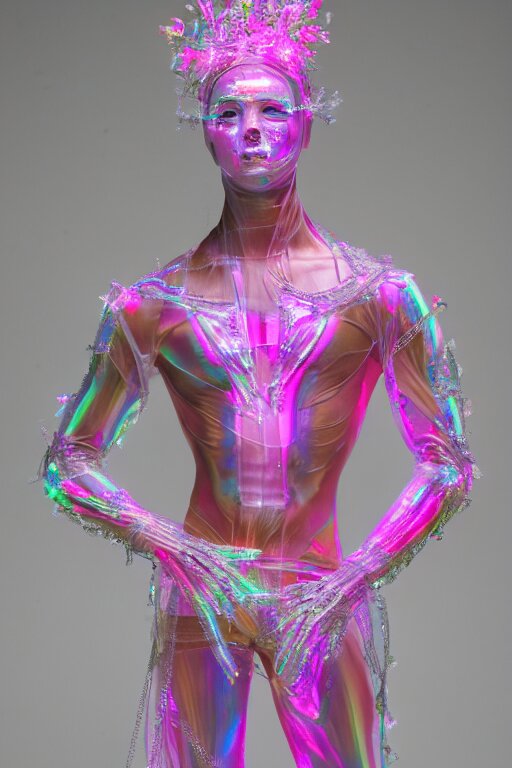
Image credit: AI Art - Skinned in Nanocrystals

Prompt: full-body rococo and cyberpunk delicate neon crystalline sculpture of (((muscular slender Nick Jonas))) as an iridescent humanoid deity wearing a thin see-through ((plastic hooded cloak)) sim roupa, reclining con (las piernas abiertas), glowing pink face, crown of (((white lasers))), large diamonds, swirling black silk fabric. futuristic elements. oozing glowing liquid, full-length view. space robots. (((human skulls))). throne made of bones, intricate artwork by caravaggio. Trending on artstation, octane render, cinematic lighting from the right, hyper realism, octane render, 8k, depth of field, 3D

Bonus: AI Art - Optical Computer Skin


Monday, September 12, 2022

Poor Man's Qubit


Physics-inspired graph neural networks to solve combinatorial optimization problems
May 2022, phys.org

Uses graph neural networks (GNNs) to tackle combinatorial optimization problems.

"Given their inherent scalability, physics-inspired GNNs can be used today to approximately solve (large-scale) combinatorial optimization problems with quantum-native models, while helping our customers get quantum-ready by using the mathematical representation that quantum devices understand," Brubaker said.

Solves optimization problems without the need for training labels.

Caveat: Brought to you by Amazon - "Our work was very much inspired by customer needs"

On the topic of optimization problems and quantum computing, it's getting easier to understand (since every other article is on this topic) that quantum computers will be good at optimization, but the key word is "will". And so for now, we're figuring out how to do optimization problems using regular computers, but in a funny way they sort of weren't meant ot be used, but which becam ereally uselful with the advent of big data. And that half-way of using regular computers like quantum computers is to use the graphics processors in parallel to create neural nets. 

via Amazon Quantum Solutions Lab: Martin J. A. Schuetz et al, Combinatorial optimization with physics-inspired graph neural networks, Nature Machine Intelligence (2022). DOI: 10.1038/s42256-022-00468-6

Image credit: Gyroid for manipulating light into topological states, Nik Spencer for Nature, 2017 [link]


The potential of p-computers
Jun 2022, phys.org

Probablistic computers, P-computers, are powered by probabilistic bits (p-bits), which interact with other p-bits in the same system. Unlike the bits in classical computers, which are in a 0 or a 1 state, or qubits, which can be in more than one state at a time, p-bits fluctuate between positions and operate at room temperature.

Camsari describes the Ising machine (sIm) as a collection of probabilistic bits which can be thought of as people. "The people can make decisions quickly because they each have a small set of trusted friends and they do not have to hear from everyone in an entire network," he explained. 

The researchers showed that their sparse architecture in field-programmable gate arrays was up to six orders of magnitude faster and had increased sampling speed five to eighteen times faster than those achieved by optimized algorithms used on classical computers.

via University of California Santa Barbara Institute for Energy Efficiency: Navid Anjum Aadit et al, Massively parallel probabilistic computing with sparse Ising machines, Nature Electronics (2022). DOI: 10.1038/s41928-022-00774-2


Also this:
'Poor man's qubit' can solve quantum problems without going quantum