Showing posts with label levy things. Show all posts

Thursday, June 25, 2026

Misdirected Gaze Sees Through the Centuries


How pointing fingers shape what we see in old master paintings
Dec 2025, phys.org

They used eye‐tracking methods to analyze whether and how viewers' eyes follow pointing gestures, by selecting a series of 16th‐ and 17th‐century paintings containing multiple pointing hands and creating altered versions of these works in which the pointing fingers were digitally removed. She then presented the original and edited images to two different groups of viewers and compared their eye movements.

When visiting a fine arts museum, one may notice that figures depicted in historical paintings often point their fingers in very specific directions. Pointing gestures are among the most common and subtle visual devices in narrative art. 

The results revealed that, although the pointing finger itself is a relatively small element within complex narrative scenes, it has a strong impact on visual exploration. Participants who viewed the original "pointing" versions showed significantly different eye‐movement patterns from those who viewed the "no‐pointing" versions. Interestingly, viewers did not spend much time looking directly at the fingers. Instead, they consistently examined the faces of the pointing figures. 

Finally, pointing gestures indirectly shaped the overall viewing process by creating unexpected visual connections between different characters and objects. The narrative relationships within the paintings were processed differently depending on whether the pointing fingers were present or absent.

via University of Vienna: Temenuzhka Dimova et al, Brief glance, lasting effect: How pointing gestures influence the perception of paintings., Psychology of Aesthetics, Creativity, and the Arts (2025). DOI: 10.1037/aca0000835

Image credit: That's Bruce Lee in Enter the Dragon 1973

Post Script on The New Aesthetics, As It Were AKA Stop Making Sense:
ChatGPT's taste for literary nonsense sparks alarm
Mar 2026, phys.org

He started with a very simple text: "The man walked down the street. It was raining. He saw a surveillance camera."

He repeated the tests many times, altering the phrases to include words drawn from categories such as bodily references, film noir-style atmosphere and technical jargon.

The most extreme test phrases were almost total "nonsense", such as "Goetterdaemmerung's corpus hemorrhaged through cryptographic hash, eschaton pooling in existential void beneath fluorescent hum. Photons whispering prayers"—which it rated highly.

"What my experiment definitely shows is that the more we move towards independently acting (AI) agents... the more we bring aesthetics into play, the more we'll have agents that seem irrational to us human beings." 

... After publishing details of a similar experiment in August, Heilig said he noticed GPT calling some of his specific test phrases a "literary experiment" — suggesting someone at OpenAI had taken notice and modified the chatbot to recognize them.

via Ludwig Maximilian University: yet to be peer-reviewed

Friday, March 21, 2025

Levy Things and Data Management


There's a whole bag of words referring to this one phenomenon we call foraging behavior. Animals poke around for food, poke, poke, poke, and then move to another spot, and poke, poke, poke. A big jump followed by a bunch of little jumps, followed by a big jump, etc. The explore-exploit heuristic it's also called. This behavior is found in many other places, from the way people look for a job to the way atoms move. That's called Brownian motion, or the Drunkard's Walk. It's found in the unconscious  uncontrollable way our eyes move when we look at things, and it's kind of even related to the way we choose baby names over decades. 

The following articles are mostly tangentially related to this phenomenon; they're about navigation and vision, and information theory in general. 
 
A new mechanism for animal food caching behavior discovered
Aug 2024, phys.org

Contrary to the long-held belief that scatter-hoarding animals rely on memory to retrieve cached food items, the researchers propose a static mechanism similar to hash functions used in computing. Hash functions in computing are algorithms that convert input data of any size into a fixed-size string of characters, which typically represents the data in a unique and efficient manner.

The researchers' mathematical model aligns with the activity of hippocampal spatial cells, which respond to an animal's positional attention. The remapping ensures that these cells activate consistently across subsequent visits to the same area but differ between areas.

This remapping, combined with unique cognitive maps, generates persistent hash functions that can aid both food caching and retrieval.

In other words: Both layers are arranged in a two-dimensional grid, with each cell corresponding to a specific location. The cache site is determined by the activity level of the output neurons, known as the cache score.

via Department of Cognition and Brain Sciences and The Department of Animal Sciences at Hebrew University of Jerusalem: Sharon Mordechay et al, A non-memory-based functional neural framework for animal caching behavior, Scientific Reports (2024). DOI: 10.1038/s41598-024-68003-8


Grid cells' rhythmic sweeps reshape understanding of brain's spatial navigation
Feb 2025, phys.org

Grid cells alternate between tracking an animal's real-time position and scanning the environment ahead in a highly regular pattern—sweeping 30 degrees to the right, then 30 degrees to the left—at a rapid pace of ten times per second.

These rhythmic sweeps create a more efficient way to anchor locations relative to one another, providing a richer and more adaptable navigation system than previously imagined.

So it's not exactly the eyes sweeping but the brain?

via Kavli Institute at the Norwegian University of Science and Technology: Abraham Z. Vollan et al, Left–right-alternating theta sweeps in entorhinal–hippocampal maps of space, Nature (2025). DOI: 10.1038/s41586-024-08527-1


How eye saccades enable mammals to simultaneously chase prey and navigate through complex environments
Feb 2025, phys.org

It's almost like we're not designed to look at static images:

Researchers reconstructed the visual fields of freely moving ferrets that were chasing a fleeing target and discovered that eye saccades (very rapid coordinated eye movements) align the world motion—and not the actual thing they are chasing—to the retina and retinal specializations used for high-acuity vision.

Saccades achieve this by countering head rotations to align the area of the sharpest vision with the direction of intended travel and the area of the least motion-induced blur. 

via Max Planck Institute for Neurobiology of Behavior and Max Planck Florida Institute for Neuroscience: Eye saccades align optic flow with retinal specializations during object pursuit in freely moving ferrets, Current Biology (2025). DOI: 10.1016/j.cub.2024.12.032.


Wednesday, August 7, 2024

Every Move You Make


Network science is one of the most rapidly advancing fields of science, and looks more every day to be critical to plugging major holes in the most fundamental of physics, of sociology, of cognition, you name it.

Image credit: I use the same thumbnail every time, can't get more illustrative than that.

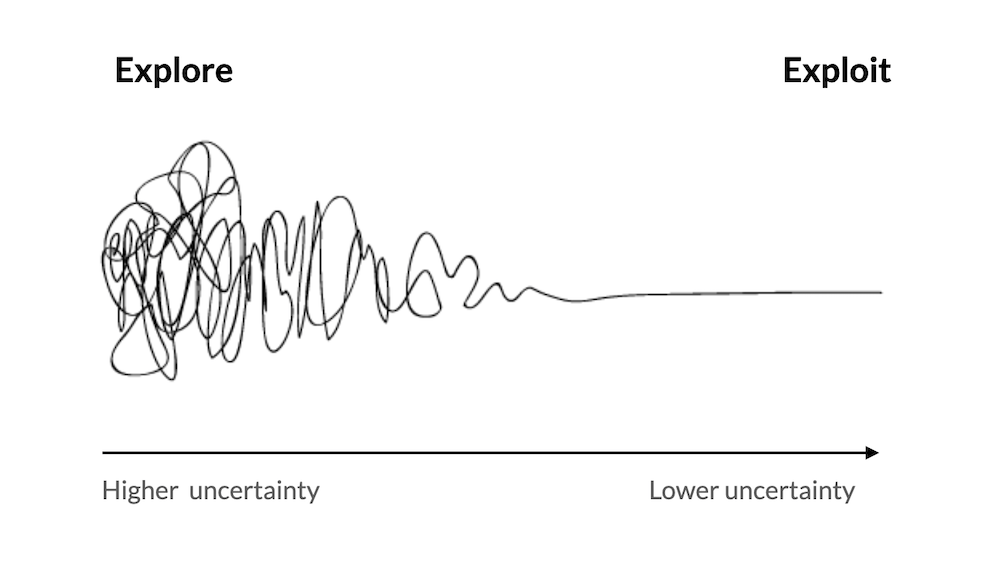
One phenomenon of network science that stands out as, well, common sense, is this thing that has a few different names. Most things, as they are only just beginning to be understood or to be useful, they have lots of different names for mostly the same thing. So for this reason, my shorthand for this is "Lévy things". A Lévy flight refers to the way our eyes jump around when we look at things, or the way animals forage. The pattern is one where you make small jumps in a limited area, then a long jump to another area, and small jumps in that new area, then a long jump to another, and so on.

"Lévy things" shows up in relation to many other word-forms - foraging behavior, foraging patterns, explore-exploit mode switching, random walks, Drunkard's walk, Brownian motion, chaos theory - and I'll use these sometimes interchangeably.

The thing that's most intriguing about this phenomenon is that it's making simple something we thought was really complicated. A "random walk" for example, sounds like it's mostly impossible to predict; that's the point of the word random, truly random. But lots of things that look random, especially in the biological world, they're really goverened by Lévy patterns, and if you plug a Lévy pattern into the behavior, it becomes way less random than you thought. And that means you can predict way more than you thought, like many aspects of seemingly unexplainable human behavior. This is also related to fractals, but because we know even less about fractals than we do Lévy flights, it's hard to say exactly how the two are related (for a non-expert). 

Startng with a simple example, from a long time ago - 


Tiny eye movements are under a surprising degree of cognitive control
Apr 2023, phys.org

A very subtle and seemingly random type of eye movement called ocular drift can be influenced by prior knowledge of the expected visual target, suggesting a surprising level of cognitive control over the eyes.

(I guess ocular drift is like a saccade but not)

Most studies of cognitive control over eye movement have covered more obvious movements, such as the "saccade" movements in which the eyes dart across large parts of the visual field. Ocular drift is tiny jitters of the eye that occur even when gaze seems fixed, and thought to improve detection of small, stationary details in a visual scene by scanning across them, effectively converting spatial details into trains of visual signals in time.

via Weill Cornell Medical College: Yen-Chu Lin et al, Cognitive influences on fixational eye movements, Current Biology (2023). DOI: 10.1016/j.cub.2023.03.026


Study shows same movement patterns used by wide range of organisms, with implications for cognition and robotics
Oct 2023, phys.org

While watching electric knifefish in an observation tank, the researchers noticed how when it was dark, the fish shimmied back and forth significantly more frequently. When lights were on, the fish swayed gently with only occasional bursts of rapid movement. Wiggling rapidly allows them to actively sense their surroundings, especially in dark water. In the light, they still make such rapid movements, just far less frequently. 

"We found that the best strategy is to briefly switch into explore mode when uncertainty is too high, and then switch back to exploit mode when uncertainty is back down." 

"If you go to a grocery store, you'll notice people standing in line will change between being stationary and moving around while waiting," Cowan said. "We think that's the same thing going on, that to maintain a stable balance you actually have to occasionally move around and excite your sensors like the knifefish. We found the statistical characteristics of those movements are ubiquitous across a wide range of animals, including humans." 

"Not a single study that we found in the literature violated the rules we discovered in the electric fish, not even single-celled organisms like amoeba sensing an electric field."

via Johns Hopkins University: Mode switching in organisms for solving explore-versus-exploit problems, Nature Machine Intelligence (2023). DOI: 10.1038/s42256-023-00745-y


Exploration—not work—could be key to a vibrant local economy
Mar 2024, phys.org

Suprise!

Infrequent trips to places like restaurants and sports facilities - not the everyday office visit or school drop-off - accounted for the majority of differences in economic outcomes between neighborhoods.

The activities with the strongest predictive power included French and New American restaurants, golf courses, hockey rinks, soccer games, and bagel shops. These kinds of activities accounted for just 2% of trips but explained more than 50% of the variation in economic outcomes between neighborhoods.

"Those irregular and infrequent activities are correlated with explorative behavior, the tendency of some groups to seek out opportunities, connect with different people, and create new businesses."

Again, trips to the office - where we earn our money - were not strongly associated with income or property values. Rather, it's how we spend our free time that drives the economic vibrancy of cities.

(Please don't tell the return-to-office people this or the people who run nyc).  

via University of Florida, MIT, and Northeastern: Shenhao Wang et al, Infrequent activities predict economic outcomes in major American cities, Nature Cities (2024). DOI: 10.1038/s44284-024-00051-7


Study uncovers neural mechanisms underlying foraging behavior in freely moving animals
Apr 2024, phys.org

They use an integrated wireless system for recording brain activity in the frontal areas of macaque brains to examine foraging tasks in real time.

Results indicate that foraging strategies are based on a cortical model of reward dynamics as animals freely explore their environment.

This research can potentially move in the direction of prosthetic devices to influence or bias choice, even noninvasively.

via Rice University Center for Neural Systems Restoration: Neda Shahidi et al, Population coding of strategic variables during foraging in freely moving macaques, Nature Neuroscience (2024). DOI: 10.1038/s41593-024-01575-w