Showing posts with label BECs. Show all posts

Thursday, April 17, 2025

The Hofstadter Regime Converges Upon Us


AKA Fine-Tuning The Chaos Machine 

The above image is the perfect example of a moiré lattice and where it comes from. I noticed it while watching a lecture by a scientist cited below, for being the first to discover Hofstadter's Butterfly in real life. It's just the best image I've seen to explain what a moiré lattice is.

Credit: Graphene hBN Moire Lattices - taken from the presentation Bloch, Landau, and Dirac - Hofstadter's Butterfly in Graphene by Philip Kim - Kavli Inst 2018 [youtube link]

The perimeter of ignorance in science is also the front door of chaos theory. You could call it a lot of other things, most of which are listed in the tags for this post, but mostly, anything that's "too complicated" for us to understand right now, it's chaos-related. Discoveries in this field come from a bunch of different places, like interdimensional graphene, like topological operators, like epilepsy surgery.

Harnessing chaos: How the brain turns randomness into robust memory
Jan 2025, phys.org

Previous work on brain-imitating artificial intelligence systems known as neural networks suggested that injecting random fluctuations into their activity could actually improve their performance as they learned to perform a task. 

Noise appears to increase the amount of time it takes for inhibitory neuron connections with other neurons to weaken. This slowing effect in turn stabilizes neural patterns of activity related to memories, helping them persist over time.

(This whole thing makes me think very differently about background noise, and maybe even the idea of 'functional music')...

via Columbia Engineering Systems Intelligence Laboratory: Nuttida Rungratsameetaweemana et al, Random noise promotes slow heterogeneous synaptic dynamics important for robust working memory computation, Proceedings of the National Academy of Sciences (2025). DOI: 10.1073/pnas.2316745122


How topology drives complexity in brain, climate and AI
Feb 2025, phys.org

Yes it does 

Transformative framework for understanding complex systems, using the new field of higher-order topological dynamics, and creating a connection between topological structures and emergent behavior. This comes from the field of information theory, and combines fusion of topology, higher-order networks, and non-linear dynamics.

via University of London: Ana P. Millán et al, Topology shapes dynamics of higher-order networks, Nature Physics (2025). DOI: 10.1038/s41567-024-02757-w

(Many body problem and higher order networks are the same thing - "interactions that extend beyond simple pairwise relationships".)

Most of us need to know: Hofstadter's butterfly (1976) was discovered before Mandelbrot coined the term "fractal" (1980), so he didn't know what to call it.

Hofstadter's butterfly: Quantum fractal patterns visualized
Feb 2025, phys.org

"Our discovery was basically an accident. We didn't set out to find this."

This is the first time Hofstadter's butterfly has been directly observed experimentally in a real material.

It was found using a moiré lattice - they were investigating superconductivity in twisted bilayer graphene, and when you hear twisted layers, you know we're also talking magic angle sandwiches. They used a scanning tunneling microscope to image moiré crystals at atomic resolution and examine their electron energy levels. The microscope works by bringing a sharp metallic tip less than a nanometer from the surface to allow quantum "tunneling" of electrons from the tip to the sample.

via Princeton University: Kevin P. Nuckolls et al, Spectroscopy of the fractal Hofstadter energy spectrum, Nature (2025). DOI: 10.1038/s41586-024-08550-2


Fitness centrality: New tool finds critical points in everything from cybersecurity to ecological conservation
Jan 2025, phys.org

The Vienna Complexity hub making waves

This approach is particularly good at finding nodes that, if removed, would isolate many other parts of the network—similar to a server failure interrupting the connection of many users in a communication network or a pump failure in a water supply network paralyzing the supply of water to districts.

Species in ecological networks, nodes in cybersecurity, roads in transportation networks. That's great. But it's people where this really has impact. Imagine trying to disable a social movement that could disturb the social fabric of a nation. You find the people, the nodes, at the center of the social network, and ... remove them, let's say. 

via Complexity Science Hub Vienna: Vito D P Servedio et al, Fitness centrality: a non-linear centrality measure for complex networks, Journal of Physics: Complexity (2025). DOI: 10.1088/2632-072X/ada845

Wednesday, January 10, 2024

The Atoms Themselves Are a Computer


Skepticism about Microsoft results regarding robust quantum bits
May 2023, phys.org

Correction -- "Researchers at the University of Basel have now dampened expectations of using Majorana particles for computation in the near future ... results published by Microsoft in 2022, according to which Majorana particles had been detected in the labs of the company, may not hold water"

Just a general reminder that not everything is true just because science says so, sometimes the true things get retracted too -- "both the current anomaly and the superconducting properties can be reproduced by a small amount of disorder from impurities inside the nanowire."

Also a reminder that Majorana fermions are an irresistible paradox of nature in that they contain both their own particle and anti-particle. They're expected to exist, but they've never been found. 

via University of Basel: Richard Hess et al, Trivial Andreev Band Mimicking Topological Bulk Gap Reopening in the Nonlocal Conductance of Long Rashba Nanowires, Physical Review Letters (2023). DOI: 10.1103/PhysRevLett.130.207001


Quantum matter breakthrough - Tuning density waves
May 2023, phys.org

Cold atomic gas can be programmed, so the atoms themselves are a computer because of the way they interact. In this case, the atoms are lithium, which were cooled, trapped in an optical cavity, and turned into a crystal, although how can a crystal be a wave, right? Quantum something.

via EPFL Ecole Polytechnique Federale de Lausanne: Jean-Phillipe Brantut, Density-wave ordering in a unitary Fermi gas with photon-mediated interactions, Nature (2023). DOI: 10.1038/s41586-023-06018-3.


Unveiling quantum gravity - New results from IceCube and Fermi data
Jun 2023, phys.org

Researchers examined a quantum-gravity model of particle propagation in which the speed of ultrarelativistic particles decreases with rising energy -- they used gamma-ray bursts observed by the Fermi telescope and ultra-high-energy neutrinos detected by the IceCube Neutrino Observatory, testing the hypothesis that some neutrinos and some gamma-ray bursts might have a common origin but are observed at different times as a result of the energy-dependent reduction in speed.

(Findings are preliminary, but) "By combining data from IceCube and Fermi, we found preliminary evidence supporting quantum gravity models that predict this effect. This marks a significant milestone in the field of quantum gravity research since it is the first time that such a level of quantum gravity-supportive statistical evidence is found," says corresponding author, Professor Giovanni Amelino-Camelia of the University of Naples on behalf of the team.

"Supportive statistical evidence" never sounded so science fiction.

via University of Naples Federico II, University of Wroclaw, and University of Bergen: Giovanni Amelino-Camelia et al, Could quantum gravity slow down neutrinos?, Nature Astronomy (2023). DOI: 10.1038/s41550-023-01993-z

AI Art - Tiny Machines - 2023

New device opens door to storing quantum information as sound waves
Jun 2023, phys.org

"Phonon" -- the sound equivalent of a light particle called a photon

To understand how a sound wave can store information, imagine an extremely echoey room. Now, let's say you need to remember your grocery list for the afternoon, so you open the door to that room and shout, "Eggs, bacon, and milk!" and shut the door. An hour later, when it's time to go to the grocery store, you open the door, poke your head inside, and hear your own voice still echoing, "Eggs, bacon, and milk!" You've just used sound waves to store information.

I mean if you can store light, you can store sound right?

via California Institute of Technology: Alkim Bozkurt et al, A quantum electromechanical interface for long-lived phonons, Nature Physics (2023). DOI: 10.1038/s41567-023-02080-w


Could quantum gravity models arising from holography explain cosmological acceleration?
Jun 2023, phys.org

"We now have fully consistent models of quantum gravity via an approach called holography, where the gravitational physics is encoded in a simpler, lower dimensional non-gravitational quantum system."

"We observed that quantum gravity models arising from holography can naturally explain cosmological acceleration in a novel way, with a changing dark energy that eventually becomes negative," Van Raamsdonk said. "We don't know for sure if our universe works this way, but it's something that we can look for in cosmological observations."

via University of Maryland and University of British Columbia: Stefano Antonini et al, Accelerating Cosmology from a Holographic Wormhole, Physical Review Letters (2023). DOI: 10.1103/PhysRevLett.130.221601


Scientists edge toward scalable quantum simulations on a photonic chip
Jun 2023, phys.org

Oh no you didn't! "quantum-correlated synthetic crystal"

What he really means: "Scientists have made an important step toward developing computers advanced enough to simulate complex natural phenomena at the quantum level. While these types of simulations are too cumbersome or outright impossible for classical computers to handle, photonics-based quantum computing systems could provide a solution."

via University of Rochester: Usman A. Javid et al, Chip-scale simulations in a quantum-correlated synthetic space, Nature Photonics (2023). DOI: 10.1038/s41566-023-01236-7

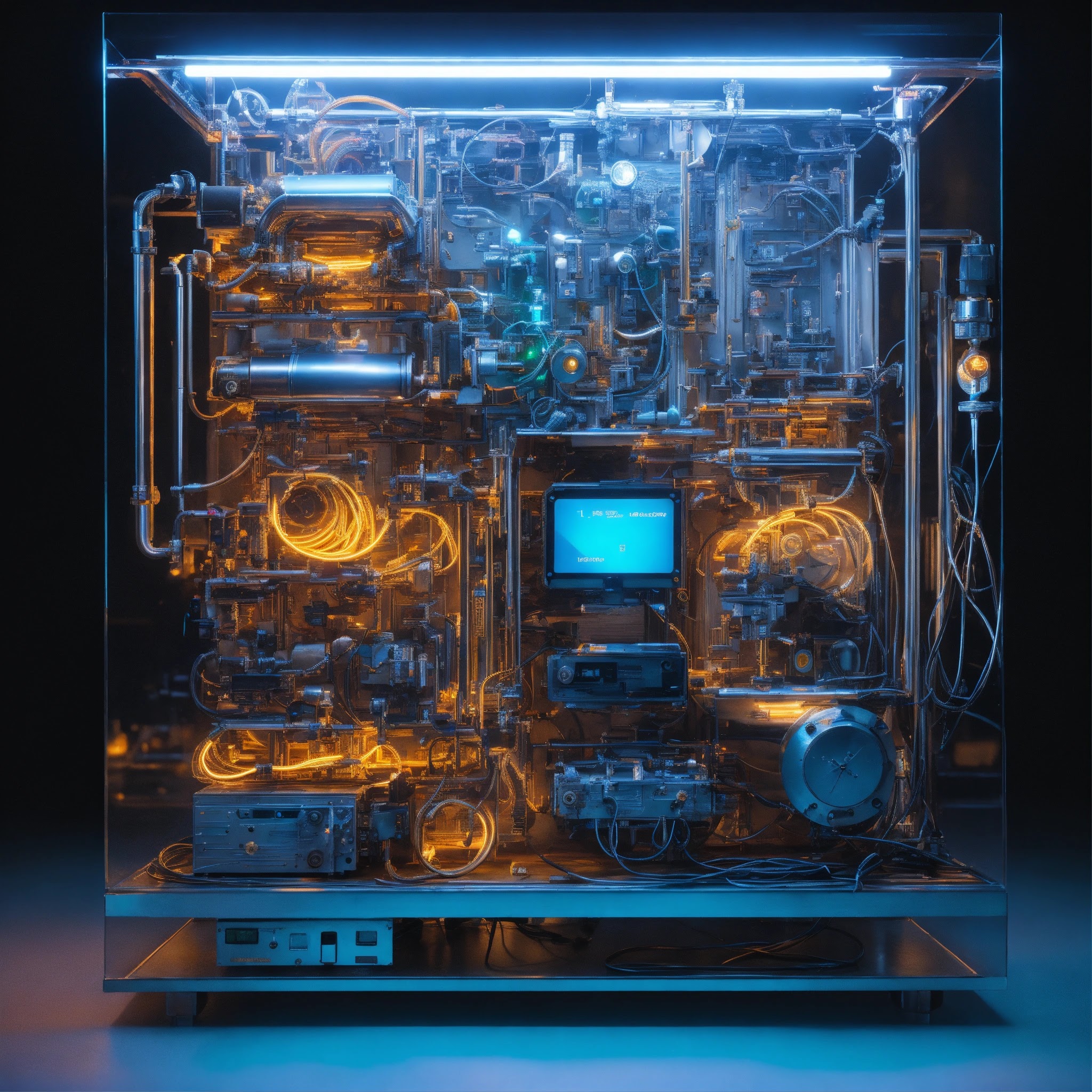
AI Art - Many Parts High Tech - 2023

Scientists observe first evidence of 'quantum superchemistry' in the laboratory
Aug 2023, phys.org

In the experiments, the scientists cooled down cesium atoms and coaxed them into the same quantum state. Next, they watched as the atoms reacted to form molecules.

In ordinary chemistry, the individual atoms would collide, and there's a probability for each collision to form a molecule. However, quantum mechanics predicts that atoms in a quantum state perform actions collectively instead.

"You are no longer treating a chemical reaction as a collision between independent particles, but as a collective process," explained Chin. "All of them are reacting together, as a whole."

One consequence is that the reaction happens faster than it would under ordinary conditions. In fact, the more atoms in the system, the faster the reaction happens.

And also, the reaction was taking place as a three-body interaction more often than as a two-body interaction (three atoms would collide; two would form a molecule, and the third remained single).

via James Franck Institute, Enrico Fermi Institute and U of Chicago: Zhendong Zhang et al, Many-body chemical reactions in a quantum degenerate gas, Nature Physics (2023). DOI: 10.1038/s41567-023-02139-8


Research team simulates super diffusion on a quantum computer
Aug 2023, phys.org

We are actually using quantum computers now, that's it -- 

Quantum physicists have successfully simulated super diffusion in a system of interacting quantum particles on a quantum computer consisting of 27 superconducting qubits and is physically located in IBM's lab in Yorktown Heights in New York and programmed remotely from Dublin.

"We were interested in a particular regime where something called super-diffusion occurs due to the underlying physics being governed by something called the Kardar-Parisi-Zhang equation. This is an equation which typically describes the stochastic growth of a surface or interface like how the height of snow grows during a snowstorm, how the stain of a coffee cup on cloth grows with time, or how a fluff fire grows. The propagation is known to give super diffusive transport." (follow the link above for a cool video of a poplar or cottonwood fluff fire)

"Consider the 27 qubits on this particular device. In quantum mechanics the state of such a system is described mathematically by an object called a wave function. In order to use a standard computer to describe this object you require a huge number of coefficients to be stored in memory and the demands scale exponentially with the number of qubits; roughly 134 million coefficients, in the case of this simulation."

"As you grow the system to say 300 qubits you would need more coefficients than there are atoms in the observable universe to describe such a system and no classical computer will be able to exactly capture the system's state. In other words we hit a wall when simulating quantum systems," Goold said.

via Trinity College of Dublin and IBM Dublin: Nathan Keenan et al, Evidence of Kardar-Parisi-Zhang scaling on a digital quantum simulator, npj Quantum Information (2023). DOI: 10.1038/s41534-023-00742-4


Researchers advance effort to turn diamonds into a quantum simulator
Oct 2023, phys.org

They bombarding diamonds with nitrogen atoms meant to dislodge the carbon atoms, creating flaws in an otherwise perfect crystal, that are then filled with electrons that have their own spin and magnetism, which are quantum properties that can be measured and manipulated for a wide range of applications.

via Washington University in St. Louis: Guanghui He et al, Quasi-Floquet Prethermalization in a Disordered Dipolar Spin Ensemble in Diamond, Physical Review Letters (2023). DOI: 10.1103/PhysRevLett.131.130401

Tuesday, November 1, 2022

Fractals in the News


It's fractals all the way down -- if you've been waiting for fractals to have their moment, that time is coming. It took the advent of computers for us to discover fractals in the first place, but then it was used for video game graphics and psychedelic art, and that's it for about 40 years. Now we're using the Large Hadron Collider, the most advanced piece of scientific equipment created, to discover that fractals are not only found in all living things, but in the furthest depths of physics - the Bose Einstein Condensate (BECs are an integral part of quantum computing, metamaterials and intelligent matter, and will be a key technology in the future). 


Study proposes mathematical tool to help understand fractal structure of quark-gluon plasma
Jun 2022, phys.org

When hadrons are accelerated to relativistic velocities and made to collide with each other their confinement is interrupted and the quarks and gluons scatter, forming a plasma that lasts only a tiny fraction of a second, but observation of it has produced important discoveries about the nature of material reality.

Quark-gluon plasma has a fractal structure. When it disintegrates into a stream of particles propagating in various directions, the behavior of the particles in the jets is similar to that of the quarks and gluons in the plasma. Moreover, it decays in a cascade of reactions with a pattern of self-similarity over many scales that is typical of fractals.

"Fractal theory explains BEC formation"

Deppman questions whether fractal structures could also be present in electromagnetism. This would explain why so many natural phenomena, from lightning to snowflakes, have fractal structures, as they are all governed by electromagnetic forces. It might also explain why Tsallis statistics are present in so many phenomena. "Tsallis statistics have been used to describe scale transformation invariance, a key ingredient of fractals," he said.

via Large Hadron Collider by the European Organization for Nuclear Research-research: E. Megías et al, Nonlinear Klein–Gordon equation and the Bose–Einstein condensation, The European Physical Journal Plus (2022). DOI: 10.1140/epjp/s13360-022-02511-2

Post Script:
Creating an ultrafast optoelectronic switch using a Bose-Einstein condensate of polaritons
Sep 2022, phys.org

Terahertz polariton switch.

via Universities in Shanghai, Xiamen, Shandong, Nanjing, Shanxi and NYU: Fei Chen et al, Optically Controlled Femtosecond Polariton Switch at Room Temperature, Physical Review Letters (2022). DOI: 10.1103/PhysRevLett.129.057402


Monday, September 26, 2022

Proponents of Free Will Synchronize Themselves


Here at Network Address, sociothermodynamics is a common topic; it's the idea that people, despite the illusion of control, behave like particles, bouncing around, and according to the very basic physical laws of thermodynamics.

The most obvious manifestation of this is synchronization, introduced in the above paper like this: "Many seemingly unrelated systems which exhibit repetitive behaviors, such as clocks, pacemaker cells in the heart, or a swarm of pulsing fireflies, are seen to undergo transitions from initial randomness to an ordered state." (Read more from the texts referenced below.)

The seemingly random intersections of all our lives are governed by the same rules that synchronize fireflies. This is why we can predict the gross domestic product of a city by how fast its people walk on its sidewalks. You can call up your free will and ask him to help you overturn this law, but he can't help. You're better off calling someone at the Santa Fe Institute; at least they can explain it for you. 


From flashing fireflies to cheering crowds: Physicists unlock secret to synchronisation
Dec 2021, phys.org

This paper is exciting, not because it made the top headlines at the New York Times when it came out, but because of what they found at the bottom of all this: "This model may be derived from the complex Ginzburg-Landau equations for a lattice of driven-dissipative Bose-Einstein condensates of exciton polaritons."

That's right, Bose-Einstein condensates, which should make you think about quantum things, and even things metaphysical, like Zipf's Law, or Serpinski's Triangles. So not only are we a bunch of particles bouncing around, but quantum particles at that. 

via Trinity College Dublin: John P. Moroney et al, Synchronization in disordered oscillator lattices: Nonequilibrium phase transition for driven-dissipative bosons, Physical Review Research (2021). DOI: 10.1103/PhysRevResearch.3.043092

Notes: 
A. Pikovskij, M. Rosenblum, and J. Kurths, Synchronization: A Universal Concept in Nonlinear Sciences, 1st ed., Cambridge Nonlinear Science Series No. 12 (Cambridge University Press, Cambridge, 2003).

S. H. Strogatz, From Kuramoto to Crawford: Exploring the onset of synchronization in populations of coupled oscillators, Physica D 143, 1 (2000).

Tuesday, September 13, 2022

Attoclock My Blogspot


All these things have to do with time. We're getting better at seeing smaller time intervals. Back when femtosecond spectroscopy came out, someone used it to suggest a quantum nature of photosynthesis, as if the photons take all the routes possible through the leaf until they find the optimal route, and then all collapse onto that one (although this has since been revisited in 2020). 

Now we can see in attoseconds. 

We're getting better at coordinating on smaller time scales. Back before there were cross-continental railroads, we didn't need time zones. Now we need to periodically "smear" the clock at the micro-second scale just to keep all the world's computers in perfect synchrony. And big platforms are developing their own Time Cards to keep in sync with itself via radio wave oscillations from satellites. 

But then there's the far out stuff, the kind of phenomena that the average person, including myself, cannot understand. We're talking about time crystals and extra time dimensions. No idea what these really are, but they seem to be hanging around with the quantum computer news a lot.

Oh let's not forget that crazy but intuitive theory of Quantum Exoticism -- that we need to just get over it and accept that things move faster than the speed of light; the subluminal and the superluminal can co-exist [links and links].


A new window into the world of attosecond phenomena
May 2022, phys.org

X-Ray Free-Electron Lasers (XFEL) and chronoscopy.

via The Henryk Niewodniczanski Institute of Nuclear Physics Polish Academy of Sciences: Wojciech Błachucki et al, Approaching the Attosecond Frontier of Dynamics in Matter with the Concept of X-ray Chronoscopy, Applied Sciences (2022). DOI: 10.3390/app12031721


Time crystals 'impossible' but obey quantum physics
Jun 2022, phys.org

Sounds like a challenge.

Scientists have created the first "time-crystal" two-body system in an experiment that seems to bend the laws of physics.

First theorized in 2012 by Nobel Laureate Frank Wilczek and identified in 2016, time crystals exhibit the bizarre property of being in constant, repeating motion in time despite no external input. Their atoms are constantly oscillating, spinning, or moving first in one direction, and then the other.

They cooled superfluid helium-3 to about one ten thousandth of a degree from absolute zero (0.0001 K or -273.15 C). The researchers created two time crystals inside the superfluid, and brought them to touch. The scientists then watched the two time crystals interacting as described by quantum physics.

Time crystals could be used to build quantum devices that work at room temperature.

via Lancaster University, Landau Institute, and Aalto University in Helsinki:  Nonlinear two-level dynamics of quantum time crystals, Nature Communications (2022). DOI: 10.1038/s41467-022-30783-w


Researchers observe continuous time crystal
Jun 2022, phys.org

In their experiment, the scientists used a Bose-Einstein condensate inside an optical high-finesse cavity. Using a time-independent pump, they observed a limit cycle phase which is characterized by emergent periodic oscillations of the intracavity photon number accompanied by the atomic density cycling through recurring patterns.

I'm just reading it for the words, and I see "time pump" in there. 

via University of Hamburg Institute of Laser Physics: Phatthamon Kongkhambut et al, Observation of a continuous time crystal, Science (2022). DOI: 10.1126/science.abo3382


As Earth spins faster, Meta joins fight against leap seconds
Jul 2022, Ars Technica

"Leap Smearing"

Facebook, like many large-scale tech companies, is tired of trying to time a global network of servers against leap seconds, which add between 0.1 and 0.9 seconds to Coordinated Universal Time (UTC) every so many years. There have been 27 leap seconds added since 1972. In a post on Meta’s engineering blog, Oleg Obleukhov and Ahmad Byagowi say 27 is quite enough for non-solar-scientist types—"enough for the next millennium."

International timekeeping bodies add leap seconds at unpredictable intervals because the things that cause them—the braking action of tides on rotation, moon position, the distribution of ice caps on mountaintops, mantle flow, earthquakes—are unpredictable. When the Earth’s speed varies too much from atomic time-keeping, a leap second is called for by the International Earth Rotation and Reference Systems Service (IERS).

At midnight on the designated day, clocks are set to tick from 23:59:59 to 23:59:60 to 00:00:00. That uncommon middle timestamp drives coordinated systems bonkers. A leap second in 2012 took down Reddit, Gawker, and Australian airline Qantas. Cloudflare took the hit on New Year’s 2017 (and detailed why). Since then, many technologies have prepped themselves for the next leap second with “leap smearing,” or using micro-second slowdowns over a long, global-server-friendly span leading up to midnight.

-"We encourage anyone smearing leap seconds to use a 24-hour linear smear from noon to noon UTC."
Google Developers, Public NTP, Aug 2022 

Image credit: Cold Atoms in an Optical Resonator Forming a Time Crystal, University of Hamburg, 2022


Friday, September 9, 2022

Quantum Update


Quantum physics in proteins - AI affords unprecedented insights into how biomolecules work
Nov 2021, phys.org

I hear the quantum biology headlines humming.

via Deutsches Elektronen-Synchrotron: Abbas Ourmazd, Few-fs resolution of a photoactive protein traversing a conical intersection, Nature (2021). DOI: 10.1038/s41586-021-04050-9


Physicists create compressible optical quantum gas
Mar 2022, phys.org

Calling BECs (Bose-Einstein Condensate) a "super photon" by the way.

via University of Bonn: Erik Busley et al, Compressibility and the equation of state of an optical quantum gas in a box, Science (2022). DOI: 10.1126/science.abm2543.


Physicists report on first programmable quantum sensor
Mar 2022, phys.org

"In the development of quantum computers, we have learned to create tailored entangled states." 
("Custom Quantum", am I right?)

via University of Innsbruck: Christian Marciniak, Optimal metrology with programmable quantum sensors, Nature (2022). DOI: 10.1038/s41586-022-04435-4.

Also: Quantum Variational Optimization of Ramsey Interferometry and Atomic Clocks, Physical Review X (2021). DOI: 10.1103/PhysRevX.11.041045.


Chinese team breaks distance record for quantum secure direct communication
Apr 2022, phys.org

Distance of 102.2 km.
Prior to this new effort, the record was just 18 km.

via Tsinghua University in China: Haoran Zhang et al, Realization of quantum secure direct communication over 100 km fiber with time-bin and phase quantum states, Light: Science & Applications (2022). DOI: 10.1038/s41377-022-00769-w

Tying Quantum Knots - TU Delft - 2022

It takes three to tangle: Long-range quantum entanglement needs three-way interaction
May 2022, phys.org

The researchers' findings are consistent with previous observations that long-range entanglement survives at a non-zero temperature only when more than three subsystems are involved.

via RIKEN: Tomotaka Kuwahara et al, Exponential Clustering of Bipartite Quantum Entanglement at Arbitrary Temperatures, Physical Review X (2022). DOI: 10.1103/PhysRevX.12.021022


Tunable quantum traps for excitons
May 2022, phys.org

Physicists can now string together many such trapped excitons and adjust them in such a way that they emit photons having exactly the same properties. "That would allow one to create identical single photon sources for quantum information processing," 

via ETH Zurich: Deepankur Thureja et al, Electrically tunable quantum confinement of neutral excitons, Nature (2022). DOI: 10.1038/s41586-022-04634-z


Scientists use quantum computers to simulate quantum materials
May 2022, phys.org

"Computational Materials" sounds like another way of saying "active matter"?

Also "Hardware Noise":
Performing calculations of the properties of materials and molecules on quantum computers faces a problem that one does not experience with a classical computer, a phenomenon known as hardware noise. Noisy calculations return slightly different answers each time a calculation is performed; a noisy addition operation might return values slightly different from 4 each time for the question, "What is 2 plus 2?"

via Argonne National Laboratory's Midwest Integrated Center for Computational Materials and University of Chicago: Benchen Huang et al, Simulating the Electronic Structure of Spin Defects on Quantum Computers, PRX Quantum (2022). DOI: 10.1103/PRXQuantum.3.010339


Researchers achieve record entanglement of quantum memories
Jul 2022, phys.org

Again with the "quantum memories" term:
Researchers coupled two atomic quantum memories using two optically trapped rubidium atoms in two laboratories on the LMU campus connected via a 700-meter-long fiber optic cable.

via Ludwig Maximilian University of Munich: Tim van Leent et al, Entangling single atoms over 33 km telecom fibre, Nature (2022). DOI: 10.1038/s41586-022-04764-4


Scientists invent 'quantum flute' that can make particles of light move together
Jul 2022, phys.org

Ah yes, the quantum flute, we've been waiting for that one.

via University of Chicago: Srivatsan Chakram et al, Seamless High- Q Microwave Cavities for Multimode Circuit Quantum Electrodynamics, Physical Review Letters (2021). DOI: 10.1103/PhysRevLett.127.107701


Strange new phase of matter created in quantum computer acts like it has two time dimensions
Jul 2022, phys.org

First, the time thing:
By shining a laser pulse sequence inspired by the Fibonacci numbers at atoms inside a quantum computer, physicists have created a remarkable, never-before-seen phase of matter. The phase has the benefits of two time dimensions despite there still being only one singular flow of time, the physicists report July 20 in Nature.

Information stored in the phase is far more protected against errors than with alternative setups currently used in quantum computers. As a result, the information can exist without getting garbled for much longer, an important milestone for making quantum computing viable, says study lead author Philipp Dumitrescu.

The approach's use of an "extra" time dimension "is a completely different way of thinking about phases of matter."

Next, never seen this phrasing til now:
"stayed quantum"

via Simons Foundation: Philipp Dumitrescu, Dynamical topological phase realized in a trapped-ion quantum simulator, Nature (2022). DOI: 10.1038/s41586-022-04853-4


Researchers explore a new connection between topology and quantum entanglement
Aug 2022, phys.org

"Our work ties two big ideas together," says Charles Kane, the Christopher H. Browne Distinguished Professor of Physics in Penn's School of Arts & Sciences. "It's a conceptual link between topology, which is a way of characterizing the universal features that quantum states have, and entanglement, which is a way in which quantum states can exhibit non-local correlations, where something that happens in one point in space is correlated with something that happens in another part in space. What we've found is a situation where those concepts are tightly intertwined."
The eureka, and one of the pandemic sort:
The seed for exploring this connection came during the long hours Kane spent in his home office during the pandemic, pondering new ideas. One train of thought had him envisioning the classic textbook image of the Fermi surface of copper, which represents the metal's potential electron energies. It's a picture every physics student sees, and one with which Kane was highly familiar.

"Of course, I learned about that picture back in the 1980s but had never thought about it as describing a topological surface," Kane says. ...

via University of Pennsylvania: Pok Man Tam et al, Topological Multipartite Entanglement in a Fermi Liquid, Physical Review X (2022). DOI: 10.1103/PhysRevX.12.031022


Unexpected quantum effects in natural double-layer graphene
Aug 2022, phys.org

Again with the unexpected:
At temperatures just above absolute zero of minus 273.15 degrees Celsius, the electrons in the graphene can interact with each other—and a variety of complex quantum phases emerge completely unexpectedly. 

via University of Göttingen and University of Texas at Dallas: Anna M. Seiler et al, Quantum cascade of correlated phases in trigonally warped bilayer graphene, Nature (2022). DOI: 10.1038/s41586-022-04937-1


Post Script on the Sub- and Super-Luminal:
Listen to this guy Andrzej Dragan  talk about the "Quantum principle of relativity" at the Centrum Fizyki Teoretycznej, 2020-05-20

(the visuals come in at 19:40)