Showing posts with label ubiquitous computing. Show all posts

Wednesday, June 24, 2026

But Can It Run Doom


AKA Everything, and I Mean Everything Is a Computer

Can it run Doom is the modern day equivalent of Can I Eat It, or its salacious step-sibling Can I Fuck It, but like for robots not for people. 

I was thinking maybe a way to explain is like this - what if you could make a 1998 Ford Taurus run Doom? Like, I don't know, the engine of the car itself, or some combination of engine and wheels or fan belt and air conditioning compressor, they somehow generate enough information to be used for computation, and we use that computation to run a computer game. And if that works, what if sunlight could run Doom?

That's what this is all about - the idea of a computer as having a microprocessor for a brain, or a  little green circuitboard, it's outdated. We aren't even using brains anymore (nope).

Anything that generates information can be a computer. That's it. Maybe another way of saying it is that anything that does anything can be a computer. "Heat rises" (computer). "Water flows downhill" (computer). *Exists* (computer). Traffic. Traffic computes for fs sake. Santa Fe Institute even had to make a new definition, so let's start with that:


What does it mean to compute? Framework maps hidden computations running inside natural dynamic systems
Feb 2026, phys.org

Compute (noun), that's it; simple - not reservoir or analog computing, just "compute" - also SFI:

"The issue is how to define, formally, a set of criteria for identifying what computation(s) a given, arbitrary dynamical system does, in order to give us insights into these computational systems found in nature" 

They want to discriminate between "constructed" computers, which would include those found in phones and laptops, and those that are "non-constructed," natural systems that carry out computations but remain poorly understood. For example, a network of chemical reactions can be seen as a kind of non-constructed computer. The input to this system is the initial concentration of chemical reactants. The output is the concentration of the chemicals after the reaction stops. 

via Santa Fe Institute and Complexity Science Hub in Vienna: David H Wolpert et al, What does it mean for a system to compute?, Journal of Physics: Complexity (2026). DOI: 10.1088/2632-072x/ae3af8


New digital state of matter could help build stable quantum computers
Dec 2025, phys.org

The Zuchongzhi 2.0 superconducting quantum processor was used to construct an exotic nonequilibrium topological material and test its protective properties.

Digital matter they call it. And who says this is a big deal like that? Paul Arnold for phys.org that's who - 

"The work is a big deal because it shows that quantum computers can be used as reliable simulators to discover and test new stable forms of matter."

via University of Science and Technology of China: Haoran Qian et al, Programmable higher-order nonequilibrium topological phases on a superconducting quantum processor, Science (2025). DOI: 10.1126/science.adp6802


Active thermal metasurfaces amplify heat signatures by a factor of nine
Dec 2025, phys.org

This shell allowed the tiny object to fake the thermal signatures of an object nine times larger than itself.

via Taiyuan University of Technology: Yichao Liu et al, Active Thermal Metasurfaces Enable Superscattering of Thermal Signatures Across Arbitrary Shapes and Thermal Conductivities, Advanced Science (2025). DOI: 10.1002/advs.202519386


Tiny silicon structures compute with heat, achieving 99% accurate matrix multiplication
Jan 2026, phys.org

The flow and distribution of heat through a specially designed material forms the basis of the calculation. Then the output is represented by the power collected at the other end, which is a thermostat at a fixed temperature.

"Most of the time, when you are performing computations in an electronic device, heat is the waste product. But here, we've taken the opposite approach by using heat as a form of information itself."

(This is a form of analog computing, in which data are encoded and signals are processed using continuous values, rather than digital bits that are either 0s or 1s.)

via MIT's Institute for Soldier Nanotechnologies: Caio Silva et al, Thermal analog computing: Application to matrix-vector multiplication with inverse-designed metastructures, Physical Review Applied (2025). DOI: 10.1103/5drp-hrx1.


Turning city traffic into a computer: Novel approach to AI could slash energy demands
Jan 2026, phys.org

"What if traffic could compute?"

This is called Harvested Reservoir Computing, and more specifically, Road Traffic Reservoir Computing: Prediction accuracy is not highest under free-flow or heavily congested conditions. Instead, it peaks just before congestion begins, at a critical, medium-density state where traffic dynamics are most diverse and informative. In this regime, the traffic system naturally processes incoming information, allowing accurate forecasts of future traffic states with minimal computational overhead.

The study suggests that social infrastructure such as roads can be reinterpreted as "large-scale, continuously operating computers."

"Computation does not have to be confined to silicon chips" (Makes you wonder why someone would want to build a billion dollar data center)

via Tohoku University Advanced Institute for Materials Research: Ryunosuke Fukuzaki et al, Harvested reservoir computing from road traffic dynamics, Scientific Reports (2025). DOI: 10.1038/s41598-025-30016-2

Georgia Institute of Technology Low-cost Passive Ultrasound Tags for Non-invasive and Non-Intrusive Smart Home Sensing

These penny-size ultrasonic tags ditch batteries and silently turn everyday objects into private smart home trackers
Apr 2026, phys.org

Activity Recognition: It's based on a flat washer with various cutouts along the outer edge to determines the frequency of the sound it makes when hit. They are small metal tags mounted on a cabinet or doorframe that signal when a door or drawer is opened, count reps in the gym, or even track bathroom use for elderly relatives. When a door is opened, etc., the tab strikes the metal disk, triggering a brief ultrasonic pulse imperceptible to human ears but detectable by a wearable device that logs the activity. They're battery-free, quiet, inherently private, and cost only a few cents each. 
 
They did not use any complicated machine learning algorithms to detect the ultrasound signatures. Instead, they created an algorithm with simple, hard-coded rules. That approach means identifying signals requires little computational and electrical power.

"Hard coded" rules, that's another way of saying this. Or, "This has really been a collaboration between computing and engineering."

Georgia Institute of Technology: Yibo Fu et al, SoundOff: Low-cost Passive Ultrasound Tags for Non-invasive and Non-Intrusive Smart Home Sensing, Proceedings of the ACM on Interactive, Mobile, Wearable and Ubiquitous Technologies (2025).


Light-based Ising computer runs at room temperature and stays stable for hours
Feb 2026, phys.org

So Ising machine is another way to say photonic computer AND reservoir computing?

It's a powerful new kind of computing machine that uses light; the Ising model represents problems as interacting magnets with "spins" that point up or down and align when brought closer, the Ising searches for the lowest-energy state (optimization problem); simple yet powerful for solving problems with many interconnected binary (up/down or yes/no) choices.

Works at room temp.

via Queen's University Canada: Nayem Al-Kayed et al, Programmable 200 GOPS Hopfield-inspired photonic Ising machine, Nature (2025). DOI: 10.1038/s41586-025-09838-7


Quantum reservoir computing peaks at the edge of many-body chaos, study suggests
Feb 2026, phys.org

In recent years, some physicists and quantum engineers have been exploring the possibility of realizing a quantum equivalent of classical reservoir computing, known as quantum reservoir computing (QRC). These approaches enable the processing of temporal data. Reservoir computing systems perform best close to the boundary between stable and chaotic dynamics (i.e., the edge of chaos).

These scientists are looking for 'the edge' of many-body quantum chaos. 

via University of Tokyo: Kaito Kobayashi et al, Edge of Many-Body Quantum Chaos in Quantum Reservoir Computing, Physical Review Letters (2026). DOI: 10.1103/j2qj-vwcl. On arXiv: DOI: 10.48550/arxiv.2506.17547


Mechanical computers use springs and bolts to count, sort odd-even pushes and remember force
Apr 2026. phys.org

They are calling them simply "Mechanical Computers"

Many everyday materials retain some kind of memory of their past—for example, rubber can 'remember' how far it has been squeezed or stretched in the past. ... The research team used common materials, such as steel springs and bars, to create three mechanical computers. The first could count how many times it was pulled back and forth. A second distinguishes whether it has been pushed an odd or even number of times. The third can remember if a medium or large amount of force was applied.

Key findings from the research include:

  • Mechanical computers can perform simple computations without a computer chip or power source.
  • Mechanical computers are able to harvest their power from physical force, rather than electricity.
  • Proof of design that mechanical computers could be a viable alternative to conventional computers in harsh settings - such as extreme temperatures or exposure to corrosive chemicals - when only simple computations are needed.

via St. Olaf College and Syracuse University: Joseph D. Paulsen, Mechanical hysterons with tunable interactions of general sign, Nature Communications (2026). DOI: 10.1038/s41467-026-70913-2


Post Script
LEGO® SMART Play™ System - Official LEGO® Shop US

"Everything will be a computer" has now hit the shelves (circa Jan 2026). Granted this is not what we're seeing in the 'ubiquitous computing' scene, but it's what it represents, because it's a consumer product application of the idea, and you can't get more widespread average person consumer adoption than a LEGO brick. 

Friday, June 12, 2026

Optomania


I'm starting to get bedazzled by the light hype, it's like there's nothing you can't say at this point that might not be actually true. Disembodied decentralized swarm neurons? Yes. Artificial evolution engine running on hijacked bacterial botnets? Sure. Non-electronics-based large-scale programmable incoherent photonic neuromorphic computing system? That is exactly what was going to happen all along. The somatic override helmet that shoots lasers into your bloodstream is a bit over the top however. 


When light 'thinks' like the brain: The connection between photons and artificial memory
Feb 2026, phys.org

(It was a surprise they said.) Italian researchers show that identical photons propagating within optical circuits spontaneously behave like a Hopfield Network, one of the best-known mathematical models used to describe the associative memory mechanisms of the human brain.

"In this system, photons are not merely carriers of data, but themselves become the 'neurons' of an associative memory."

via Italian Institute of Technology, Nanotechnology of the National Research Council, and Sapienza University of Rome: Gennaro Zanfardino et al, Multiphoton Quantum Simulation of the Generalized Hopfield Memory Model, Physical Review Letters (2026). DOI: 10.1103/945c-11wt


Light-guided 'optovolution' evolves proteins that switch states on schedule
Mar 2026, phys.org

Optovolution - uses light to guide the evolution of proteins with dynamic, multi‑state, and computational functions - making yes-or-no decisions based on specific rules

The team built their system in the budding yeast Saccharomyces cerevisiae, widely used to brew beer and a laboratory workhorse. They rewired the yeast's cell cycle so that progression depended on the protein to be evolved, switching cleanly between off and on states.

The key was linking the protein's output signal to a cell‑cycle regulator that is essential at one stage but toxic at another. If the protein of interest stayed on or off for too long, the yeast cell stalled or died. Only cells in which the protein oscillated correctly could keep dividing.

via EPFL Ecole Polytechnique Federale de Lausanne Laboratory of the Physics of Biological Systems: Light-directed evolution of dynamic, multi-state, and computational protein functionalities., Cell (2026). DOI: 10.1016/j.cell.2026.02.002


Photonic chips advance real-time learning in spiking neural systems
Mar 2026, phys.org

"Photonic spiking neural systems use brief optical pulses, or spikes, to emulate neural signaling, but they can typically only process the linear parts of computation using light. Previously, the nonlinear steps that make learning and decision-making possible required the signal to be converted back into electronic signals. This adds delay and undercuts the speed and energy advantages of photonics."

via Xidian University in China: Shui Xiang et al, Nonlinear Photonic Neuromorphic Chips for Spiking Reinforcement Learning, Optica (2026). DOI: 10.1364/optica.578687


Physicists create optical phenomenon inspired by the quantum Hall and spin Hall effects
Mar 2026, phys.org

The findings open up new possibilities for applications such as topological polariton lasers, spin-based transistors, and optical information processing.

via University of Würzburg: Simon Widmann et al, Artificial gauge fields and dimensions in a polariton hofstadter ladder, Nature Communications (2026). DOI: 10.1038/s41467-026-68530-0


Ultrasound creates light inside the body, opening a new path to targeted treatments
Apr 2026, phys.org

I believe they are shooting lasers through the fluids in your blood vessels - I'll be on my way now.

Nanomaterials distributed through the bloodstream to turn ultrasound waves into precise points of light - "With these materials, we can produce light emission in the brain, in the gut, in the spinal cord, in the muscle—virtually anywhere—without needing a physical implant."

They started with large, ceramic particles that give off light in response to mechanical stress, which can be created by ultrasound waves. Then they created a biocompatible coating for the particles and injected them into mice.

The researchers created a small ultrasound-producing hat for mice, and used it to create light that stimulated different neurons, causing the mouse to turn left or right depending on the part of the brain being activated.

via Stanford University: Shan Jiang et al, An ultrasound-scanning in vivo light source, Nature Materials (2026). DOI: 10.1038/s41563-026-02556-z

Thursday, December 18, 2025

The Op Box


A major shift is happening right now, in fact it's not an exaggeration to call it a revolution. Back in the day, like back when Daniel DeFoe was writing The Plague Years, we had hydraulics and water pressure through pipes and channels, and that was the predominant technological paradigm. This started with agriculture and irrigation. Everything was explained as if it were pipes and pressure. Somewhere in between the pipes went from carrying water to carrying steam, and then air itself, and we got the internal combustion engine, right after the steam engine. That gave us the industrial revolution.

Then electricity happened. And it's still electricity. The internet is a bunch of electrical pulse patterns. Even the fiber optic cable, which carries photons, gets converted to electrical signals at the end. That's about to be over. 

Now it's light. Granted, quantum computers can use electrons, which aren't photons, but the end result is mostly photons doing the work. 

And this is a big deal, revolutionary you could call it, because it seems inevitable that this will upend the current "revolution" in artificial intelligence, which to be honest seems more about economic happenstance and less about revolutionary technology. Using GPUs for deep learning is kind of a kludge, meaning it wasn't designed this way on purpose, instead someone (Bill Dally to Andrew Ng?) said, hey I bet these GPUs could do what you're trying to do better, and so it happened. It's still electricity.

But not anymore. Now it's light, and that changes everything, and that's because the light itself computes. That's right, the light itself is the computer. ("But that doesn't even make sense." Well you're not wrong.) Still not crazy enough? Optical origami computers; which were of course discovered by accident. 


Researchers pioneer optical generative models, ushering in a new era of sustainable generative AI
Aug 2025, phys.org

I keep trying but can't seem to explain how different this is to what's currently happening in the world of computing. Then again, I was also confused when Deep Seek released their model and yet it took two weeks for the stock market to realize (true story). To be clear, this requires no internet connection and no data center. In other words, today you might call this magic. 

Optical generative models capable of producing novel images using the physics of light instead of conventional electronic computation.

The models integrate a shallow digital encoder with a free-space diffractive optical decoder, trained together as one system. Random noise is first processed into "optical generative seeds," which are projected onto a spatial light modulator and illuminated by laser light. As this light propagates through the static, pre-optimized diffractive decoder, it produces images that statistically follow the target data distribution. These models could be embedded in smart glasses, AR/VR headsets, or mobile platforms to enable real-time, on-the-go generative AI.

via UCLA Engineering Institute for Technology Advancement: Shiqi Chen et al, Optical generative models, Nature (2025). DOI: 10.1038/s41586-025-09446-5


Sustainable AI: Physical neural networks exploit light to train more efficiently
Sep 2025, phys.org

Physical Neural Networks - analog circuits that directly exploit the laws of physics like properties of light beams or quantum phenomena to process information.

Mathematical operations can now be performed through light interference mechanisms on silicon microchips barely a few square millimeters in size.

via Polytechnic University of Milan, École Polytechnique Fédérale, Stanford, Cambridge, and the Max Planck Institute: Ali Momeni et al, Training of physical neural networks, Nature (2025). DOI: 10.1038/s41586-025-09384-2


First device based on 'optical thermodynamics' can route light without switches
Oct 2025, phys.org

Optical Thermodynamics - framework captures how light behaves in nonlinear lattices using analogs of familiar thermodynamic processes such as expansion, compression, and even phase transitions. Rather than actively steering the signal, the system is engineered so that the light routes itself. "First optical device that follows the emerging framework of optical thermodynamics".

via University of Southern California: Hediyeh M. Dinani et al, Universal routing of light via optical thermodynamics, Nature Photonics (2025). DOI: 10.1038/s41566-025-01756-4

First electronic–photonic quantum chip created in commercial foundry
Jul 2025, phys.org

Microring Resonators - a "quantum light factory"; a kind of photonic device that combines quantum light sources and stabilizing electronics using a standard 45-nanometer semiconductor manufacturing process to produce reliable streams of correlated photon pairs.

via Boston University, UC Berkeley, and Northwestern University, and GlobalFoundries and Silicon Valley startup Ayar Labs: Danielius Kramnik et al, Scalable feedback stabilization of quantum light sources on a CMOS chip, Nature Electronics (2025). DOI: 10.1038/s41928-025-01410-5


Photonic origami folds glass into microscopic 3D optical devices
Aug 2025, phys.org

The laser-induced technique triggers precise bending in 3-D printed ultra-thin glass sheets that are so smooth that light reflects off them without distortion.

Surprise - The new photonic origami method was discovered by chance when Carmon asked graduate student Manya Malhotra to pinpoint where an invisible laser was hitting the glass by increasing the power until the spot glowed. Instead of glowing, the glass folded - revealing a simple and unexpected way to achieve glass folding. Malhotra then became the pioneering expert in photonic origami.

Using the new photonic origami approach, the researchers were able to bend sheets of glass up to 10 microns thick into shapes ranging from a 90-degree knee to helices. They were able to do this with fine control, down to 0.1 microradians.

"This new technique brings silica photonics - using glass to guide and control light - into the third dimension."

via Tel Aviv University: Manya Malhotra et al, Photonic Origami of Silica on a Silicon Chip with Microresonators and Concave Mirrors, Optica (2025). DOI: 10.1364/OPTICA.560597


Beyond electronics: Optical system performs feature extraction with unprecedented low latency
Oct 2025, phys.org

This is what I call the Op Box, I'm imagining a new type of computer, in the way the Steam Machine has (or is about to) upend the personal computer market, this Op Box will upend the very concept of a computer, and what it means to compute. 

Optical Diffraction Operators - plate-like structures that perform calculations as light propagates through them. 

This optical feature extraction engine de-serializes the data stream by sampling the input signal into multiple stable parallel branches. [For feature extraction, read recogntion, like facial recognition, etc.]

via Tsinghua University: Run Sun et al, High-speed and low-latency optical feature extraction engine based on diffraction operators, Advanced Photonics Nexus (2025). DOI: 10.1117/1.apn.4.5.056012

Sunday, December 14, 2025

Compubiquity and Alternative Intelligence


You think you're taking crazy pills, but it's just science doing its thing. Reality is not partial to computers; computing on the other hand...

Researchers build next-gen swarm robots using simple linked particles
May 2025, phys.org

The research team created a new type of robot inspired by this phenomenon, known as "emergent collective behavior." Their solution, called the link-bot, connects small self-moving particles in a V-shaped chain formation that naturally gives rise to coordinated, lifelike movement - without any embedded intelligence.

via Seoul National University: Kyungmin Son et al, Emergent functional dynamics of link-bots, Science Advances (2025). DOI: 10.1126/sciadv.adu8326.


Synthetic molecules encode and decode 11-character password using electrical signals
May 2025, phys.org

"This is the first attempt to write information in a building block of plastic that can then be read back using electrical signals"

They designed molecules that contain electrochemical information, a method that allows messages to be decoded using electrical signals.

"It opens exciting prospects for interfacing chemical encoding with modern electronic systems and devices."

"polymer-based data storage"

via University of Texas at Austin: Electrochemical Sequencing of Sequence-Defined Ferrocene-Containing Oligourethanes, Chem (2025). DOI: 10.1016/j.chempr.2025.102571


Low-power 'microwave brain' on a chip computes on both ultrafast data and wireless signals
Aug 2025, phys.org

Unlike traditional neural networks that rely on digital operations and step-by-step instructions timed by a clock, this network uses analog, nonlinear behavior in the microwave regime, allowing it to handle data streams in the tens of gigahertz - much faster than most digital chips.

via Cornell University: An integrated microwave neural network for broadband computation and communication, Nature Electronics (2025). DOI: 10.1038/s41928-025-01422-1


'Singing' electrons synchronize in Kagome crystals, revealing geometry-driven quantum coherence
Oct 2025, phys.org

After sculpting micrometer crystalline pillars into Kagome metal CsV₃Sb₅, then applying magnetic fields, the electrons remained coherent far beyond what single-particle physics would allow.

Even more surprisingly, the oscillations depended on the crystal's geometry.

via Max Planck Institute for the Structure and Dynamics of Matter: Chunyu Guo et al, Many-body interference in kagome crystals, Nature (2025). DOI: 10.1038/s41586-025-09659-8


Programming robots with rubber bands
Oct 2025, phys.org

Here's another way of saying it:

There's another way to design robots: Programming intended functions directly into a robot's physical structure, allowing the robot to react to its surroundings without the need for extensive on-board electronics.

Or this:

"This is kind of an extreme version of 'form follows function,' where functionalities like memory, adaptability and intelligence can be enabled by geometry and material parameters."

via Harvard: Leon M. Kamp et al, Reprogrammable sequencing for physically intelligent underactuated robots, Proceedings of the National Academy of Sciences (2025). DOI: 10.1073/pnas.2508310122

Monday, March 31, 2025

Does It Compute


AKA All Computers All the Time

Right now a computer is a box that sits on your desk. It's plugged in. Maybe it's a little box, one you keep in your pocket. That one's not plugged in, but it does need power. Soon, the computer will not be a thing. Instead, all things will be a computer. Maybe it's better to say that all things will compute. And like instead of saying 'there's an app for that' we might hear instead 'does it compute'? Like, "Can you pass me the paper towel?" "Does it compute?" Or, "Hey I just got a new haircut." "But does it compute?" 

First - The Fiber Computer:

Fiber computer allows apparel to run apps and 'understand' the wearer
Feb 2025, phys.org

It's an autonomous programmable computer in the form of an elastic fiber.

The fiber computer contains a series of microdevices, including sensors, a microcontroller, digital memory, Bluetooth modules, optical communications, and a battery, making up all the necessary components of a computer in a single elastic fiber.

"Our bodies broadcast gigabytes of data through the skin every second in the form of heat, sound, biochemicals, electrical potentials, and light, all of which carry information about our activities, emotions, and health. Unfortunately, most, if not all, of it gets absorbed and then lost in the clothes we wear."

via MIT, RISD, Brown, Stanford, Soldier Nanotechnologies: Yoel Fink, A single-fibre computer enables textile networks and distributed inference, Nature (2025). DOI: 10.1038/s41586-024-08568-6. 


Materials can remember a sequence of events in an unexpected way
Jan 202,5 phys.org

Material memory is like wrinkles on a crumpled piece of paper. These memories are stored in disordered solids in which the arrangement of particles seems random but actually contains details about past deformations. Materials should not be able to form return-point memory when the force only occurs in one direction. For example, a bridge might sag slightly as cars drive over it, but it doesn't curve upwards once the cars are gone.

The researchers boiled down the components of the system—such as the particles in a solid or the microscopic domains in a magnet—into abstract elements called hysterons. "Hysterons are elements of a system that may not immediately respond to external conditions, and can stay in a past state."

The hysterons in the model interact either in a cooperative way, where a change in one encourages a change in the other, or in a non-cooperative "frustrated" way, where a change in one discourages a change in the other. Frustrated hysterons are the key to forming and recovering a sequence in a system with asymmetric driving.

"We think this is a way to design artificial systems with this special kind of memory, starting with the simplest mechanical systems not much more complicated than a bendy straw, and hopefully working up to something like an asymmetrical combination lock."

via Penn State: Chloe Lindeman et al, Generalizing multiple memories from a single drive: The hysteron latch, Science Advances (2025). DOI: 10.1126/sciadv.adr5933


Soap's maze-solving skills could unlock secrets of the human body
Jan 2025, phys.org

"Surfactants—the molecules found in soap—can naturally find its way through a maze"

We're talking about things acting like people. Imagine discovering that chairs can figure out how to best position themselves in a theater. Or the straps on your backpack can figure out the best length for positioning the pack on your back depending on the weight and the way you walk etc. Your pencil can figure out how to write a better sentence for convincing your roommate to do the dishes. I'm just trying to imagine what this all means.  

"When we put soap into a liquid filled maze, the natural surfactants already present in the liquid interact, creating an omniscient view of the maze, so the soap can intuitively find the correct path, ignoring all other irrelevant paths. This behavior occurs due to very subtle but powerful physics where the two types of surfactants generate tension forces that guide the soap to the exit."

Yes, they called soap bubbles omniscient. 

via Department of Mathematics at the University of Manchester: Richard Mcnair et al, Exogenous–Endogenous Surfactant Interaction Yields Heterogeneous Spreading in Complex Branching Networks, Physical Review Letters (2025). DOI: 10.1103/PhysRevLett.134.034001

Friday, January 10, 2025

Everything is Everywhere All of the Sudden


I usually don't post artist renderings like this, but this is what I see when imagining everything made of computers, using ambient energy like light to control different particles each designed to take it and do different things with it but all in one jumble of matter, like an intelligent matter: Above image: An artistic depiction of a wavelength-multiplexed diffractive optical processor for 3D quantitative phase imaging. Credit: UCLA Engineering Institute for Technology Advancement [link]

On what could be called "ubiquitous computing", a legend of artificial intelligence (Hinton) describes it really well:
(What's next in computing?) My last years at Google I was thinking about analog computing ... run these big language models in analog hardware ... if you're gonna use that low power analog computation, every piece of hardware is gonna be a bit different. And the idea is that the learning is gonna make use of the specific properties of that hardware.
--Geoffrey Hinton interview, "On Working w Ilya, Choosing Problems, and the Power of Intuition", July 2024 30min?

Researchers use 'smart' rubber structures to carry out computational tasks
May 2024, phys.org

"We now know how to design simple materials so they can process information."

The research team created a rubber computer that can act as a two-bit binary counter using slender rubber elements as mechanical bits, and assembling multiple bits together in a metamaterial.

Note: The title of their demonstration video is "Can Rubber Compute?" and I now see it all as a series of experiments like the Will It Blend series, where they just do it to everything - can crystals compute? (Yes, we already know that) Can light compute? (Yes we already know that too) Can slime mold compute? But can salt compute? (Actually yes, like in a gradient of fresh water and salt water, but I was talking about a pile of table salt.) Can my sneakers compute? (I mean obviously) Can my front door compute? (Also obvious, its whole thing is to open and close like 1/0) I'm not talking about a computer screwed on top of my doorknob, I mean the door itself, the whole thing, is a computer, just by the way its materials are put together.  The garbage can? Definitely garbage cans will compute. 

via Leiden University and AMOLF: Jingran Liu et al, Controlled pathways and sequential information processing in serially coupled mechanical hysterons, Proceedings of the National Academy of Sciences (2024). DOI: 10.1073/pnas.2308414121


Using DNA origami, researchers create diamond lattice for future semiconductors of visible light
May 2024, phys.org

With headlines like that, there is no further explanation. 

via Ludwig Maximilian University of Munich: Gregor Posnjak et al, Diamond-lattice photonic crystals assembled from DNA origami, Science (2024). DOI: 10.1126/science.adl2733

Also: Hao Liu et al, Inverse design of a pyrochlore lattice of DNA origami through model-driven experiments, Science (2024). DOI: 10.1126/science.adl5549


Mechanical computer relies on kirigami cubes, not electronics
Jun 2024, phys.org

It's a mechanical computer, one that doesn't use electronics. Is that all we need to call it? A mechanical computer?

Historically, these mechanical components have been things like levers or gears. But cubes can have five or more different states. Theoretically, that means a given cube can convey not only a 1 or a 0, but also a 2, 3 or 4.

When any of the cubes are pushed up or down, this changes the geometry—or architecture—of all of the connected cubes. This can be done by pushing up or down on one of the cubes with a magnetic field. These 64-cube functional units can be grouped together into increasingly complex metastructures that allow for storing more data or for conducting more complex computations.

The cubes are connected by thin strips of elastic tape. To edit data, you have to change the configuration of functional units. That requires users to pull on the edges of the metastructure, which stretches the elastic tape and allows you to push cubes up or down. When you release the metastructure, the tape contracts, locking the cubes—and the data—in place.

"One potential application for this is that it allows for users to create three-dimensional, mechanical encryption or decryption"

via North Carolina State University: Yanbin Li et al, Reprogrammable and reconfigurable mechanical computing metastructures with stable and high-density memory, Science Advances (2024). DOI: 10.1126/sciadv.ado6476 , www.science.org/doi/10.1126/sciadv.ado6476


New material paves the way to on-chip energy harvesting
Jul 2024, phys.org

They utilize the waste heat generated during operation and convert it back into electrical energy, called "on-chip energy harvesting", and it works because they put tin in the germanium (Ge+Sn). 

via Forschungszentrum Jülich and IHP—Leibniz Institute for High Performance Microelectronics in Germany, University of Pisa, University of Bologna, University of Leeds: Omar Concepción et al, Room Temperature Lattice Thermal Conductivity of GeSn Alloys, ACS Applied Energy Materials (2024). DOI: 10.1021/acsaem.4c00275


A first physical system to learn nonlinear tasks without a traditional computer processor
Jul 2024, phys.org

They made a contrastive local learning network where components evolve on their own based on local rules without knowledge of the larger structure, similar to how neurons in the human brain don't know what other neurons are doing and yet learning emerges.

"It can learn, in a machine learning sense, to perform useful tasks, similar to a computational neural network, but it is a physical object."

(Physical object, that's the key)

"Because the way that it both calculates and learns is based on physics, it's way more interpretable. You can actually figure out what it's trying to do because you have a good handle on the underlying mechanism. That's kind of unique because a lot of other learning systems are black boxes where it's much harder to know why the network did what it did.

via University of Pennsylvania: Sam Dillavou et al, Machine learning without a processor: Emergent learning in a nonlinear analog network, Proceedings of the National Academy of Sciences (2024). DOI: 10.1073/pnas.2319718121

The optical era of science reporting where every picture has rainbows in it: Artistic depiction of diffractive information processing - Ozcan Lab at UCLA - Jul 2024

Scientists demonstrate chemical reservoir computation using the formose reaction
Jul 2024, phys.org

Good explanation by the writeup author here, Tejasri Gururaj: The field of molecular computing interests researchers who wish to harness the computational power of chemical and biological systems. In these systems, the chemical reactions or molecular processes act as the reservoir computer, transforming inputs into high-dimensional outputs. ...

The formose reaction is the only example of a self-organizing reaction network with a highly non-linear topology, containing numerous positive and negative feedback loops.

The researchers used a continuous stirred tank reactor (CSTR) to implement the formose reaction. The input concentrations of four reactants—formaldehyde, dihydroxyacetone, sodium hydroxide, and calcium chloride—are controlled to modulate the reaction network's behavior.

The output molecule is identified using a mass spectrometer, which allows them to track up to 106 molecules. 

This setup can be used to do calculations, with the reactant concentrations being the input value to any function that needs to be computed.

The team showed that it could predict the behavior of a complex metabolic network model of E. coli, accurately capturing both linear and nonlinear responses to fluctuating inputs across various concentration ranges.

Furthermore, the system demonstrated the ability to forecast future states of a chaotic system (the Lorenz attractor), accurately predicting two out of three input dimensions several hours into the future.

via Institute for Molecules and Materials at Radboud University: Mathieu G. Baltussen et al, Chemical reservoir computation in a self-organizing reaction network, Nature (2024). DOI: 10.1038/s41586-024-07567-x

Monday, August 5, 2024

Ambient Computing


In addition to the noticeable drop in "wearables" papers released sometime around the pandemic, "ambient energy harvesting" seemed to have the same thing. There wasn't as much papers on this, so it wasn't as noticeable as "wearables". It's like all the papers on these two topics just disappeared for at least a year, maybe two. But now we're getting back into it, so here's a few circa 2024.

The first one is an example of the way The Internet of Everything is going to work. This device can do very (very) basic voice recognition with nothing resembling what we would today call a computer. It just measures the sound energy vibrations when you say the word. Actual things, like coffee cups, pencils, windows and park benches, will be like this, so that everything computes. And it's using ambient energy like sound waves, temperature differences, your own body's electricity, or light, so it doesn't need a power source or maybe even a battery. It would be very hard to convince a person from 1920 that in 2020 the internet would exist, or video chat, or the International Space Station. So for us to think of a world where everything, the matter itself, is a computer, it's hard to imagine, but it's coming, and this is it right here. 


Sound-powered sensors stand to save millions of batteries
Jan 2024, phys.org

"The sensor works purely mechanically and doesn't require an external energy source. It simply utilizes the vibrational energy contained in sound waves"

This energy is then sufficient to generate a tiny electrical pulse that switches on an electronic device that has been switched off.

But it's better than you think - 

It can distinguish between the spoken words "three" and "four." Because the word "four" has more sound energy that resonates with the sensor compared to the word "three," it causes the sensor to vibrate, whereas "three" does not. That means the word "four" could switch on a device or trigger further processes. Nothing would happen with "three."

Newer variants of the sensor should be able to distinguish between up to twelve different words, such as standard machine commands like "on," "off," "up" and "down." 

It's a metamaterial but not one made of rare earths; instead it's made of silicon plates connected to each other via tiny bars that act like springs.

"Our sensor consists purely of silicone and contains neither toxic heavy metals nor any rare earths, as conventional electronic sensors do" 

via ETH Zurich: Tena Dubček et al, In‐Sensor Passive Speech Classification with Phononic Metamaterials, Advanced Functional Materials (2024). DOI: 10.1002/adfm.202311877


Dual-energy harvesting device could power future wireless medical implants
Feb 2024, phys.org

The new device can harvest energy from magnetic field and ultrasound sources simultaneously, converting this energy to electricity to power implants; it can generate 300% higher power than the current state-of-the-art devices.

via Pennsylvania State University: Sumanta Kumar Kumar Karan et al, Magnetic field and ultrasound induced simultaneous wireless energy harvesting, Energy & Environmental Science (2024). DOI: 10.1039/D3EE03889K


This device gathers, stores electricity in remote settings
Apr 2024, phys.org

Novel type of battery called a pyroelectrochemical cell, which uses a composite material of porous polyvinylidene fluoride and barium titanate nanoparticles. This material's electrical properties change as it's heated or cooled, which decreases or increases the polarization of the pyroelectric separator. It's charged by changing temperatures in the surrounding environment, whether it's inside a car or aircraft or just under the soil in an agricultural environment. 

via University of Utah: Tim Kowalchik et al, Direct conversion of thermal energy to stored electrochemical energy via a self-charging pyroelectrochemical cell, Energy & Environmental Science (2024). DOI: 10.1039/D3EE03497F


Salt battery harvests osmotic energy where the river meets the sea
Apr 2024, phys.org

Salt gradients and osmotic energy are sort of ambient energy harvesting.

(Estuaries are where freshwater rivers meet the salty sea; I think any gradient is a reservoir of ambient energy harvesting.)

via School of Chemistry and Chemical Engineering at Guangxi University China: Decoupled Ionic and Electronic Pathways for Enhanced Osmotic Energy Harvesting, ACS Energy Letters (2024). DOI: 10.1021/acsenergylett.4c00320

Wednesday, July 10, 2024

Everything Is A Computer If You Try Hard Enough


You walk into a room, and it's empty, but you enter, and without hesitation, you sit down into mid air, and before you land, a chair materializes itself to catch you. The actual matter, the particles that make up the chair, have been engineered to become chairs. They have "chair" written not into their DNA, but into their fundamental physics. They have no power source because they take their energy from light waves, sound waves, vibrations, even gradients like in between high temperatures and lows, or saltwater and fresh, or whatever that means, since it could be an information gradient (could it?). They have no battery because they don't use more than they need in real time. Every particle of this special form of matter is a computer, with wireless communication, with sensors, all of it built into the physics of the particles themselves. It will know you're in the room, who you are and what you want. And that's why all you have to do is want to sit, and the chair materializes. It's still too hard to explain what it means when everything is a computer, but here is an introduction:  

Photonic chip that 'fits together like Lego' opens door to semiconductor industry
Dec 2023, phys.org

Chiplets - The chip is built using an emerging technology in silicon photonics that allows the integration of diverse systems on semiconductors less than 5 millimeters wide; it's like fitting together Lego building blocks, where new materials are integrated through advanced packaging of components, using electronic "chiplets."

via University of Sydney Nano Institute:  Matthew Garrett et al, Integrated microwave photonic notch filter using a heterogeneously integrated Brillouin and active-silicon photonic circuit, Nature Communications (2023). DOI: 10.1038/s41467-023-43404-x

Unexpected AI fingers image credit: AI Art - AI Fingers at Work on a Circuitboard - 2023


Study suggests that physical processes can have hidden neural network-like abilities
Jan 2024, phys.org

Natural molecular processes can do complex calculations that rival a simple neural network. On the face of it, the initial steps in the act of freezing - called 'nucleation' in physics - do not resemble 'thinking'. But the new study shows that the act of freezing can "recognize" subtly different chemical combinations - e.g., the smell of oatmeal raisin cookies versus chocolate chip - and build different molecular structures in response.

The work points at a new view of computation that does not involve designing circuits, but rather designing what physicists call a phase diagram. For example, for water, a phase diagram might describe the temperature and pressure conditions in which liquid water will freeze or boil, which are 'muscle'-like material properties. But this work shows that the phase diagram can also encode 'thinking' in addition to 'doing,' when scaled up to complex systems with many different kinds of components.

via University of Chicago, California Institute of Technology, and Maynooth University: Constantine Glen Evans et al, Pattern recognition in the nucleation kinetics of non-equilibrium self-assembly, Nature (2024). DOI: 10.1038/s41586-023-06890-z

 
International research team develops new hardware for neuromorphic computing
Feb 2024, phys.org

In the eye, the visual information is pre-processed by hundreds of millions of the retina's photoreceptors and converted into electrical signals that are transmitted by the optic nerve to the brain. This process greatly reduces the amount of data processed in the brain by the visual cortex.

(The nose is far, far crazier in what it does, by the way)

Inspired by eyesight, this on-chip phonon-magnon reservoir for neuromorphic computing maps input signals into a multidimensional reservoir space. The reservoir is made of acoustic waves (phonons) and spin waves (magnons), and is not trained but only expedites recognition by a simplified artificial neural network, resulting in enormous reduction of computational resources and training time.

(Wait until they get inspired by the nose)

via Technische Universität Dortmund, Loughborough University, V. E. Lashkaryov Institute of Semiconductor Physics in Kyiv, University of Nottingham: Dmytro D. Yaremkevich et al, On-chip phonon-magnon reservoir for neuromorphic computing, Nature Communications (2023). DOI: 10.1038/s41467-023-43891-y


A low-cost system to collect EEG measurements during VR experiences
Feb 2024, phys.org

Everything gets it's own chip, just like this

NeuroVista, the new system proposed by the researchers, utilizes KS1092, a cost-effective biological potential measurement chip. The prototype of the device created by the researchers is comprised of this chip, along with a set of electrodes, and a lithium battery.

via South China University of Technology: Zhiyuan Yu et al, A low-cost, wireless, 4-channel EEG measurement system used in virtual reality environments, HardwareX (2024). DOI: 10.1016/j.ohx.2024.e00507.
 

Giant leap toward neuromorphic devices: High-performance spin-wave reservoir computing
Mar 2024, phys.org

It's a high-performance spin wave reservoir computing that uses spintronics. It works with a randomly generated network called the "reservoir" which enables the memorization of past input information and its nonlinear transformation, allowing physical systems to perform tasks for sequential data.

via Tohoku University Advanced Institute for Materials Research: Satoshi Iihama et al, Universal scaling between wave speed and size enables nanoscale high-performance reservoir computing based on propagating spin-waves, npj Spintronics (2024). DOI: 10.1038/s44306-024-00008-5

Monday, March 13, 2023

Of Course Biocomputers Are Real, They're Us


I always thought mass social behavioral modification would be via olfactory receptor manipulation, but this looks like another option:

Controlling nematode worm behavior using two different light-sensitive proteins called opsins*
Nov 2022, phys.org

So they are "introducing" new sensory cells into the C. elegans. They find light-sensitive cells (opsins) in other animals, and put them in the worms.

One opsin is sensitive to white light and comes from a mosquito, another is sensitive to ultraviolet light and comes from a lamprey. These "tuned" light-receptor cells are then introduced to parts of the worm's motor neurons.

When you shine light on the worm, it stimulates the motor neurons, making them move. They made the white-light opsins to make the worm go, and the UV light makes it stop.

They can then move the worm, or rather make the worm move itself, by shining light on it. Fuck off.

*Opsins, like olfactory receptros, are GPCR's -- G protein-coupled receptors

via Graduate School of Human Life and Ecology at Osaka Metropolitan University: Mitsumasa Koyanagi et al, High-performance optical control of GPCR signaling by bistable animal opsins MosOpn3 and LamPP in a molecular property–dependent manner, Proceedings of the National Academy of Sciences (2022). DOI: 10.1073/pnas.2204341119


Scientists create living smartwatch powered by slime mold
Dec 2022, phys.org

Using the electrically conductive single-cell organism known as "slime mold," the researchers created a watch that only works when the organism is healthy, requiring the user to provide it with food and care.

The organism (Physarum polycephalum or slime mold) is placed in an enclosure on the watch, and the user must regularly feed it a mixture of water and oats to induce its growth. When the slime mold reaches the other side of the enclosure, it forms an electrical circuit that activates the heart rate monitor function. The organism can also enter a dormant state when not fed, allowing for revival days, months, or even years later.

The researchers found a high level of attachment to the watch, with some users saying it felt like a pet -- even naming it, or putting their partner in charge of the feeding when they got sick.

via University of Chicago: Jasmine Lu et al, Integrating Living Organisms in Devices to Implement Care-based Interactions, The 35th Annual ACM Symposium on User Interface Software and Technology (2022). DOI: 10.1145/3526113.3545629

Image credit: It's not C elegans but it is a nematode (P pacificus) showing us its teeth. Because it has teeth. Everyday Nightmare Pictures - Nematode Teeth - P pacificus nematode showing its teeth - Jürgen Berger MPI for Biology - 2022

Tuesday, September 13, 2022

Where Color Comes From


Toward 4D printing with structural colors
Jun 2022, phys.org

While you were sleeping, 3D printing makes a huge evolutionary leap - now making "structural colors" directly into the nanoscopic surface textures of the materials. What better name to call it than 4D printing:

3D printing with stimuli-responsive materials, called 4D printing. 4D printing enables 3D printed structures to change its configurations over time and is used in a wide variety of fields such as soft robotics, flexible electronics, and medical devices.

Structural coloration occurs on surfaces with a nanostructure with dimensions similar to those of the wavelength of the incident light (typically below a micron). These ordered nanostructures are known as photonic crystals.

But it's not just about printing structurally-memetic dragonfly iridescence that changes depending on the light. It's about the surface textures changing over time, and in response to any number of stimuli in the environment. Too hot? Turns red. Cyanide gas in the air? Turns green.

Humidity-responsive color changing ink for extrusion 3D printing reversibly changes volume and reflected color based on hydration state.


But again it's not just about changing colors, it's about the materials sensing its environment and changing its structure in response:

"Ideally, by including responsive elements in these polymers, we can create materials that can both sense and respond to their environment, perhaps even allowing communication between individual devices as well to generate a level of autonomy for a collection of individual units," Debije concludes.

via Eindhoven University of Technology: Jeroen A. H. P. Sol et al, Direct Ink Writing of 4D Structural Colors, Advanced Functional Materials (2022). DOI: 10.1002/adfm.202201766


Natural mineral hackmanite demonstrates highly repeatable color change ability
Jun 2022, phys.org

"Structural Breathing" he says.

Also, radiation exposure detection:
Hackmanite changes color when it's exposed to ultraviolet radiation, and without wearing out, but until now we didn't know why.

It can do this repeatedly without wearing out because it does not use the change in color of the organic molecules the make it up, like similar minerals, but by using structural color -- a change in the position of the molecules, but not their composition.

"In this research, we found out for the first time that there is actually a structural change involved in the color change process, as well. When the color changes, sodium atoms in the structure move relatively far away from their usual places and then return back. This can be called 'structural breathing,' and it does not destroy the structure even if it is repeated a large number of times,"
 
via Intelligent Materials Research Group at the Department of Chemistry of the University of Turku, Finland: Pauline Colinet et al, The structural origin of the efficient photochromism in natural minerals, Proceedings of the National Academy of Sciences (2022). DOI: 10.1073/pnas.2202487119


Engineers repurpose 19th-century photography technique to make stretchy, color-changing films
Aug 2022, phys.org

By applying a 19th-century color photography technique to modern holographic materials, an MIT team has printed large-scale images onto elastic materials that when stretched can transform their color, reflecting different wavelengths as the material is strained.

The eureka:
While puzzling over how to resolve this challenge of getting microscale control and scalability together in structural color technology, Miller happened to visit the MIT Museum, where a curator talked him through an exhibit on holography, a technique that produces three-dimensional images by superimposing two light beams onto a physical material. "I realized what they do in holography is kind of the same thing that nature does with structural color."

via MIT: Benjamin Harvey Miller et al, Scalable optical manufacture of dynamic structural colour in stretchable materials, Nature Materials (2022). DOI: 10.1038/s41563-022-01318-x


Post Script:
Researchers add antireflection coatings to complex 3D printed micro-optical systems
Apr 2022, phys.org

Another nod to the future where everything becomes a computer -- the mirrors (for optical circuits, for optical computers) are sprayed right onto the 3D printed objects themselves. 

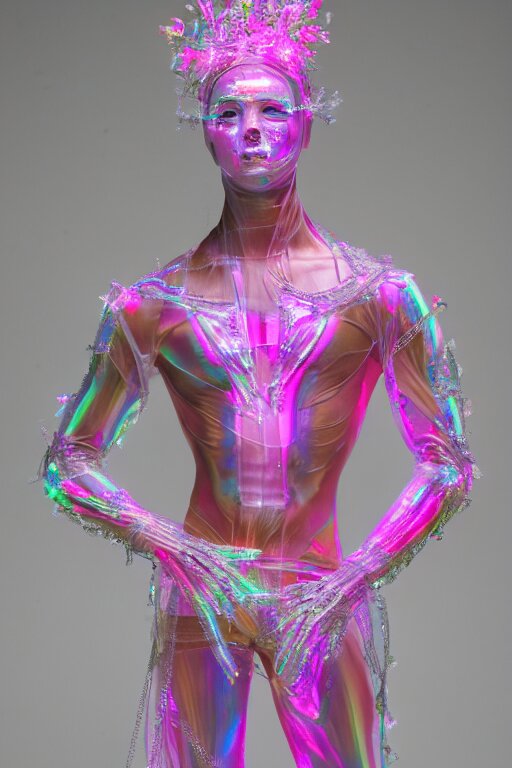
Imagine being skinned in nanocrystal photon routers.  

via University of Stuttgart: Simon Ristok et al, Atomic layer deposition of conformal anti-reflective coatings on complex 3D printed micro-optical systems, Optical Materials Express (2022). DOI: 10.1364/OME.454475


Image credit: AI Art - Skinned in Nanocrystals

Prompt: full-body rococo and cyberpunk delicate neon crystalline sculpture of (((muscular slender Nick Jonas))) as an iridescent humanoid deity wearing a thin see-through ((plastic hooded cloak)) sim roupa, reclining con (las piernas abiertas), glowing pink face, crown of (((white lasers))), large diamonds, swirling black silk fabric. futuristic elements. oozing glowing liquid, full-length view. space robots. (((human skulls))). throne made of bones, intricate artwork by caravaggio. Trending on artstation, octane render, cinematic lighting from the right, hyper realism, octane render, 8k, depth of field, 3D

Bonus: AI Art - Optical Computer Skin