Showing posts with label UI. Show all posts

Wednesday, October 5, 2022

Terraforming the Anthroposphere


Engineered crystals could help computers run on less power
Apr 2022, phys.org

Crystals are cool and all, but did you know that the total amount of energy the U.S. uses on computers has risen dramatically over the last decade and is quickly approaching that of other major sectors, like transportation.

This is a big deal, and despite the well-deserved environmental crypto-hate, we hear almost nothing about this. In the United States, roughly 30% of our energy is used in buildings (lighting, heating and cooling) another 30% for transportation, and the last 30% for industrial processes (gross estimation, see the US Energy Information Administration for real stats). Switching to CFL's alone, since about 2012, has already made a huge dent in our national energy expenditure (go figure, that was easy, and yet you almost never hear about this). Any other attempts to lower that expenditure are aimed at buildings and transportation, think tighter buildings with better insulation and cars with better fuel efficiency. We are absolutely not talking about how to wrestle with the computing sector, and it will be very interesting to see how this takes shape in the coming years. 

via University of California - Berkeley: Suraj S. Cheema et al, Ultrathin ferroic HfO2–ZrO2 superlattice gate stack for advanced transistors, Nature (2022). DOI: 10.1038/s41586-022-04425-6

Note: According to the Energy Information Administration's statistics, the per-capita energy consumption in the U.S. has been somewhat consistent from the 1970s to the present time. The average was about 334 million British thermal units [BTU] (352 GJ) per person from 1980 to 2010. One explanation suggested that the energy required to increase the nation's consumption of manufactured equipment, cars, and other goods has been shifted to other countries producing and transporting those goods to the U.S. 

Another Note: Lawrence Livermore Labs have devised a connection between energy and information that allows for the creation of a cryptocurrency token that is directly backed by and convertible into one kilowatt-hour of electricity. 

Image credit: Artwork by Anatoly Fomenko, Russian mathematician and artist from the 1960's and beyond.


These simple changes can make AI research much more energy efficient
Jul 2022, MIT Technology Review

They found that emissions can be significantly reduced if researchers use servers in specific geographic locations and at certain times of day. Emissions from training small machine-learning models can be reduced up to 80% if the training starts at times when more renewable electricity is available on the grid, while emissions from large models can be reduced over 20% if the training work is paused when renewable electricity is scarce and restarted when it’s more plentiful. 

This has me thinking about the crypto-nomads who followed the rainy season across China to use the cheaper hydropower. Once we synchronize our entire energy system to the sun and the seasons, we'll be able to feed the army of computers being trained to replace us. 

via Allen Institute for AI, Microsoft, Hugging Face, University of Washington: Measuring the Carbon Intensity of AI in Cloud Instances, Jesse Dodge et al, FAccT ’22, June 21–24, 2022, Seoul, Republic of Korea. https://doi.org/10.1145/3531146.3533234


Post Script:
Climate change: 'Sand battery' could solve green energy's big problem
Jul 2022, BBC News

Around 100 tonnes of builder's sand, piled high inside a dull grey silo.

Using low-grade sand, the device is charged up with heat made from cheap electricity from solar or wind. The sand stores the heat at around 500C, which can then warm homes in winter when energy is more expensive.

via Finnish researchers Markku Ylönen and Tommi Eronen, who came up with the sand battery idea.


Post Post Script:
The cryptopocalypse is nigh! NIST rolls out new encryption standards to prepare
Jul 2022, Ars Technica
 
Decision will be binding on many companies and change the way they protect your data.

In the not-too-distant future—as little as a decade, perhaps, nobody knows exactly how long—the cryptography protecting your bank transactions, chat messages, and medical records from prying eyes is going to break spectacularly with the advent of quantum computing. On Tuesday, a US government agency named four replacement encryption schemes to head off this cryptopocalypse. CRYSTALS-Kyber, CRYSTALS-Dilithium, FALCON, and SPHINCS+.


Tuesday, September 20, 2022

Whatever Happened To Good Old Fashioned Robots


Twisted soft robots navigate mazes without human or computer guidance
May 2022, phys.org

Physical intelligence vs Computational intelligence, active matter, and the Internet of Everything.
Also, Translucent Rotini:

The soft robots are made of liquid crystal elastomers in the shape of a twisted ribbon, resembling translucent rotini. 

When you place the ribbon on a surface that is at least 55 degrees Celsius (131 degrees Fahrenheit), which is hotter than the ambient air, the portion of the ribbon touching the surface contracts, while the portion of the ribbon exposed to the air does not. This induces a rolling motion in the ribbon. And the warmer the surface, the faster it rolls.

"It's much like the robotic vacuums that many people use in their homes," Yin says. "Except the soft robot we've created draws energy from its environment and operates without any computer programming."

via North Carolina State University: Twisting for Soft Intelligent Autonomous Robot in Unstructured Environments, Proceedings of the National Academy of Sciences (2022). DOI: 10.1073/pnas.2200265119


A marsupial robotic system that combines a legged and an aerial robot
Jun 2022, phys.org

"Our idea comes from a very simple concept: the complementarity of walking and flying robots," De Petris explained.

via DARPA Subterranean Challenge and winning team CERBERUS of NTNU, UNR, ETH Zurich, UC Berkley, Oxford and Flyability: Paolo De Petris et al, Marsupial walking-and-flying robotic deployment for collaborative exploration of unknown environments. arXiv:2205.05477v1 [cs.RO], arxiv.org/abs/2205.05477


Robotic lightning bugs take flight
Jun 2022, phys.org

Electroluminescent soft artificial muscles for flying, insect-scale robots that communicate with each other. 

These researchers previously demonstrated a new fabrication technique to build soft actuators, or artificial muscles, that flap the wings of the robot. and are made by alternating ultrathin layers of elastomer and carbon nanotube electrode in a stack and then rolling it into a squishy cylinder. When a voltage is applied to that cylinder, the electrodes squeeze the elastomer, and the mechanical strain flaps the wing. Electroluminescent zinc sulfate particles into the elastomeric artificial muscles. 

via MIT: Suhan Kim et al, FireFly: An Insect-Scale Aerial Robot Powered by Electroluminescent Soft Artificial Muscles, IEEE Robotics and Automation Letters (2022). DOI: 10.1109/LRA.2022.3179486


Robotic arms connected directly to brain of partially paralyzed man allows him to feed himself
Jul 2022, phys.org

A person with very limited upper body mobility, who hasn't been able to use his fingers in about 30 years, has just fed himself dessert using his mind and some smart robotic hands.

The new paper outlines an innovative model for shared control that enables a human to maneuver a pair of robotic prostheses with minimal mental input. "This shared control approach is intended to leverage the intrinsic capabilities of the brain machine interface and the robotic system, creating a 'best of both worlds' environment where the user can personalize the behavior of a smart prosthesis,"

via Johns Hopkins Applied Physics Laboratory and the Department of Physical Medicine and Rehabilitation in the Johns Hopkins School of Medicine: Shared control of bimanual robotic limbs with a BMI for self-feeding, Frontiers in Neurorobotics (2022). DOI: 10.3389/fnbot.2022.918001


Extra 'eye' movements are the key to better self-driving cars
Jul 2022, phys.org
 
With the help of Levy patterns, also called a foraging behavior model:

When tested with shifted images that mimicked naturally altered visual input that would occur when the eyes move, performance dropped drastically to chance level. Classification improved significantly after training the network with shifted images, as long as the direction and size of the eye movements that resulted in the shift were also included. Adding the eye movements and their corresponding motor commands to the network model allowed the system to better cope with visual noise in the images. "This advancement will help avoid dangerous mistakes in machine vision,"

via RIKEN: Andrea Benucci et al, Motor-related signals support localization invariance for stable visual perception, PLOS Computational Biology (2022). DOI: 10.1371/journal.pcbi.1009928

Tuesday, September 13, 2022

Where Color Comes From


Toward 4D printing with structural colors
Jun 2022, phys.org

While you were sleeping, 3D printing makes a huge evolutionary leap - now making "structural colors" directly into the nanoscopic surface textures of the materials. What better name to call it than 4D printing:

3D printing with stimuli-responsive materials, called 4D printing. 4D printing enables 3D printed structures to change its configurations over time and is used in a wide variety of fields such as soft robotics, flexible electronics, and medical devices.

Structural coloration occurs on surfaces with a nanostructure with dimensions similar to those of the wavelength of the incident light (typically below a micron). These ordered nanostructures are known as photonic crystals.

But it's not just about printing structurally-memetic dragonfly iridescence that changes depending on the light. It's about the surface textures changing over time, and in response to any number of stimuli in the environment. Too hot? Turns red. Cyanide gas in the air? Turns green.

Humidity-responsive color changing ink for extrusion 3D printing reversibly changes volume and reflected color based on hydration state.


But again it's not just about changing colors, it's about the materials sensing its environment and changing its structure in response:

"Ideally, by including responsive elements in these polymers, we can create materials that can both sense and respond to their environment, perhaps even allowing communication between individual devices as well to generate a level of autonomy for a collection of individual units," Debije concludes.

via Eindhoven University of Technology: Jeroen A. H. P. Sol et al, Direct Ink Writing of 4D Structural Colors, Advanced Functional Materials (2022). DOI: 10.1002/adfm.202201766


Natural mineral hackmanite demonstrates highly repeatable color change ability
Jun 2022, phys.org

"Structural Breathing" he says.

Also, radiation exposure detection:
Hackmanite changes color when it's exposed to ultraviolet radiation, and without wearing out, but until now we didn't know why.

It can do this repeatedly without wearing out because it does not use the change in color of the organic molecules the make it up, like similar minerals, but by using structural color -- a change in the position of the molecules, but not their composition.

"In this research, we found out for the first time that there is actually a structural change involved in the color change process, as well. When the color changes, sodium atoms in the structure move relatively far away from their usual places and then return back. This can be called 'structural breathing,' and it does not destroy the structure even if it is repeated a large number of times,"
 
via Intelligent Materials Research Group at the Department of Chemistry of the University of Turku, Finland: Pauline Colinet et al, The structural origin of the efficient photochromism in natural minerals, Proceedings of the National Academy of Sciences (2022). DOI: 10.1073/pnas.2202487119


Engineers repurpose 19th-century photography technique to make stretchy, color-changing films
Aug 2022, phys.org

By applying a 19th-century color photography technique to modern holographic materials, an MIT team has printed large-scale images onto elastic materials that when stretched can transform their color, reflecting different wavelengths as the material is strained.

The eureka:
While puzzling over how to resolve this challenge of getting microscale control and scalability together in structural color technology, Miller happened to visit the MIT Museum, where a curator talked him through an exhibit on holography, a technique that produces three-dimensional images by superimposing two light beams onto a physical material. "I realized what they do in holography is kind of the same thing that nature does with structural color."

via MIT: Benjamin Harvey Miller et al, Scalable optical manufacture of dynamic structural colour in stretchable materials, Nature Materials (2022). DOI: 10.1038/s41563-022-01318-x


Post Script:
Researchers add antireflection coatings to complex 3D printed micro-optical systems
Apr 2022, phys.org

Another nod to the future where everything becomes a computer -- the mirrors (for optical circuits, for optical computers) are sprayed right onto the 3D printed objects themselves. 

Imagine being skinned in nanocrystal photon routers.  

via University of Stuttgart: Simon Ristok et al, Atomic layer deposition of conformal anti-reflective coatings on complex 3D printed micro-optical systems, Optical Materials Express (2022). DOI: 10.1364/OME.454475


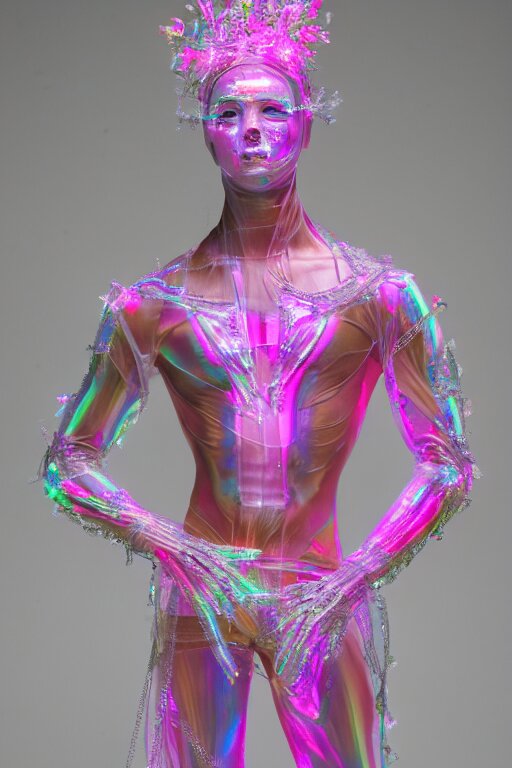
Image credit: AI Art - Skinned in Nanocrystals

Prompt: full-body rococo and cyberpunk delicate neon crystalline sculpture of (((muscular slender Nick Jonas))) as an iridescent humanoid deity wearing a thin see-through ((plastic hooded cloak)) sim roupa, reclining con (las piernas abiertas), glowing pink face, crown of (((white lasers))), large diamonds, swirling black silk fabric. futuristic elements. oozing glowing liquid, full-length view. space robots. (((human skulls))). throne made of bones, intricate artwork by caravaggio. Trending on artstation, octane render, cinematic lighting from the right, hyper realism, octane render, 8k, depth of field, 3D

Bonus: AI Art - Optical Computer Skin


Monday, September 12, 2022

Poor Man's Qubit


Physics-inspired graph neural networks to solve combinatorial optimization problems
May 2022, phys.org

Uses graph neural networks (GNNs) to tackle combinatorial optimization problems.

"Given their inherent scalability, physics-inspired GNNs can be used today to approximately solve (large-scale) combinatorial optimization problems with quantum-native models, while helping our customers get quantum-ready by using the mathematical representation that quantum devices understand," Brubaker said.

Solves optimization problems without the need for training labels.

Caveat: Brought to you by Amazon - "Our work was very much inspired by customer needs"

On the topic of optimization problems and quantum computing, it's getting easier to understand (since every other article is on this topic) that quantum computers will be good at optimization, but the key word is "will". And so for now, we're figuring out how to do optimization problems using regular computers, but in a funny way they sort of weren't meant ot be used, but which becam ereally uselful with the advent of big data. And that half-way of using regular computers like quantum computers is to use the graphics processors in parallel to create neural nets. 

via Amazon Quantum Solutions Lab: Martin J. A. Schuetz et al, Combinatorial optimization with physics-inspired graph neural networks, Nature Machine Intelligence (2022). DOI: 10.1038/s42256-022-00468-6

Image credit: Gyroid for manipulating light into topological states, Nik Spencer for Nature, 2017 [link]


The potential of p-computers
Jun 2022, phys.org

Probablistic computers, P-computers, are powered by probabilistic bits (p-bits), which interact with other p-bits in the same system. Unlike the bits in classical computers, which are in a 0 or a 1 state, or qubits, which can be in more than one state at a time, p-bits fluctuate between positions and operate at room temperature.

Camsari describes the Ising machine (sIm) as a collection of probabilistic bits which can be thought of as people. "The people can make decisions quickly because they each have a small set of trusted friends and they do not have to hear from everyone in an entire network," he explained. 

The researchers showed that their sparse architecture in field-programmable gate arrays was up to six orders of magnitude faster and had increased sampling speed five to eighteen times faster than those achieved by optimized algorithms used on classical computers.

via University of California Santa Barbara Institute for Energy Efficiency: Navid Anjum Aadit et al, Massively parallel probabilistic computing with sparse Ising machines, Nature Electronics (2022). DOI: 10.1038/s41928-022-00774-2


Also this:
'Poor man's qubit' can solve quantum problems without going quantum

Tuesday, September 6, 2022

Skin So Soft


AKA Wearable Skin Asks What's My Retronym

New 'fabric' converts motion into electricity
Jun 2022, phys.org

In a proof-of-concept experiment reported in the scientific journal Advanced Materials in April, the NTU Singapore team showed that tapping on a 3cm by 4cm piece of the new fabric generated enough electrical energy to light up 100 LEDs (capable of 2.34 watts per square meter).

The electricity-generating fabric is an energy harvesting device that turns vibrations produced from the smallest body movements in everyday life into electricity either when pressed or squashed (piezoelectricity), or when in friction with other materials (triboelectric effect).

This stretchable electrode made by screenprinting an "ink" comprising silver and styrene-ethylene-butylene-styrene (SEBS) is then attached to a piece of nanofibre fabric made of poly(vinylidene fluoride)-co-hexafluoropropylene (PVDFHPF), and lead-free perovskites.

Very new meaning to Rainwater Harvesting:
The team recently developed a type of film that could potentially be mounted on roofs or walls to harness the energy produced from wind or raindrops falling onto the film.

via Nanyang Technological University: Feng Jiang et al, Stretchable, Breathable, and Stable Lead‐Free Perovskite/Polymer Nanofiber Composite for Hybrid Triboelectric and Piezoelectric Energy Harvesting, Advanced Materials (2022). DOI: 10.1002/adma.202200042

Image credit: interband collective excitations in twisted bilayer graphene, Matteo Ceccanti, 2021 [link


Artificial skin gives robots sense of touch and beyond
Jun 2022, phys.org

This new skin technology is part of a robotic platform that integrates the artificial skin with a robotic arm and sensors that attach to human skin. A machine-learning system that interfaces the two allows the human user to control the robot with their own movements while receiving feedback through their own skin.

Called the M-Bot:

Gelatinous hydrogel makes robot fingertips a lot more like our own, and are embedded with sensors to detect the world around it. These sensors are literally printed onto the skin in the same way that an inkjet printer applies text to a sheet of paper.

Some applications:

"Graphene impregnated with platinum detects the explosive TNT very quickly and selectively. For a virus, we are printing carbon nanotubes, which have very high surface area, and attaching antibodies for the virus to them. This is all mass producible and scalable."

via California Institute of Technology: You Yu et al, All-printed soft human-machine interface for robotic physicochemical sensing, Science Robotics (2022). DOI: 10.1126/scirobotics.abn0495


Artificial skin capable of feeling pain could lead to new generation of touch-sensitive robots
Jun 2022, phys.org

Artificial skin with a new type of processing system based on "synaptic transistors," which mimics the brain's neural pathways in order to learn to react to external stimuli.

Data from the electronic skin sensors is usually sent to a computer to be processed and interpreted, but that data is too big, introducing delays.

The Glasgow team uses the human peripheral nervous system as inspiration with artificial synapses on a circuit built into the skin that process stimuli at the point of contact, reducing it to only the vital information before it is sent to the brain. 

The team used the varying output of that voltage spike to teach the skin appropriate responses to simulated pain, which would trigger the robot hand to react. By setting a threshold of input voltage to cause a reaction, the team could make the robot hand recoil from a sharp jab in the center of its palm.

via University of Glasgow: Fengyuan Liu et al, Printed Synaptic Transistors based Electronic Skin for Robots to Feel and Learn, Science Robotics (2022). DOI: 10.1126/scirobotics.abl7286.

Intel's new Core i9-11980HK leads the 11th-gen laptop CPU lineup

Scientists develop novel pain-perception biomimetic skin enabled by strain-perception-strengthening effect
Jun 2022, phys.org

Proposed strain-perception-strengthening (SPS) enabled biomimetic soft skin, which realizes the dynamic transformation from tactile to pain perception.

Elastic and conductive film (ECF), composed of elastomeric thin-film and assembled graphene nanosheets with an interlocked structural interface.

Pufferfish-inspired.

via Chinese Academy of Sciences Ningbo Institute of Materials Technology and Engineering: Peng Xiao et al, Biomimetic Skins Enable Strain‐Perception‐Strengthening Soft Morphing, Advanced Functional Materials (2022). DOI: 10.1002/adfm.202201812


Researchers develop a wearable textile exomuscle
Jun 2022, phys.org

The Myoshirt: a soft, wearable exomuscle for the upper body

via ETH Zurich: Anna-Maria Georgarakis et al, A textile exomuscle that assists the shoulder during functional movements for everyday life, Nature Machine Intelligence (2022). DOI: 10.1038/s42256-022-00495-3


Rubbery camouflage skin exhibits smart and stretchy behaviors
Jun 2022, phys.org

Artificially intelligent bioelectronic skin devices that mimics both the elasticity and the neurologic functions of cephalopod skin, with potential applications for neurorobotics, skin prosthetics, artificial organs and more.  

"Although several artificial camouflage skin devices have been recently developed, they lack critical noncentralized neuromorphic processing and cognition capabilities, and materials with such capabilities lack robust mechanical properties," Yu said. "Our recently developed soft synaptic devices have achieved brain-inspired computing and artificial nervous systems that are sensitive to touch and light that retain these neuromorphic functions when biaxially stretched."  

The Future: Where every molecule computes, and every desire an algorithm (long live the mass transference device).

via Pennsylvania State University: Hyunseok Shim et al, Artificial neuromorphic cognitive skins based on distributed biaxially stretchable elastomeric synaptic transistors, Proceedings of the National Academy of Sciences (2022). DOI: 10.1073/pnas.2204852119


Personal health trackers may include smart face mask, other wearables
Jun 2022, phys.org

Metallic conductor called MoO2 for a bioelectronic facemask.

via University of Missouri: Zhilu Ye et al, A Breathable, Reusable, and Zero-Power Smart Face Mask for Wireless Cough and Mask-Wearing Monitoring, ACS Nano (2022). DOI: 10.1021/acsnano.1c11041

And: Ganggang Zhao et al, Laser-scribed conductive, photoactive transition metal oxide on soft elastomers for Janus on-skin electronics and soft actuators, Science Advances (2022). DOI: 10.1126/sciadv.abp9734


Future robots could 'see' using new type of electronic skin
Jul 2022, phys.org

The breakthrough development involves a newly-developed method of printing microscale semiconductors made from gallium arsenide onto a flexible plastic surface, and which could provide future robots with an electronic skin capable of "seeing" light beyond the range of human vision.

via University of Glasgow: Ayoub Zumeit et al, Printed GaAs Microstructures‐Based Flexible High‐Performance Broadband Photodetectors, Advanced Materials Technologies (2022). DOI: 10.1002/admt.202200772


Hearing better with skin than ears: Research team develops a sound-sensing skin-attachable acoustic sensor
Jul 2022, phys.org

"auditory electronic skin"

Microelectro-mechanical systems (MEMS)-based microphone structure using polymer materials, a quarter of a fingernail in size and thickness of a few hundred micrometers. The microphone can be attached to large surface areas of the body or even on the finger.

The research team plans to create auditory electronic skin by integrating it with skin-attachable pressure and temperature sensors, flexible displays, and others.

via Pohang University of Science & Technology: Siyoung Lee et al, A High‐Fidelity Skin‐Attachable Acoustic Sensor for Realizing Auditory Electronic Skin, Advanced Materials (2022). DOI: 10.1002/adma.202109545


Artificial skin sweats on command
Jul 2022, phys.org

Sweats on command.

via Eindhoven University of Technology: Yuanyuan Zhan et al, Light‐ and Field‐Controlled Diffusion, Ejection, Flow and Collection of Liquid at a Nanoporous Liquid Crystal Membrane, Angewandte Chemie International Edition (2022). DOI: 10.1002/anie.202207468


Stretchy computing device feels like skin—but analyzes health data with brain-mimicking artificial intelligence
Aug 2022, phys.org

Rather than work like a typical computer, the chip — called a neuromorphic computing chip — functions more like a human brain, able to both store and analyze data in an integrated way.

via University of Chicago Pritzker School of Molecular Engineering: Shilei Dai et al, Intrinsically stretchable neuromorphic devices for on-body processing of health data with artificial intelligence, Matter (2022). DOI: 10.1016/j.matt.2022.07.016


Researchers engineer biofilm capable of producing long-term, continuous electricity from your sweat
Aug 2022, phys.org

Biofilm that harvests the energy in evaporation and converts it to electricity.

That's because this biofilm—a thin sheet of bacterial cells about the thickness of a sheet of paper—is produced naturally by an engineered version of the bacteria Geobacter sulfurreducens. G. sulfurreducens is known to produce electricity and has been used previously in "microbial batteries" to power electrical devices. But such batteries require that G. sulfurreducens is properly cared for and fed a constant diet. By contrast, this new biofilm, which can supply as much, if not more, energy than a comparably sized battery, works, and works continuously, because it is dead. And because it's dead, it doesn't need to be fed.

It makes energy from the moisture on your skin. Since the surface of our skin is constantly moist with sweat, the biofilm can "plug-in" and convert the energy locked in evaporation into enough energy to power small devices.

via University of Massachusetts Amherst: Xiaomeng Liu et al, Microbial biofilms for electricity generation from water evaporation and power to wearables, Nature Communications (2022). DOI: 10.1038/s41467-022-32105-6


Wearable technology measures mental activity through the skin
Aug 2022, phys.org

Measures mental activity using electrodermal activity — an electrical phenomenon of the skin that is influenced by brain activity related to emotional status.

The overarching goal—a Multimodal Intelligent Noninvasive brain state Decoder for Wearable AdapTive Closed-loop arcHitectures, or MINDWATCH.

via NYU Tandon School of Engineering: Rafiul Amin et al, Physiological characterization of electrodermal activity enables scalable near real-time autonomic nervous system activation inference, PLOS Computational Biology (2022). DOI: 10.1371/journal.pcbi.1010275


Engineers fabricate a chip-free, wireless, electronic 'skin'
Aug 2022, phys.org

Conforms to the skin like electronic Scotch tape, using a film of piezoelectric gallium nitride paired with a conducting layer of gold.

The device was sensitive enough to vibrate in response to a person's heartbeat, as well as the salt in their sweat, and that the material's vibrations generated an electrical signal that could be read by a nearby receiver to wirelessly transmit sensing information, without the need for a chip or battery.

via MIT: Yeongin Kim et al, Chip-less wireless electronic skins by remote epitaxial freestanding compound semiconductors, Science (2022). DOI: 10.1126/science.abn7325.


A flexible device that harvests thermal energy to power wearable electronics
Aug 2022, phys.org

First-of-its kind flexible, wearable thermoelectric device that converts body heat to electricity

via University of Washington: Youngshang Han et al, Printing Liquid Metal Elastomer Composites for High‐Performance Stretchable Thermoelectric Generators, Advanced Energy Materials (2022). DOI: 10.1002/aenm.202201413


Self-charging, ultra-thin device that generates electricity from air moisture
Aug 2022, phys.org

Moisture-driven electricity generation (MEG) device containing two regions of different properties to perpetually maintain a difference in water content across the regions to generate electricity and allow for electrical output for hundreds of hours.

The device is a thin layer of commercially available fabric made of wood pulp and polyester and coated with carbon nanoparticles.

via National University of Singapore: Yaoxin Zhang et al, An Asymmetric Hygroscopic Structure for Moisture‐Driven Hygro‐Ionic Electricity Generation and Storage, Advanced Materials (2022). DOI: 10.1002/adma.202201228


A wearable textile-based pneumatic energy harvesting system for assistive robotics
Aug 2022, phys.org

Engineers have built a handy extra limb able to grasp objects and go, powered only by compressed air.

(Similar to, but not the same as, the "dead spider" robot approach)

via Rice University: Rachel A. Shveda et al, A wearable textile-based pneumatic energy harvesting system for assistive robotics, Science Advances (2022). DOI: 10.1126/sciadv.abo2418


Thursday, August 11, 2022

Greatest Retronym in History


When it comes to AI, can we ditch the datasets?
Mar 2022, phys.org

Synthetic fucking data. They're making synthetic data to train the robots. And that makes us analog data. Me and you, our faces, our fingerprints, our gaits, gestures, voices (and most especially our consumer behaviors), are analog, starting now.

First there was the acoustic guitar, then dairy milk ffs. Hopefully, when we finally cede control to the omnibot envelope, we don't go the way of the flip-phone. 

via MIT: Paper: Generative models as a data source for multiview representation learning. openreview.net/pdf?id=qhAeZjs7dCL


Physiological signals could be the key to 'emotionally intelligent' AI, scientists say
Apr 2022, phys.org

You got any more of that analog data?
They're coming for your sweat, your biodata. You are the training set for the artificial humans of the future. 

via Japan Advanced Institute of Science and Technology JAIST: Shun Katada et al, Effects of Physiological Signals in Different Types of Multimodal Sentiment Estimation, IEEE Transactions on Affective Computing (2022). DOI: 10.1109/TAFFC.2022.3155604

Image credit: Jared Michael