Showing posts with label color tech. Show all posts

Monday, June 8, 2026

New Things in Color Tech


We have cracked the color-changing codes of both the chameleon and the octopus, we're printing structural color from an inkjet, and making something apparently darker than vantablack. But I'm really just here to say words like nanophotonic metamaterials, and quantum polycrystals. 

'OCTOID,' a soft robot that changes color and moves like an octopus
Dec 2025, phys.org

By precisely controlling the helical molecular arrangement and polymer network structure of this material, they achieved a structure capable of both soft, flexible movement and color changes, just like an actual octopus tentacle.

When an electrical signal is applied, the helical molecular arrangement and polymer network structure of this material's surface undergoes microscopic contraction and expansion, displaying a continuous color change from blue to green to red. It also performs bending and unfolding motions through asymmetric structural changes. Through this process, OCTOID can simultaneously perform three functions - camouflaging, moving, and grabbing - within a single system, just like a real octopus.

via Composite Materials Research Center of the Korea Institute of Science and Technology: Seung Hui Han et al, OCTOID: A Soft Robotic System Featuring Programmable Shape Morphing and Dynamic Structural Coloration, Advanced Functional Materials (2025). DOI: 10.1002/adfm.202520014

Absolutely Completely Unrelated Image Credit: (are we still pretending to care about attribution?)


Chameleon-like nanomaterial can adapt its color to mechanical strain
Dec 2025, phys.org

2D nanophotonic metamaterial - Kirigami-inspired structural color, as different from pigment or dye colors - When the material is stretched, its microscopic patterns move and rotate, changing how light reflects from the surface. As a result, during the stretching, the color of the light reflected from this 'nanoscale chameleon skin' shifts smoothly from green to yellow and finally to red. 

via University fo Amsterdam: Freek van Gorp et al, Nonlocal Mechano-Optical Metasurfaces, ACS Photonics (2025). DOI: 10.1021/acsphotonics.5c01385


Smart material instantly changes colors on demand for use in textiles and consumer products
Dec 202,5 phys.org

They stacked a thin layer of vanadium dioxide on top of a reflective aluminum layer. When heated above a specific temperature, the vanadium dioxide turns from an insulator to a metal, accompanied by a change in its crystalline structure. When light hits this stack, some bounces off the top of the vanadium dioxide, while the rest passes through and bounces off the aluminum below. These two reflected paths of light interfere with each other. The rapid structural change in vanadium dioxide alters the timing of light bouncing from the top and the bottom, making them out of phase. This changes the color that is canceled out, which, in turn, changes the color we see.

via University of Florida: Aritra Biswas et al, Dynamic control of phase for tunable structural colors, Proceedings of the National Academy of Sciences (2025). DOI: 10.1073/pnas.2520990122


Bird-of-paradise inspires darkest fabric ever made
Dec 2025, phys.org

They dyed a white merino wool knit fabric with polydopamine, followed by etching of the material in a plasma chamber to create spiky nanofibrils, to mimic the light-trapping capabilities found on the riflebird's ultrablack feathers.

via Cornell University College of Human Ecology Responsive Apparel Design Lab: Hansadi Jayamaha et al, Ultrablack wool textiles inspired by hierarchical avian structure, Nature Communications (2025). DOI: 10.1038/s41467-025-65649-4


Structural color can now be printed with an inkjet printer
Apr 2026, phys.org

Spherical silicon crystals that reflect color specifically based on their precise size in the range between 100 and 200 nanometers can now be printed at resolutions between 250 and 125 dots per inch onto a flat PET film as well as on a 3D metallic surface.

via Kobe University: Hiroto Yamana et al, Structural Color Inkjet Printing With Mie‐Resonant Silicon Nanoparticles, Advanced Materials (2026). DOI: 10.1002/adma.202523036

Wednesday, December 3, 2025

Colors Keep Coming


This is where all the colors come from. 

Color-changing sensor offers new way to track motion and stress
Dec 2024, phys.org

Yeah go ahead and read that and get back to me.

It's a mechanochromic strain sensor that changes color in response to mechanical stress, using magnetoplasmonic nanoparticles (MagPlas NPs) which form a uniform layer called an amorphous photonic array producing bright, consistent colors that remain stable when viewed from different angles, and which are transferred onto a flexible, stretchable material called polydimethylsiloxane (PDMS) enabling the sensor to change color under mechanical stress.

via Chungnam National University in Korea: Huu-Quang Nguyen et al, Mechanochromic strain sensor by magnetoplasmonic amorphous photonic arrays, Chemical Engineering Journal (2024). DOI: 10.1016/j.cej.2024.155297


Squid are some of nature's best camouflagers. Researchers have a new explanation for why
Mar 2025, phys.org

Chromatophores are pigmented organs that sit all over the squid's skin. They have muscle fibers on the outside that are filled with neurons, allowing the animal to neuromuscularly open and control these pigment sacks based on what's in their environment.

Together with iridophores, which act as a kind of photo filter, adding greens and blues to the chromatophores' reds, yellows and browns, they give squid the ability to change color within hundreds of milliseconds, distributing the color all over their body.

"To have something sense the colors around it and distribute [them] within hundreds of milliseconds is really insane," Deravi says. "It's not something that's easy to do, especially in a living system that's under water."

And then they made an artificial squid skin circuit.

via Northeastern University: Taehwan Kim et al, Cephalopod chromatophores contain photosensitizing nanostructures that may facilitate light sensing and signaling in the skin, Journal of Materials Chemistry C (2025). DOI: 10.1039/D4TC04333B


The first genetic editing in spiders with CRISPR‐Cas yields colorful silk
May 2025, phys.org

They developed an injection solution that included the components of the gene-editing system as well as a gene sequence for a red fluorescent protein. This solution was injected into the eggs of unfertilized female spiders, which were then mated with males of the same species. As a result, the offspring of the gene-edited spiders showed red fluorescence in their dragline silk — clear evidence of the successful knock-in of the gene sequence into a silk protein.

via University of Bayreuth's Biomaterials research group: Edgardo Santiago‐Rivera et al, Spider Eye Development Editing and Silk Fiber Engineering Using CRISPR‐Cas, Angewandte Chemie International Edition (2025). DOI: 10.1002/anie.202502068

Fire retardant dropped on California after wildfires 2 - via Getty - Jan 2025

Long-used red pigment carmine has a surprisingly complex porous structure
Jun 2025, phys.org

Every artist knows about carmine red, or at least they know it comes from an insect and not a chemistry lab, and they know it's hard to get and it's expensive. In case you're not an artist - Carmine is a natural red coloring agent produced from an extract of the cochineal insect, rich in carminic acid, and which is combined with aluminum (Al) and calcium (Ca) to produce carmine. 

Now they're using better microscopy, and find that it's actually a metal complex built from two calcium ions, two aluminum ions, and four organic ligand molecules of carminic acid. It makes a porous metal structure (that sounds to me like the MOFs you keep hearing about).

via Stockholm University: Erik Svensson Grape et al, Brilliantly Red: The Structure of Carmine, Crystal Growth & Design (2025). DOI: 10.1021/acs.cgd.5c00185


Pigment researchers create vivid yellows, oranges, reds that are durable, non-toxic
Jul 2025, phys.org

Brought to you by Mas Subramanian, who made color history in 2009 with the discovery of a vivid blue pigment now known commercially as YInMn Blue.

The work centers around the crystal structure of a rare mineral found in Norway called thortveitite, a silicate containing scandium and yttrium. Thortveitite isn't known for vibrant colors, but by introducing the abundant elements nickel, zinc and vanadium into a thortveitite-like crystal lattice, scientists have produced a collection of intense yellow, orange and reddish pigments.

Chromophores - the parts of a molecule that determine color by reflecting some wavelengths of light while absorbing others.

"Although divalent nickel is known to produce yellow and green colors in inorganic compounds, it rarely produces oranges and/or reds. The discovered pigments are stable under high temperatures and in acidic environments with no change in the structure or color properties, and they can be made in air at relatively low temperatures, around 750°C, which makes large-scale production feasible."

via Oregon State University: Yi-Chia Lin et al, Intense Yellow/Orange/Red Pigments Based on a Thortveitite-like Structure without Toxic Elements: Zn2-xNixV2O7, Chemistry of Materials (2025). DOI: 10.1021/acs.chemmater.5c00324


True blue: Researchers create better blue food dye from algae
Aug 2025, phys.org

Phyco Blue (?) - natural blue food dye made of an algae protein called Phycocyanin

via Cornell University: Qike Li et al, Elucidating structure-functionality relationships of phycocyanin through size-exclusion chromatography coupled with in-line small-angle X-ray scattering, Food Hydrocolloids (2025). DOI: 10.1016/j.foodhyd.2025.111798

Sunday, January 5, 2025

Nature's Palette Prompts Advances in Color Tech


Ecocidal maniacs consider alternatives to destroying the planet with glitter:

Bacterial glitter - New findings open up possibilities for sustainable color technologies
Jul 2024, phys.org

Scientists sequenced the DNA of 87 structurally colored bacteria and 30 colorless strains and identified genes that are responsible for these fascinating colonies. 

"We discovered that the genes responsible for structural color are mainly found in oceans, freshwater, and special habitats such as intertidal zones and deep-sea areas. In contrast, microbes in host-associated habitats such as the human microbiome displayed very limited structural color,"

Surprisingly, these genes are also found in bacteria that live in deep oceans without sunlight. This could imply that the colors could reflect deeper processes of cell organization with important functions, such as protecting the bacteria from viruses, or efficiently colonizing floating food particles.

via Friedrich Schiller University of Jena, Max Planck Institute of Colloids and Interfaces, Leibniz Institute DSMZ-German Collection of Microorganisms and Cell Cultures, Utrecht University, University of Cambridge, and the Netherlands Institute for Sea Research: Colin J. Ingham et al, Structural color in the bacterial domain: The ecogenomics of a 2-dimensional optical phenotype, Proceedings of the National Academy of Sciences (2024). DOI: 10.1073/pnas.2309757121

Related image credit: Wing scales of a butterfly Papilio ulysses on a medical syringe needle - Daniel Knop Nikon Small World 12th Place - 2024 [link]


Study reveals why orange netting packaging makes oranges look more appealing
Aug 2024, phys.org

The "confetti illusion" - Food growers learned a long time ago that if they packed oranges in orange netting, the oranges inside look more orange, which the mind interprets as a more luscious ripe fruit. The same thing is true for yellow netting for lemons and green netting for limes. 

This research shows that the change in fruit color is not due to the way light reflects off the netting but that sensory stimuli are made of partial information and assembled into images only after the brain has knitted together input from several sources. 

via Giessen University: Karl R. Gegenfurtner, Perceptual ripening of oranges, i-Perception (2024). DOI: 10.1177/20416695241258748


Synthetic molecular switch enables 'painting' with natural light
Oct 2024, phys.org

A synthetic molecular switch made up of the organic molecule triptycene and a class of compounds called hydrazones can trigger shape changes in liquid crystals that allow them to reflect different colors. 

When chiral triptycene interacts with a liquid crystal molecule, it rearranges other liquid crystal molecules in twisted, DNA-like helices, which then reflect ambient light at different wavelengths based on their pitch, or how far apart the coils in their helical structure are spaced.

via Dartmouth and Southern Methodist University: Indu Bala et al, Multi-stage and multi-colour liquid crystal reflections using a chiral triptycene photoswitchable dopant, Nature Chemistry (2024). DOI: 10.1038/s41557-024-01648-0

Friday, August 2, 2024

Making Colors


Making colors is not easy. Actually, seeing colors isn't easy either - most creatures don't see the rainbow the way we do. There's even plenty of humans who can't "see" certain colors, blue being the last to be recognized and named in most cultures (if this is the first time you're hearing about this, just search this site with the term "color" and learn more). 

Colors are not easy to make, not by nature and certainly not by humans. If a tree, for example, makes a vibrant, jewelescent red color, it might be bright, but it won't last long. To make a color that's strong but that also lasts a long time, it usually takes either a lot of effort, or a lot of toxic materials, and usually both. Tyrian purple? Not easy. Fire engine red? Toxic. 

But once in a while, we figure out a way to break those rules, because humans are pretty good at that, in fact, it's kind of one of the things we do best. 

Nature's palette reinvented: New fermentation breakthrough in sustainable food coloring
Dec 2023, phys.org

It's a fermentation process that produces "betalain-type" food colors (betalanins give red beets their distinctive bright pinkish red color).

They used an oleaginous yeast Yarrowia lipolytica found in cheese, then performed metabolic engineering to optimize the cellular metabolism.

via Danmarks Tekniske Universitet Novo Nordisk Foundation Center for Biosustainability DTU Biosustain: Philip Tinggaard Thomsen et al, Beet red food colourant can be produced more sustainably with engineered Yarrowia lipolytica, Nature Microbiology (2023). DOI: 10.1038/s41564-023-01517-5

Totally unrelated image credit: AI Art - Holographic Pill Advertisement - 2024


Chemists create organic molecules in a rainbow of colors that could be useful as organic light-emitting diodes
Dec 2023, phys.org

Acenes are chains of benzene molecules that have unique optoelectronic properties for use as semiconductors, and can also be tuned to emit different colors of light. These researchers dope acenes with boron and nitrogen for better properties, but also add the ligand carbodicarbene to improve stability.

via MIT: Chun-Lin Deng et al, Air- and photo-stable luminescent carbodicarbene-azaboraacenium ions, Nature Chemistry (2023). DOI: 10.1038/s41557-023-01381-0


What makes urine yellow? Scientists discover the enzyme responsible
Jan 2024, phys.org

When red blood cells degrade after their six-month lifespan, a bright orange pigment called bilirubin is produced as a byproduct, and is secreted into the gut. "Gut microbes encode the enzyme bilirubin reductase that converts bilirubin into a colorless byproduct called urobilinogen. Urobilinogen then spontaneously degrades into a molecule called urobilin, which is responsible for the yellow color we are all familiar with."

via University of Maryland: BilR is a gut microbial enzyme that reduces bilirubin to urobilinogen, Nature Microbiology (2024). DOI: 10.1038/s41564-023-01549-x


Beetles living in the dark teach us how to make sustainable colors
Mar 2024, phys.org

Chitin, or insect exoskeleton, is Earth's second most abundant organic molecule, and is already approved for medical use.  

They created the color by manipulating the folding patterns of the structure, so this is a structural color approach as opposed to a dye or pigment. 

via Singapore University of Technology and Design: Akshayakumar Kompa et al, Large‐Scale Artificial Production of Coleoptera Cuticle Iridescence and Its Use in Conformal Biodegradable Coatings, Advanced Engineering Materials (2024). DOI: 10.1002/adem.202301713


Researchers advance pigment chemistry with moon-inspired reddish magentas
Apr 2024, phys.org

RED!
From the makers of YInMn blue who mixed black manganese oxide with other chemicals, then heated them in a furnace to nearly 2,400 degrees Fahrenheit.

The new pigments, which could be used as energy-efficient coatings for vehicles and buildings, are based on divalent chromium, Cr2+, and are the first to use it as a chromophore; chromophores are the parts of a molecule that determine color by reflecting some wavelengths of light while absorbing others.

Inspired by the divalent copper that serves as a chromophore in Egyptian blue, they replaced the divalent copper with divalent chromium, leading to durable, reddish magenta pigments. 

BTW - "Most of the magenta-colored pigments used today are organic chemicals and suffer from stability issues when exposed to ultraviolet rays and heat from the sun because they can break down organic chemical bonds. Inorganic magenta pigments are rare, and most require a significant amount of cobalt salts that are hazardous to both humans and the environment."

via Oregon State University: Anjali Verma et al, Cr2+ in Square Planar Coordination: Durable and Intense Magenta Pigments Inspired by Lunar Mineralogy, Chemistry of Materials (2024). DOI: 10.1021/acs.chemmater.4c00253

Post Script:
The role of history in how efficient color names evolve
Mar 2024, phys.org

The past color vocabulary of a language shapes its ability to evolve.

"Once you as a linguistic community have an efficient vocabulary, that starting point restricts the next possible efficient vocabulary that you could have when you introduce a new term," says Twomey, the first author. "As the vocabulary grows, the number of different vocabularies that you could move to is increasingly constrained."

(I call this the 'chips vs crisps' phenomenon)

They used Berlin and Kayes World Color Survey - 25 speakers from each of 110 languages asked to name the same set of 330 color stimuli. 

  • Green-blue and blue are quite susceptible to changes in meaning as new terms are added, whereas red, black, and yellow remain relatively stable in meaning.
  • A historical vocabulary would most likely split green-blue into separate terms whereas the de novo vocabulary is more likely to introduce light green or orange than pink.
  • In principle, we can infer what ancestral color vocabularies were and then compare that to the historical record.
  • An example he provides is that at certain points in history, certain commercial dyes were introduced that became economically important to a culture.

via University of Pennsylvania: Colin R. Twomey et al, History constrains the evolution of efficient color naming, enabling historical inference, Proceedings of the National Academy of Sciences (2024). DOI: 10.1073/pnas.2313603121

Wednesday, January 17, 2024

Color Check


Butterfly-inspired films create vibrant colors while passively cooling objects
Aug 2023, phys.org

Morpho-inspired nanofilms -- a disordered material of rough frosted glass under a multilayer material made of titanium dioxide and aluminum dioxide, then placed on a silver layer that reflects all light. Although this type of passive photonic thermal management has been accomplished before, it has only been used with white or clear objects because it is difficult to maintain a wide viewing angle and high color saturation. "Thanks to the layered structure we developed, we were able to extend the passive cooling method from colorless objects to colorful ones while preserving color performance," said Wang. "In other words, our blue film looks blue across a large range of viewing angles and doesn't heat up because it reflects all the light."

via Shenzhen University: Wanlin Wang et al, Cooling colors below the ambient temperature, Optica (2023). DOI: 10.1364/OPTICA.487561


Inspired by butterfly wings, researchers develop a soft, color-changing system for optical devices
Sep 2023, phys.org

The new pixelated, soft, color-changing system called a Morphable Concavity Array (MoCA) has a top layer of photonic crystal elastomer actuator (PC-EA) film and a bottom layer of a hole array (lattice with regularly spaced round holes), where ethanol can be added to make the one-half of the top layer swell, resulting in  tension that pulls the other-half of the top layer downward into the hole, producing a dish-like concave shape that acts as a pixel. 

MoCA was inspired by the structures on butterfly wings called dual-color micro-concavities that produce vibrant, iridescent colors and are called photonic crystals. 

via University of Hong Kong: Yi Pan et al, Pixelating Responsive Structural Color via a Bioinspired Morphable Concavity Array (MoCA) Composed of 2D Photonic Crystal Elastomer Actuators, Advanced Science (2023). DOI: 10.1002/advs.202300347


Chameleon-inspired coating could cool and warm buildings through the seasons
Sep 2023, phys.org

Namaqua chameleons of southwestern Africa use light gray to reflect sunlight and dark brown to absorb heat. These thermochromic microcapsules were sprayed or brushed onto a metal surface that when heated to 68 degrees, began to change from dark to light gray; at 86 degrees it reflected 93% of solar radiation.

For anyone who lived in the Northeast in October 2023 and had to use both their air conditioner and heater in the same week -

"During spring and fall, the new coating was the only system that could adapt to the widely fluctuating temperatures changes, switching from heating to cooling throughout the day."

via School of New Energy, Harbin Institute of Technology, Weihai China: "Warm in Winter and Cool in Summer" Scalable Biochameleons Inspired Temperature Adaptive Coating with Easy Preparation and Construction, Nano Letters (2023). DOI: 10.1021/acs.nanolett.3c02733

AI Art - Close Up of an Eye 2 - 2024

From glowing cats to wombats, fluorescent mammals are much more common than you'd think
Oct 2023, phys.org

Almost every mammal we studied showed some form of fluorescence in the  fur, spines and even skin and nails.

In particular, we noticed that white and light-colored fur is fluorescent, with dark pigmentation preventing fluorescence. For example, a zebra's white stripes fluoresced while the dark stripes didn't. Nocturnal mammals were more fluorescent, while aquatic species were less fluorescent than those that burrowed, lived in trees, or on land.

via Curtin University and the Western Australian Museum: Kenny J. Travouillon et al, All-a-glow: spectral characteristics confirm widespread fluorescence for mammals, Royal Society Open Science (2023). DOI: 10.1098/rsos.230325


Paint that can change colors? The skin of an octopus holds the key, researchers say
Oct 2023, phys.org

Xanthommatin is a naturally occurring dye present in the bodies of cephalapods like octopi and squid. Previously the researchers found that mixing different amounts of titanium dioxide with xanthommatin could speed up color change or add to the intensity of the color shift.

via Northeastern University: Cassandra L. Martin et al, Color‐Changing Paints Enabled by Photoresponsive Combinations of Bio‐Inspired Colorants and Semiconductors, Advanced Science (2023). DOI: 10.1002/advs.202302652


Morpho butterfly nanostructure inspires technology for bright, balanced lighting
Oct 2023, phys.org

Two-dimensional nanopatterns in common transparent polydimethylsiloxane elastomer are an effective optical diffuser for short- and long-wavelength light. The diffuser surface patterns were tailored to optimize the performance for blue and red light, and for self-cleaning properties.

via Osaka University: Kazuma Yamashita et al, Development of a High‐Performance, Anti‐Fouling Optical Diffuser Inspired by Morpho Butterfly's Nanostructure, Advanced Optical Materials (2023). DOI: 10.1002/adom.202301086


Thursday, March 2, 2023

In the Future Matter Is Intelligent


Floppy or not: AI predicts properties of complex metamaterials
Nov 2022, phys.org

With infinite options, infinite intelligence?

Also words:
Artificial materials - These are engineered materials whose properties are determined by their geometrical structure rather than their chemical composition [like origami].

I must have missed the part when we started calling them artificial materials, I thought they were all metamaterials.

Designing these materials is a combinatorial problem, which means it's hard. You can't really predict what will happen, you just have to do it. But artificial intelligence can do it virtually, all day, and find the ones that work. 

via University of Amsterdam: Ryan van Mastrigt et al, Machine Learning of Implicit Combinatorial Rules in Mechanical Metamaterials, Physical Review Letters (2022). DOI: 10.1103/PhysRevLett.129.198003


Clear window coating could cool buildings without using energy
Nov 2022, phys.org

A "transparent radiative cooler" could lower the temperature inside buildings, without expending a single watt of energy. 

The team constructed computer models of TRCs consisting of alternating thin layers of common materials like silicon dioxide, silicon nitride, aluminum oxide or titanium dioxide on a glass base, topped with a film of polydimethylsiloxane. They optimized the type, order and combination of layers using an iterative approach guided by machine learning and quantum computing, which stores data using subatomic particles. 

Cooling accounts for about 15% of global energy consumption; this thing can potentially reduce cooling energy consumption by 31% compared with conventional windows.

via Notre Dame: High-Performance Transparent Radiative Cooler Designed by Quantum Computing, ACS Energy Letters (2022). DOI: 10.1021/acsenergylett.2c01969


Photovoltaic windows unlock goal of increased energy efficiency for skyscrapers
Nov 2022, phys.org

Energy use climbs when a building has more windows than wall space, yet larger floor-to-floor height coupled with PV glazing reduces building energy use. 

via National Renewable Energy Laboratory: Vincent M. Wheeler et al, Photovoltaic windows cut energy use and CO2 emissions by 40% in highly glazed buildings, One Earth (2022). DOI: 10.1016/j.oneear.2022.10.014


New study suggests mobile data collected while traveling over bridges could help evaluate their integrity
Nov 2022, phys.org

I can see a future where we intercept wifi signals from building occupants, and measure their interactions to determine not only the building materials getting hit by the wifi waves, but their changes over time:

"Information about structural health of bridges can be extracted from smartphone-collected accelerometer data"

via MIT: Thomas Matarazzo, Crowdsourcing bridge dynamic monitoring with smartphone vehicle trips, Communications Engineering (2022). DOI: 10.1038/s44172-022-00025-4.

AI Art - Fibonacci Alien Library 1 - 2022

Centimeter-scale multicolor printing with a pixelated optical cavity
Nov 2022, phys.org

"pixelated optical cavity"

The colorful image with multiple color components is first converted to a predefined grayscale pattern and then engraved on the photoresist layer by controlling the exposure dose during the grayscale laser writing process.

Pixelated photoresist spacer layers are sandwiched by two semitransparent sliver thin films to form the Fabry–Perot cavities (pixelated optical cavities). The transmission color can be continuously tuned in the visible spectral regime by finely controlling the thickness of the photoresist layer. 

via Southern University of Science and Technology in Shenzhen: Yu Chen et al, Centimeter scale color printing with grayscale lithography, Advanced Photonics Nexus (2022). DOI: 10.1117/1.APN.1.2.026002


Team creates crystals that generate electricity from heat
Nov 2022, phys.org

This novel synthetic material is composed of copper, manganese, germanium, and sulfur, and it is produced by simple ball-milling and then heating to 600 degrees Celsius. 

It's called a "thermoelectric material" because it converts heat to electricity. 

via Normandie University: V. Pavan Kumar et al, Engineering Transport Properties in Interconnected Enargite‐Stannite Type Cu 2+ x Mn 1− x GeS 4 Nanocomposites, Angewandte Chemie International Edition (2022). DOI: 10.1002/anie.202210600


Mimicking life: A breakthrough in non-living materials
Nov 2022, phys.org

Artificial Life - Ok they're calling them all kinds of things, now including "non-living materials", also related to soft robotics:

New process that uses fuel to control non-living materials at a specified rate, similar to what living cells do

"Ultimately you'd want a robot to be able to control itself. You can program our cycle into a particle in advance, then leave it alone, and it performs its function independently as soon as it encounters a signal to do so."

Particles man.

via Delft University of Technology: Benjamin Klemm et al, Temporally programmed polymer—solvent interactions using a chemical reaction network, Nature Communications (2022). DOI: 10.1038/s41467-022-33810-y


Discovery reveals 'brain-like computing' at molecular level is possible
Nov 2022, phys.org

Brains all the way down:

"Intelligent molecular materials"

Disruptive new alternative to conventional silicon-based digital switches that can only ever be either on or off. It displays all the mathematical logic functions necessary for deep learning.

"The community has long known that silicon technology works completely differently to how our brains work and so we used new types of electronic materials based on soft molecules to emulate brain-like computing networks."

via  University of Limerick's Bernal Institute: Enrique del Barco, Dynamic molecular switches with hysteretic negative differential conductance emulating synaptic behaviour, Nature Materials (2022). DOI: 10.1038/s41563-022-01402-2

AI Art - Mobius in an Escher Room with Penrose Triangles - 2022

Self-assembled nanoscale architectures could feature improved electronic, optical, and mechanical properties
Nov 2022, phys.org

Internet of Everything 

"Self-assembly is a really beautiful way to make structures," Yager said. "You design the molecules, and the molecules spontaneously organize into the desired structure."

via Department of Energy's Brookhaven National Laboratory's Center for Functional Nanomaterials: Sebastian T. Russell et al, Priming self-assembly pathways by stacking block copolymers, Nature Communications (2022). DOI: 10.1038/s41467-022-34729-0


Breakthrough algorithm expands the exploration space for materials by orders of magnitude
Nov 2022, phys.org

Algorithm that predicts the structure and dynamic properties of any material—whether existing or new—almost instantaneously.

It's called M3GNet and it was used to develop matterverse.ai, a database of more than 31 million yet-to-be-synthesized materials with properties predicted by machine learning algorithms. 

via University of California San Diego: Chi Chen, A universal graph deep learning interatomic potential for the periodic table, Nature Computational Science (2022). DOI: 10.1038/s43588-022-00349-3


Kirigami technique hints at promising outcomes for breast reconstruction
Dec 2022, phys.org

Kirigami boobs

via University of Pennsylvania: Young‐Joo Lee et al, Natural Shaping of Acellular Dermal Matrices for Implant‐Based Breast Reconstruction via Expansile Kirigami, Advanced Materials (2022). DOI: 10.1002/adma.202208088

Tuesday, September 13, 2022

Where Color Comes From


Toward 4D printing with structural colors
Jun 2022, phys.org

While you were sleeping, 3D printing makes a huge evolutionary leap - now making "structural colors" directly into the nanoscopic surface textures of the materials. What better name to call it than 4D printing:

3D printing with stimuli-responsive materials, called 4D printing. 4D printing enables 3D printed structures to change its configurations over time and is used in a wide variety of fields such as soft robotics, flexible electronics, and medical devices.

Structural coloration occurs on surfaces with a nanostructure with dimensions similar to those of the wavelength of the incident light (typically below a micron). These ordered nanostructures are known as photonic crystals.

But it's not just about printing structurally-memetic dragonfly iridescence that changes depending on the light. It's about the surface textures changing over time, and in response to any number of stimuli in the environment. Too hot? Turns red. Cyanide gas in the air? Turns green.

Humidity-responsive color changing ink for extrusion 3D printing reversibly changes volume and reflected color based on hydration state.


But again it's not just about changing colors, it's about the materials sensing its environment and changing its structure in response:

"Ideally, by including responsive elements in these polymers, we can create materials that can both sense and respond to their environment, perhaps even allowing communication between individual devices as well to generate a level of autonomy for a collection of individual units," Debije concludes.

via Eindhoven University of Technology: Jeroen A. H. P. Sol et al, Direct Ink Writing of 4D Structural Colors, Advanced Functional Materials (2022). DOI: 10.1002/adfm.202201766


Natural mineral hackmanite demonstrates highly repeatable color change ability
Jun 2022, phys.org

"Structural Breathing" he says.

Also, radiation exposure detection:
Hackmanite changes color when it's exposed to ultraviolet radiation, and without wearing out, but until now we didn't know why.

It can do this repeatedly without wearing out because it does not use the change in color of the organic molecules the make it up, like similar minerals, but by using structural color -- a change in the position of the molecules, but not their composition.

"In this research, we found out for the first time that there is actually a structural change involved in the color change process, as well. When the color changes, sodium atoms in the structure move relatively far away from their usual places and then return back. This can be called 'structural breathing,' and it does not destroy the structure even if it is repeated a large number of times,"
 
via Intelligent Materials Research Group at the Department of Chemistry of the University of Turku, Finland: Pauline Colinet et al, The structural origin of the efficient photochromism in natural minerals, Proceedings of the National Academy of Sciences (2022). DOI: 10.1073/pnas.2202487119


Engineers repurpose 19th-century photography technique to make stretchy, color-changing films
Aug 2022, phys.org

By applying a 19th-century color photography technique to modern holographic materials, an MIT team has printed large-scale images onto elastic materials that when stretched can transform their color, reflecting different wavelengths as the material is strained.

The eureka:
While puzzling over how to resolve this challenge of getting microscale control and scalability together in structural color technology, Miller happened to visit the MIT Museum, where a curator talked him through an exhibit on holography, a technique that produces three-dimensional images by superimposing two light beams onto a physical material. "I realized what they do in holography is kind of the same thing that nature does with structural color."

via MIT: Benjamin Harvey Miller et al, Scalable optical manufacture of dynamic structural colour in stretchable materials, Nature Materials (2022). DOI: 10.1038/s41563-022-01318-x


Post Script:
Researchers add antireflection coatings to complex 3D printed micro-optical systems
Apr 2022, phys.org

Another nod to the future where everything becomes a computer -- the mirrors (for optical circuits, for optical computers) are sprayed right onto the 3D printed objects themselves. 

Imagine being skinned in nanocrystal photon routers.  

via University of Stuttgart: Simon Ristok et al, Atomic layer deposition of conformal anti-reflective coatings on complex 3D printed micro-optical systems, Optical Materials Express (2022). DOI: 10.1364/OME.454475


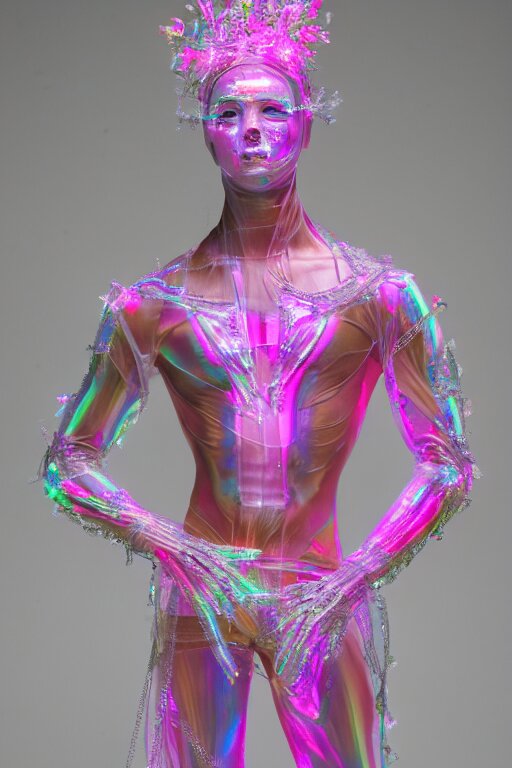
Image credit: AI Art - Skinned in Nanocrystals

Prompt: full-body rococo and cyberpunk delicate neon crystalline sculpture of (((muscular slender Nick Jonas))) as an iridescent humanoid deity wearing a thin see-through ((plastic hooded cloak)) sim roupa, reclining con (las piernas abiertas), glowing pink face, crown of (((white lasers))), large diamonds, swirling black silk fabric. futuristic elements. oozing glowing liquid, full-length view. space robots. (((human skulls))). throne made of bones, intricate artwork by caravaggio. Trending on artstation, octane render, cinematic lighting from the right, hyper realism, octane render, 8k, depth of field, 3D

Bonus: AI Art - Optical Computer Skin


Monday, July 5, 2021

Camo Tech

 Fluorescent Jello

For a lesson on the history of colors, the must-read is The Color Revolution by ReginaLee Blaszczyk (2012). For a lesson on the future of colors, here's a few updates.

With a zap of light, system switches objects' colors and patterns
May 2021, phys.org

Color-shifting "programmable matter" system update imagery on object surfaces:
The system, dubbed "ChromoUpdate" pairs an ultraviolet (UV) light projector with items coated in light-activated dye. The projected light alters the reflective properties of the dye, creating colorful new images in just a few minutes. ... Rather than using an LED, which uniformly blasts the entire surface, ChromoUpdate uses a UV projector that can vary light levels across the surface. So, the operator has pixel-level control over saturation levels. ..."selective saturation procedure"

via  Massachusetts Institute of Technology: Paper: "ChromoUpdate: Locally Updating Photochromatic Multi-Color Textures for Fast Design Iterations"

Artificial color-changing material that mimics chameleon skin can detect seafood freshness
May 2021, phys.org

Wordwatch -- Luminogens are the molecules that make crystals glow, like the ones you can see at the Franklin Mines Fluorescent Mineral Room in New Jersey.
Chemosensors developed with this design can detect seafood freshness by changing color in response to amine vapors released by microbes as fish spoils. The material may also be used to advance the development of stretchable electronics, dynamic camouflaging robots, and anticounterfeiting technologies.

via: Cell Reports Physical Science, Lu et al.: "Panther Chameleon skin-inspired core@shell supramolecular hydrogel with spatially organized multi-luminogens enables programmable color change" DOI: 10.1016/j.xcrp.2021.100417

'Whitest ever' paint reflects 98% of sunlight
Apr 2021, BBC News

They use different particle sizes to scatter each different wavelength, so it looks brighter.
It doesn't have a cool name like Vanta Black though (nanoscale carbon tubes); it's called Ultra-White.

A new natural blue for food coloring
Apr 2021, phys.org

This time it's from red cabbage, last time it was beets

via UC Davis: P.R. Denish el al., "The Discovery of a natural cyan blue: A unique food-sourced anthocyanin could replace synthetic brilliant blue," Science Advances (2021).

Friday, July 2, 2021

Rainbows End


AKA Yellow is Not a Real Color

Image: The Canada Heat Wave of 2021 (should probably be called "the first" heat wave of 2021, since it happened in June)

Heat maps are a big deal these days, especially since the planet is now getting so hot that we have run out of colors.

But this brings up a problem in science communication that's been around forever --  
rainbows distort data. They also make the data unreadable for those with color blindness. It's actually a big deal, especially for scientists, journalists, public health professionals, law enforcement, you name it. 

This is something that's upset me forever; I was an art teacher -- The color yellow does not belong on a lettered sign. You want to make a sign? Prom? Fine. Lots of colors? Fine. But know this -- any letter that is colored yellow, on a background of white paper, will be invisible, and it will make your sign illegible.

Full-grown adults still don't get it; I see it happen all the time. Please stop. 

And if what you're trying to do is to make the data visible according to a continuum of visual stimuli, then maybe stick to black and white; light-to-dark communicates this continuum much better than a rainbow (which goes from light to dark to light to dark and back again,  which is confusing). 

Notes:
Using better colours in science
Oct 2020, phys.org

via University of Oslo: Fabio Crameri et al. The misuse of colour in science communication, Nature Communications (2020). DOI: 10.1038/s41467-020-19160-7

Also, this: Evolution of Basic Color Terms (red was the first color that we could see, and some groups of people still can't see blue)

Sunday, January 10, 2021

Exobiological Skin Shell Sensors and Remote Control Metabolism Engineering


Just trying to come up with a catchy title for a quick list of developments in color application technology, but also biomimicry, wearables, and radioactive fungi. We're finishing off with some recent bits in the endless stream of synthetic biology advancements that will eventually define the 21st century.

Images courtesy of Nikon's Small World Challenge, best microscopy photos you can get!

The first one is a snail tongue by Dr. Igor Siwanowicz, and has nothing to do with the articles below.


Blue dye from red beets - Chemists devise a new pigment option
Apr 2020, phys.org

Non-toxic and Blue dye do not belong in the same sentence, historically. But now, a new class of dyes called pseudo-natural dyes use the same molecules that come from bright red beets (betalains), and they change the carbon-nitrogen chemical bond to a carbon-carbon bond. These new molecules are called quasibetalains, and they're blue.

On a sidenote, I do not recognize the opening statement in the above link, which says that blue is the most liked color the world over. In my art room, in the box of color pencils, and in the box of markers, both followed the same pattern every year for every class: the red pencils are the first to go, followed by blue; it gets fuzzy after that, but they all end up with nothing but brown, orange and yellow, and in that order. After all, brown is the entropic heat death of the rainbow, kind of an anti-color. 

B. C. Freitas-Dörr et al. A metal-free blue chromophore derived from plant pigments, Science Advances (2020). DOI: 10.1126/sciadv.aaz0421
http://dx.doi.org/10.1126/sciadv.aaz0421


Red light for stress - A color-changing organic crystal
May 2020, phys.org

Here we've got some organic crystals that change color based on pressure, but that can also return to their original shape. And that's called superelastochromism.

The idea here is to use them as sensors to show you where a building is getting out of whack. But there's a whole lot more you can imagine doing with these.

via the University of Tokyo: Toshiki Mutai et al, A superelastochromic crystal, Nature Communications (2020). DOI: 10.1038/s41467-020-15663-5


Liquid crystals create easy-to-read, color-changing sensors
Jul 2020, phys.org

Similar thing here; they're pushing and pulling liquid crystals to manipulate their color. The thing is, these don't just change color based on pressure, but even temperature. The walls in your room could change if the temperature shifts too quickly, for example. 
 
Then again, if you're wearing this, it could show you inflammation in your body. 

via the University of Chicago: "Prolate and oblate chiral liquid crystal spheroids". Juan de Pablo et al. Science Advances (2020). DOI: 10.1126/sciadv.aba6728 

Mohamed Ghassen Nouira makes purple dye.

Passion for purple revives ancient dye in Tunisia
Aug 2020, phys.org

Emperors hate him. This guy figures out how to take special snails and make purple dye out of them, just like how they used to do. Imperial clothiers and dye-makers knew how to do this centuries ago, and the art was lost to the time in between us and them. 

And that wasn't a mistake. The process of making Tyrian Purple was a secret, kind of like how we try to keep people from making believable hundred dollar bills. 

Think about it, if you, a Carthaginian hustlepimp, could make your own purple robe and deceive the court into thinking you were royalty, kind of like an ancient Borat, you could cause a ruckus. And we can't have a ruckus in the upper reaches of the royal elites. 

More importantly, empires made their fortunes selling this dye to other empires. Can't have some guy in his garage creeping into your marketshare. 

100,000 grams (100kg) of shelled murex yields 1 gram of Tyrian Purple, and goes for $2,400 - $4,000 per gram, and takes about a week's worth of work.

Sidenote, if you search the words "royal elite" it reeks of fake shit and dupery, which I think is funny because it's a redundant term that would only be used by people who don't really know what either word means.


Testing Chernobyl fungi as a radiation shield for astronauts
Aug 2020, phys.org

Bioshell.

They want to coat spaceships in a shell of superfungus to protect from radiation. They didn't create these fungi by engineering them in a lab; they found them. 

And where are on earth are you going to find an organism that metabolizes radioactive isotopes? Yes, thank you Chernobyl.

Graham K. Shunk et al. A Self-Replicating Radiation-Shield for Human Deep-Space Exploration: Radiotrophic Fungi can Attenuate Ionizing Radiation aboard the International Space Station, bioRxiv (2020). DOI: 10.1101/2020.07.16.205534. http://dx.doi.org/10.1101/2020.07.16.205534

Beetle leg - Aigars Jukna

Low-cost, fly footpad-like adhesive structure capable of repeated attachment/detachment
Aug 2020, phys.org

The design is based on fly feet, fine, that's pretty standard biomimicry. But the way they learned how to manufacutre the thing is by looking at how the fly itself makes flies, in the pupa. That's next level biomimicry. And it allows you to repeatedly stick and unstick  without losing any of its stickiness.

Ken-ichi Kimura et al, Framework with cytoskeletal actin filaments forming insect footpad hairs inspires biomimetic adhesive device design, Communications Biology (2020). DOI: 10.1038/s42003-020-0995-0


Florida mosquitoes - 750 million genetically modified insects to be released
Aug 2020, BBC News

I'm not sure where this belongs on this list, but modified mosquitoes were approved by federal regulators, fuck yeah.


Development of photovoltaics that can be applied like paint for real-life application
Sep 2020, phys.org

It's a solar cell solution that can coat surfaces. Eventually it will coat your body, so that you can live forever.

So Hyun Park et al, Developement of highly efficient large area organic photovoltaic module: Effects of nonfullerene acceptor, Nano Energy (2020). DOI: 10.1016/j.nanoen.2020.105147


Evergreen needles act as air quality monitors
Sep 2020, phys.org

Biosensors that measure the magnetism of the particulate matter that accumulates on the needles. Pretty smart.

Grant Rea‐Downing et al, Evergreen needle magnetization as a proxy for particulate matter pollution in urban environments, GeoHealth (2020). DOI: 10.1029/2020GH000286

Bindweed Epidermis - Michael Gibson

Electronic skin promises cheap and recyclable alternative to wearable devices
Nov 2020, phys.org

Man.

"Stretchy and fully-recyclable circuit board that's inspired by, and sticks onto, human skin."

via University of Colorado Boulder:  "Heterogeneous integration of rigid, soft, and liquid materials for self-healable, recyclable, and reconfigurable wearable electronics" Science Advances (2020). DOI: 10.1126/sciadv.abd0202


Engineers print wearable sensors directly on skin without heat
Oct 2020, phys.org

Direct printing for on-body sensors, usually hindered by the bonding process on skin. You can't sinter skin. So they add an "aid layer", basically a protective insulator for the skin that bonds at room temperature. And room temperature.


Artificial skin heals wounds and makes robots sweat
Jun 2020, phys.org

It's about time these robots take over. This is a skin (or "smart coating" when we're trying not to make it sound like the robots will become human and take over) that control fluid flow across its membrane via radio, or UV. And it's made of liquid-crystal molecules, like LCD.

Nylon Stockings - Alexander Klepnev

Thanks to flexoskeletons, these insect-inspired robots are faster and cheaper to make
Apr 2020, phys.org

Just flexoskeletons.


Machine learning takes on synthetic biology - algorithms can bioengineer cells for you
Sep 2020, phys.org

This one is about creating virtual laboratories that produce probable outcomes. They used to say, if you can't build it, you can't know it. But now, we just let the computer figure it out. 

Anyway, they specifically say engineering microbiomes. That's a bit new, because although engineering cells has now penetrated the consumer market (fake meat), engineering the entire ecosystem is a new frontier.

Nature Communications. A machine learning Automated Recommendation Tool for synthetic biology. Tijana Radivojević. (2020). DOI: 10.1038/s41467-020-18008-4

Unopened Flower Bud - Charles B. Krebs


Chemists expand genetic code of E. coli to produce 21st amino acid, giving it new abilities
Aug 2020, phys.org

Bodymods and beyond.

They've created a new amino acid, a "noncanonical amino acid" which kind of means not a real amino acid. It's called 5-hydroxyl-tryptophan (5HTP), and it's now the 21st amino acid. Kind of like how the ampersand was the 27th letter in the alphabet for a while.

They put the code for this protein into a "blank" space of the E. coli's genetic code. This means that the bacteria is now a factory that we designed to produce a molecule. It's a living factory. We're all living factories, bioreactors. But we don't make anything we want with our bodies. In this case, we've reverse-engineered the "making" process itself. The is called biohacking. 

Yuda Chen et al, Creation of Bacterial Cells with 5-Hydroxytryptophan as a 21st Amino Acid Building Block, Chem (2020). DOI: 10.1016/j.chempr.2020.07.013


Researchers develop a yeast-based platform to boost production of rare natural molecules
Aug 2020, phys.org

Again, biofarms of the future.


Engineers reprogram yeast cells to become microscopic drug factories
Sep 2020, phys.org

"Metabolic engineering" is another term for this. They're reprogramming yeast cells at the genetic level to convert sugars and amino acids into drugs. (And someting about the name has me thinking these are hallucinogenic drugs?)

Biosynthesis of medicinal tropane alkaloids in yeast, Nature (2020). DOI: 10.1038/s41586-020-2650-9 

Duckweed Root Decay - Dr. Robert Markus

Soil-powered fuel cell promises cheap, sustainable water purification
Oct 2020, phys.org

Soil microbial fuel cells (SMFCs)


Lowering atmospheric CO2 in large-scale renewable energy electrochemical process
Jun 2020, phys.org

This plus synthetic biology aka the biological revolution, or the 5th(?) industrial revolution, and I say that in 100 years, we'll be taking more CO2 out of the air than what we put in. 
Researchers at the National Renewable Energy Laboratory (NREL) have been focusing on improving electrochemical routes to convert CO2, which would otherwise be released into the atmosphere, into a range of value-added products.

the research team created a high rate of formate production and product selectivity, the latter of which is critical to reduce the need for further costly separations processes downstream. The formate could then be fed to biological organisms or coupled with enzymes, resulting in robust interactions between the formate and enzymes that yield high-density chemicals or fuels, such as ethylene or ethanol, respectively.

The program's larger goal is to use highly efficient electrons at industry scale to convert a waste compound such as CO2 into a multitude of more useful industry-relevant, energy-dense fuels or chemicals, such as polyethylene, which has a large global market.

Google conducts largest chemical simulation on a quantum computer to date
Aug 2020, phys.org

Stuff like this scares the shit out of me, although it's hard to articulate why. Probably because quantum chemical simulator is another word for reality generator, and I just don't think we're ready to activate the mass transference device yet.

Hartree-Fock on a superconducting qubit quantum computer, Science  28 Aug 2020: Vol. 369, Issue 6507, pp. 1084-1089, DOI: 10.1126/science.abb9811


IBM announces AI based chemistry lab - RoboRXN
Sep 2020, phys.org

Same as above.

Automating chemical synthesis with RoboRXN. https://www.ibm.com/blogs/research/2020/08/roborxn-automating-chemical-synthesis/

More Snail Tongue - Dr. Igor Siwanowicz

Remote control of blood sugar - Electromagnetic fields treat diabetes in animal models
Oct 2020, phys.org

And lastly; completely fucking bonkers.

Exposing diabetic mice to a combination of static electric and magnetic fields for a few hours per day normalizes two major hallmarks of type 2 diabetes. And it works by remote control, and it can be applied in your sleep to normalize your blood sugar for the rest of the day.

EMF therapy. Sounds like absolute and total bullshit. Remote control blood sugar.

And this makes it even better; "The initial finding was pure serendipity." One scientist borrowed another scientist's mice; he was working on EMF exposure, and she was working on bloodsugar. Using his mice in her experiment, she found something strange going on. Now we think the EMFs prolong activation of superoxide molecules in the liver, rebalancing the body's response to insulin.

Later, they even treated human liver cells with EMFs, for six hours, and found that the surrogate marker for insulin sensitivity improved.

Calvin S. Carter et al, Exposure to Static Magnetic and Electric Fields Treats Type 2 Diabetes, Cell Metabolism (2020). DOI: 10.1016/j.cmet.2020.09.012