Showing posts with label surprise. Show all posts

Friday, June 12, 2026

Optomania


I'm starting to get bedazzled by the light hype, it's like there's nothing you can't say at this point that might not be actually true. Disembodied decentralized swarm neurons? Yes. Artificial evolution engine running on hijacked bacterial botnets? Sure. Non-electronics-based large-scale programmable incoherent photonic neuromorphic computing system? That is exactly what was going to happen all along. The somatic override helmet that shoots lasers into your bloodstream is a bit over the top however. 


When light 'thinks' like the brain: The connection between photons and artificial memory
Feb 2026, phys.org

(It was a surprise they said.) Italian researchers show that identical photons propagating within optical circuits spontaneously behave like a Hopfield Network, one of the best-known mathematical models used to describe the associative memory mechanisms of the human brain.

"In this system, photons are not merely carriers of data, but themselves become the 'neurons' of an associative memory."

via Italian Institute of Technology, Nanotechnology of the National Research Council, and Sapienza University of Rome: Gennaro Zanfardino et al, Multiphoton Quantum Simulation of the Generalized Hopfield Memory Model, Physical Review Letters (2026). DOI: 10.1103/945c-11wt


Light-guided 'optovolution' evolves proteins that switch states on schedule
Mar 2026, phys.org

Optovolution - uses light to guide the evolution of proteins with dynamic, multi‑state, and computational functions - making yes-or-no decisions based on specific rules

The team built their system in the budding yeast Saccharomyces cerevisiae, widely used to brew beer and a laboratory workhorse. They rewired the yeast's cell cycle so that progression depended on the protein to be evolved, switching cleanly between off and on states.

The key was linking the protein's output signal to a cell‑cycle regulator that is essential at one stage but toxic at another. If the protein of interest stayed on or off for too long, the yeast cell stalled or died. Only cells in which the protein oscillated correctly could keep dividing.

via EPFL Ecole Polytechnique Federale de Lausanne Laboratory of the Physics of Biological Systems: Light-directed evolution of dynamic, multi-state, and computational protein functionalities., Cell (2026). DOI: 10.1016/j.cell.2026.02.002


Photonic chips advance real-time learning in spiking neural systems
Mar 2026, phys.org

"Photonic spiking neural systems use brief optical pulses, or spikes, to emulate neural signaling, but they can typically only process the linear parts of computation using light. Previously, the nonlinear steps that make learning and decision-making possible required the signal to be converted back into electronic signals. This adds delay and undercuts the speed and energy advantages of photonics."

via Xidian University in China: Shui Xiang et al, Nonlinear Photonic Neuromorphic Chips for Spiking Reinforcement Learning, Optica (2026). DOI: 10.1364/optica.578687


Physicists create optical phenomenon inspired by the quantum Hall and spin Hall effects
Mar 2026, phys.org

The findings open up new possibilities for applications such as topological polariton lasers, spin-based transistors, and optical information processing.

via University of Würzburg: Simon Widmann et al, Artificial gauge fields and dimensions in a polariton hofstadter ladder, Nature Communications (2026). DOI: 10.1038/s41467-026-68530-0


Ultrasound creates light inside the body, opening a new path to targeted treatments
Apr 2026, phys.org

I believe they are shooting lasers through the fluids in your blood vessels - I'll be on my way now.

Nanomaterials distributed through the bloodstream to turn ultrasound waves into precise points of light - "With these materials, we can produce light emission in the brain, in the gut, in the spinal cord, in the muscle—virtually anywhere—without needing a physical implant."

They started with large, ceramic particles that give off light in response to mechanical stress, which can be created by ultrasound waves. Then they created a biocompatible coating for the particles and injected them into mice.

The researchers created a small ultrasound-producing hat for mice, and used it to create light that stimulated different neurons, causing the mouse to turn left or right depending on the part of the brain being activated.

via Stanford University: Shan Jiang et al, An ultrasound-scanning in vivo light source, Nature Materials (2026). DOI: 10.1038/s41563-026-02556-z

Wednesday, June 10, 2026

Unexpected Intent


Superheated gold withstands 'entropy catastrophe': New method challenges established physics
Jul 2025, phys.org

In an experimental debut, the team superheated solid gold far beyond the theoretical limit, unexpectedly overturning four decades of established theory. The team was thrilled to have successfully demonstrated this technique—and as they took a deeper look at the data, they discovered something even more exciting.

"We were surprised to find a much higher temperature in these superheated solids than we initially expected, which disproves a long-standing theory from the 1980s," White said. "This wasn't our original goal, but that's what science is about—discovering new things you didn't know existed."

In their recent study, the team discovered that the gold had been superheated to an astonishing 19,000 kelvins (33,740 degrees Fahrenheit) - more than 14 times its melting point and well beyond the proposed entropy catastrophe limit - all while maintaining its solid crystalline structure.

"It's important to clarify that we did not violate the Second Law of Thermodynamics," White said with a chuckle. "What we demonstrated is that these catastrophes can be avoided if materials are heated extremely quickly — in our case, within trillionths of a second."

The researchers believe that the rapid heating prevented the gold from expanding, enabling it to retain its solid state. The findings suggest that there may not be an upper limit for superheated materials, if heated quickly enough.

via US Department of Energy's SLAC National Accelerator Laboratory: Thomas G. White et al, Superheating gold beyond the predicted entropy catastrophe threshold, Nature (2025). DOI: 10.1038/s41586-025-09253-y

Image credit: Crushed Crushed Tomatoes, found in the wild at local Shop Rite


Very different mammals follow the same rules of behavior: Research hints at an underlying architecture
May 202,5 phys.org

Across behaviors, individuals, and species, one common principle emerged: The longer an animal stays in one behavioral state, the less likely it is to change it in the next moment. "This was unexpected"

via Max Planck Institute of Animal Behavior: Pranav Minasandra et al, Behavioral sequences across multiple animal species in the wild share common structural features, Proceedings of the National Academy of Sciences (2025). DOI: 10.1073/pnas.2503962122


How a one‑eyed creature gave rise to our modern eyes
Feb 2026, phys.org

"The results are a surprise. They turn our understanding of the evolution of the eye and the brain upside down"

All vertebrates evolved from a distant ancestor that had a single eye located at the top of its head, and the remnants of this so-called median eye have today become the pineal gland in our brains.

600 million years ago, a worm that had two eyes, for some reason, lost them, but kept a group of light-sensitive cells in the middle of its head that developed into a small, primitive median eye that could keep track of night and day, and sense what was up and down.

A million years later, from parts of the small median eye, new image-forming eyes in pairs developed. 

"Now we finally understand why the eyes of vertebrates differ so radically from the eyes of all other animal groups, such as insects and squid. The film of our eyes—the retina—developed from the brain, whereas the eyes of insects and squid originate in the skin on the sides of the head."

A fascinating fact is that remnants of the ancient parietal median eye from our distant ancestor actually remain in our heads today, transformed into the pineal gland. The pineal gland is a light-sensitive organ in the vertebrate brain. It produces the hormone melatonin, which helps regulate the body's circadian rhythm.

"It's mind-boggling that our pineal gland's ability to regulate our sleep according to light stems from the cyclopean median eye of a distant ancestor 600 million years ago,"

via Lund University: George Kafetzis et al, Evolution of the vertebrate retina by repurposing of a composite ancestral median eye, Current Biology (2026). DOI: 10.1016/j.cub.2025.12.028

Post Script: Pineal Organoids

Lab-grown pineal gland organoids produce melatonin, offering a new sleep model
Apr 2026, phys.org

via Yale University: Ferdi Ridvan Kiral et al, Generation of human pineal gland organoids with melatonin production for disease modeling, Cell Stem Cell (2026). DOI: 10.1016/j.stem.2025.12.004


Thursday, April 17, 2025

The Hofstadter Regime Converges Upon Us


AKA Fine-Tuning The Chaos Machine 

The above image is the perfect example of a moiré lattice and where it comes from. I noticed it while watching a lecture by a scientist cited below, for being the first to discover Hofstadter's Butterfly in real life. It's just the best image I've seen to explain what a moiré lattice is.

Credit: Graphene hBN Moire Lattices - taken from the presentation Bloch, Landau, and Dirac - Hofstadter's Butterfly in Graphene by Philip Kim - Kavli Inst 2018 [youtube link]

The perimeter of ignorance in science is also the front door of chaos theory. You could call it a lot of other things, most of which are listed in the tags for this post, but mostly, anything that's "too complicated" for us to understand right now, it's chaos-related. Discoveries in this field come from a bunch of different places, like interdimensional graphene, like topological operators, like epilepsy surgery.

Harnessing chaos: How the brain turns randomness into robust memory
Jan 2025, phys.org

Previous work on brain-imitating artificial intelligence systems known as neural networks suggested that injecting random fluctuations into their activity could actually improve their performance as they learned to perform a task. 

Noise appears to increase the amount of time it takes for inhibitory neuron connections with other neurons to weaken. This slowing effect in turn stabilizes neural patterns of activity related to memories, helping them persist over time.

(This whole thing makes me think very differently about background noise, and maybe even the idea of 'functional music')...

via Columbia Engineering Systems Intelligence Laboratory: Nuttida Rungratsameetaweemana et al, Random noise promotes slow heterogeneous synaptic dynamics important for robust working memory computation, Proceedings of the National Academy of Sciences (2025). DOI: 10.1073/pnas.2316745122


How topology drives complexity in brain, climate and AI
Feb 2025, phys.org

Yes it does 

Transformative framework for understanding complex systems, using the new field of higher-order topological dynamics, and creating a connection between topological structures and emergent behavior. This comes from the field of information theory, and combines fusion of topology, higher-order networks, and non-linear dynamics.

via University of London: Ana P. Millán et al, Topology shapes dynamics of higher-order networks, Nature Physics (2025). DOI: 10.1038/s41567-024-02757-w

(Many body problem and higher order networks are the same thing - "interactions that extend beyond simple pairwise relationships".)

Most of us need to know: Hofstadter's butterfly (1976) was discovered before Mandelbrot coined the term "fractal" (1980), so he didn't know what to call it.

Hofstadter's butterfly: Quantum fractal patterns visualized
Feb 2025, phys.org

"Our discovery was basically an accident. We didn't set out to find this."

This is the first time Hofstadter's butterfly has been directly observed experimentally in a real material.

It was found using a moiré lattice - they were investigating superconductivity in twisted bilayer graphene, and when you hear twisted layers, you know we're also talking magic angle sandwiches. They used a scanning tunneling microscope to image moiré crystals at atomic resolution and examine their electron energy levels. The microscope works by bringing a sharp metallic tip less than a nanometer from the surface to allow quantum "tunneling" of electrons from the tip to the sample.

via Princeton University: Kevin P. Nuckolls et al, Spectroscopy of the fractal Hofstadter energy spectrum, Nature (2025). DOI: 10.1038/s41586-024-08550-2


Fitness centrality: New tool finds critical points in everything from cybersecurity to ecological conservation
Jan 2025, phys.org

The Vienna Complexity hub making waves

This approach is particularly good at finding nodes that, if removed, would isolate many other parts of the network—similar to a server failure interrupting the connection of many users in a communication network or a pump failure in a water supply network paralyzing the supply of water to districts.

Species in ecological networks, nodes in cybersecurity, roads in transportation networks. That's great. But it's people where this really has impact. Imagine trying to disable a social movement that could disturb the social fabric of a nation. You find the people, the nodes, at the center of the social network, and ... remove them, let's say. 

via Complexity Science Hub Vienna: Vito D P Servedio et al, Fitness centrality: a non-linear centrality measure for complex networks, Journal of Physics: Complexity (2025). DOI: 10.1088/2632-072X/ada845

Friday, April 11, 2025

Did Not See That Coming


I thought about whether I should use these thumbnails, or just provide a verbal description and a link, because honestly they are disturbing. Sometimes the truth hurts. But sometimes, it's necessary: "What was considered a granivorous species actually is an opportunistic omnivore and more flexible in its diet than was assumed".

Carnivorous squirrels documented in California
Dec 2024, phys.org

Surprise!

via University of Wisconsin-Eau Claire and University of California Davis: Vole hunting: Novel predatory and carnivorous behavior by California ground squirrels, Journal of Ethology (2024). DOI: 10.1007/s10164-024-00832-6


Collaboration uncovers how gravity influences qubits
Feb 2025, phys.org

Quantum and gravity together at last:

"Our research reveals that the same finely tuned qubits engineered to process information can also serve as precise gravity sensors—so sensitive, in fact, that future quantum chips may double as practical gravity sensors." (and that was a surprise)

via Nordic Institute for Theoretical Physics, Stockholm University and Google Quantum AI: Alexander V. Balatsky et al, Quantum sensing from gravity as a universal dephasing channel for qubits, Physical Review A (2025). DOI: 10.1103/PhysRevA.111.012411


An unexpected connection between the equations for crystalline lattice defects and electromagnetism
Mar 2025, phys.org

Researchers uncovered an unexpected connection between the equations for defects in a crystalline lattice and a well-known formula from electromagnetism.

via Osaka University: Biot-Savart law in the geometrical theory of dislocations, Royal Society Open Science (2025). DOI: 10.1098/rsos.241568.

Saturday, January 25, 2025

Peak Climate Confusion


There's a lot happening in the climate news, but Network Address is less interested in the facts, and more interested in the meta-facts, like how many superlatives an article uses, or how many new words have to be coined in order to keep track of what the heck is going on, or just cases where the weather centers monitoring disasters are themselves in the disaster zone, or maybe just outer space observatories that were never meant to be weather stations yet provide more accurate data than actual weather stations. It's all in there:

But first! More examples of scientists saying the word "crazy"
Hurricane Beryl supercharged by ‘crazy’ ocean temperatures, experts say
Jul 2024, The Guardian

“In the Caribbean Sea it has actually been warmer than its usual peak since mid-May, which is absolutely crazy,” said McNoldy. “If the ocean already looks like it’s the peak of hurricane season, we are going to get peak hurricanes.” [Not just crazy but absolutely crazy.]


Shipping emissions regulations enacted in 2020 improved air quality but accelerated warming
Aug 2024, phys.org

Regulations put into effect in 2020 by the International Maritime Organization required a roughly 80% reduction in the sulfur content of shipping fuel used globally.

They scanned over a million satellite images and quantified the declining count of ship tracks, estimating a 25 to 50% reduction in visible tracks. Where the cloud count was down, the degree of warming was generally up.

Further work by the authors simulated the effects of the ship aerosols in three climate models and compared the cloud changes to observed cloud and temperature changes since 2020. Roughly half of the potential warming from the shipping emission changes materialized in just four years, according to the new work. In the near future, more warming is likely to follow as the climate response continues unfolding. (Although it is noted that the magnitude of warming in 2023 is too significant to be attributed to the emissions change alone, according to their findings.)

via Department of Energy's Pacific Northwest National Laboratory: A. Gettelman et al, Has Reducing Ship Emissions Brought Forward Global Warming?, Geophysical Research Letters (2024). DOI: 10.1029/2024GL109077


Say something about the speed of new word occurrence in a general field as related to a kind of turbulence or unpredictability or some kind of measurement of entropy in a system: 

Mexico counting dead from 'zombie storm' John
Sep 2024, BBC News

The term "zombie storm" was first used by meteorologists from the US National Weather Service in 2020 to describe a storm which dissipates only to regenerate again.

This storm hit Mexico's Pacific Coast, then dissipated over the mountains before regaining strength over the waters of the Pacific and hitting the Mexican coast a second time.


We’re only beginning to understand the historic nature of Helene’s flooding
Sep 2024, Eric Berger for Ars Technica

The National Climatic Data Center maintains the world's largest climate data archive and provides historical perspective to put present-day weather conditions and natural disasters into context in a warming world due to climate change.

Unfortunately, the National Climatic Data Center is based in Asheville, North Carolina. As I write this, the center's website remains offline. That's because Asheville, a city in North Carolina's Blue Ridge Mountains, is the epicenter of catastrophic flooding from Hurricane Helene that has played out over the last week. The climate data facility is inoperable because water and electricity services in the region have entirely broken down due to flooding.

N.J. weather - Is this our driest October ever?
Oct 2024, nj.com

So many superlatives:
If our long streak of dry weather continues, this not only will turn out to be the driest October in most areas of New Jersey — but also the driest of any month on record.

If the month ended today, this would be the driest October ever recorded in the Newark, Trenton and Atlantic City areas, as well as New York City and Philadelphia.

It also would be number one for the least amount of rain to fall from the sky in any month of any year — not just October, according to the weather data.


Observatory finds local 1.1 ºC increase in 20 years, twice as much as predicted by climate models
Oct 2024, phys.org

Surprise - At the observatory, the weather station has sent data on temperature, relative humidity, atmospheric pressure and wind speed and direction every two seconds for the past twenty years. "The station was built with the intention to have some guidance for telescope operations, not to characterize local weather professionally, let alone the effects of climate change on the measured parameters. But the fact that they were relatively low-cost devices has been an advantage, since they had to be changed and recalibrated every two years or so, which has favored the reliability of the data and greatly limited the effects of long-term sensor drifts, which are difficult to detect."

But alas - The experimental data obtained show an increase of 1.1ºC over the past 20 years, i.e., 0.55ºC per decade. This is more than double the increase predicted by climate models for the same area, and even more than expected for the next 20 years.

via Department of Physics of the Autonomous University of Barcelona and the Roque de los Muchachos  Observatory: Markus Gaug et al, Detailed analysis of local climate at the CTAO-North site on La Palma from 20 yr of MAGIC weather station data, Monthly Notices of the Royal Astronomical Society (2024). DOI: 10.1093/mnras/stae2214


'Doomsday' Antarctic glacier melting faster than expected, fueling calls for geoengineering
Nov 2024, phys.org

This is about glacial geoengineering not just the "regular kind" (i.e., stratospheric injection)

One example - creating a giant submarine curtain that would at least partially prevent warm tidal currents from reaching the glacier ice. 

via the Columbia University Climate School


Unexplained heat-wave 'hotspots' are popping up across the globe
Nov 2024, phys.org

Just here for the ad copy:

Distinct regions are seeing repeated heat waves that are so extreme, they fall far beyond what any model of global warming can predict or explain.

For instance, a nine-day wave that hammered the U.S. Pacific Northwest and southwestern Canada in June 2021 broke daily records in some locales by 30°C, or 54°F. This included the highest ever temperature recorded in Canada, 121.3°F, in Lytton, British Columbia. The town burned to the ground the next day ... .

via Columbia Climate School's Lamont-Doherty Earth Observatory: Kai Kornhuber et al, Global emergence of regional heatwave hotspots outpaces climate model simulations, Proceedings of the National Academy of Sciences (2024). DOI: 10.1073/pnas.2411258121

You know we're having a problem making sense of what's happening with the climate when we're willing to take into consideration the quantum effects of water:

Quantum mechanism identified as a key to accelerating ocean temperatures
Nov 2024, phys.org

Professor Smith said the apparent role of non-thermal energy in accelerating ocean temperatures now needs to be factored into climate models:

"When ocean water is heated by radiation from the sun and the sky it stores energy not only as heat, but as hybrid pairs of photons coupled to oscillating water molecules.

"These pairs are a natural form of quantum information, different to the information researchers are pursuing in the development of quantum computing. This extra store of energy has always been present and aided ocean thermal stability prior to 1960.

"But now the average heat dissipated overnight from each day's heating is no longer stable as extra heat input from Earth's atmosphere raises both forms of stored energy [including the quantum energy described above]."

via University of Technology Sydney: G B Smith, A many-body quantum model is proposed as the mechanism responsible for accelerating rates of heat uptake by oceans as anthropogenic heat inputs rise, Journal of Physics Communications (2024). DOI: 10.1088/2399-6528/ad8f11


On the heels of recent concern over the use of the word "tipping point" as having become kind of useless, and the scientific community is asking to stop using the word because it's confusing and counterproductive:

Rapid surge in global warming mainly due to reduced planetary albedo, researchers suggest
Dec 2024, phys.org

Far worse than expected - not only is it yes to the shipping sulfur aerosols, but also the warming itself is doing this, which means we've passed the tipping point (decades early).

"The 0.2-degree-Celsius 'explanation gap' for 2023 is currently one of the most intensely discussed questions in climate research."

One trend appears to have significantly affected the reduced planetary albedo: the decline in low-altitude clouds in the northern mid-latitudes and the tropics. In this regard, the Atlantic particularly stands out, i.e., exactly the same region where the most unusual temperature records were observed in 2023. [Albedo being the reflection of sunlight back off the earth, so that it never accumulates as heat.]

"It's conspicuous that the eastern North Atlantic, which is one of the main drivers of the latest jump in global mean temperature, was characterized by a substantial decline in low-altitude clouds not just in 2023, but also—like almost all of the Atlantic—in the past 10 years." 

It appears global warming itself is reducing the number of low clouds.

"If a large part of the decline in albedo is indeed due to feedbacks between global warming and low clouds, as some climate models indicate, we should expect rather intense warming in the future. We could see global long-term climate warming exceeding 1.5 degrees Celsius sooner than expected to date."

via Alfred Wegener Institute, Helmholtz Center for Polar and Marine Research, and European Center for Medium-Range Weather Forecasts: Helge F. Goessling, Recent global temperature surge intensified by record-low planetary albedo, Science (2024). DOI: 10.1126/science.adq7280.

Wednesday, September 4, 2024

Quantum Surprise


You can't escape quantum this and quantum that while perusing science headlines, but these articles in particular are examples of moments when quantum experiments produced surprising results, or even better, results that look really cool but we don't even know what to do with them yet. That's the best kind of surprise. 

Promising quantum state found during error correction research
Sep 2023, phys.org

A team of Cornell researchers unexpectedly discovered the presence of "spin-glass" quantum state while conducting a research project designed to learn more about quantum algorithms and, relatedly, new strategies for error correction in quantum computing.

The researchers emphasized that they weren't simply trying to generate a better error protection scheme when they began this research. Rather, they were studying random algorithms to learn general properties of all such algorithms.

"Interestingly, we found nontrivial structure," Mueller said. "The most dramatic was the existence of this spin-glass order, which points toward there being some extra hidden information floating around, which should be useable in some way for computing, though we don't know how yet."

via Cornell's Laboratory of Atomic and Solid State Physics: Vaibhav Sharma et al, Subsystem symmetry, spin-glass order, and criticality from random measurements in a two-dimensional Bacon-Shor circuit, Physical Review B (2023). DOI: 10.1103/PhysRevB.108.024205


Redefining quantum machine learning
Mar 2024, phys.org

The team has discovered that neuronal quantum networks can not only learn but also memorize seemingly random data. 

"Our experiments show that these quantum neural networks are incredibly adept at fitting random data and labels, challenging the very foundations of how we understand learning and generalization."

via Free University of Berlin: Elies Gil-Fuster et al, Understanding quantum machine learning also requires rethinking generalization, Nature Communications (2024). DOI: 10.1038/s41467-024-45882-z


Research demonstrates a new mechanism of order formation in quantum systems
Apr 2024, phys.org

This means something for materials science which is already leaping past us. Also RIKEN:

Active matter agents change from a disordered to an ordered state in what is called a "phase transition." As a result, they move together in an organized fashion without an external controller.

They created a theoretical model in which spins of subatomic particles align in one direction just like how flocking birds face the same direction while flying. They found that the ordering can appear without elaborate interactions between the agents in the quantum model.

"It was different from what was expected based on biophysical models."

via University of Tokyo and RIKEN: Activity-induced ferromagnetism in one-dimensional quantum many-body systems, Physical Review Research (2024). dx.doi.org/10.1103/PhysRevResearch.6.023096

Monday, August 12, 2024

Keeping an Eye on the Fractal Frontier


Dimensions are not always whole numbers, they can be fractions too. Electrons are not always one single indivisible entity, but apparently they can be fractions of themselves. You too, the illusion of a persistent subjective self, fractions.

Fractal photonic anomalous Floquet topological insulators to generate multiple quantum chiral edge states
Dec 2023, phys.org

Fractal photonics - stable carriers for high-capacity quantum information transmission by carry multiple topologically protected quantum chiral edge states

Chinese Academy of Science: Meng Li et al, Fractal photonic anomalous Floquet topological insulators to generate multiple quantum chiral edge states, Light: Science & Applications (2023). DOI: 10.1038/s41377-023-01307-y


Study finds no evidence for fractal scaling in canopy surfaces across a diverse range of forest types
Jan 2024, phys.org

The way trees grow together do not resemble how branches grow on a single tree (called self-similarity or fractality).

Airborne laser scanning data from nine sites spread across Australia's Terrestrial Ecosystem Research Network. "We found that forest canopies are not fractal, but they are very similar in how they deviate from fractality, irrespective of what ecosystem they are in. Most ecosystems, like forests, will hit an upper limit—most likely determined by the maximum size of its organisms—beyond which their structure cannot vary freely anymore.

So it's scale, but not fractals. 

via University of Bristol: Fabian Jörg Fischer et al, No evidence for fractal scaling in canopy surfaces across a diverse range of forest types, Journal of Ecology (2023). DOI: 10.1111/1365-2745.14244


Electrons become fractions of themselves in graphene
Feb 2024, phys.org

"This five-layer graphene (pentalayer graphene) is a material system where many good surprises happen"

In very special states of matter, electrons can splinter into fractions of their whole. This phenomenon is known as "fractional charge", and known to physicists as the "fractional quantum Hall effect," is rare.

When five sheets of graphene are stacked like steps on a staircase, the resulting structure inherently provides just the right conditions for electrons to pass through as fractions of their total charge, with no need for any external magnetic field.

The results are the first evidence of the "fractional quantum anomalous Hall effect"

The pentalayer structure were aligned with hexagonal boron nitride (hBN) to produce a moiré superlattice that could slow electrons down in ways that mimic a magnetic field.

"The day we saw it, we didn't recognize it at first," says first author Lu. "Then we started to shout as we realized, this was really big. It was a completely surprising moment."

via Massachusetts Institute of Technology: Long Ju, Fractional quantum anomalous Hall effect in multilayer graphene, Nature (2024). DOI: 10.1038/s41586-023-07010-7.


Discovery of the first fractal molecule in nature
Apr 2024, phys.org

The first regular molecular fractal in nature. They discovered a microbial enzyme - citrate synthase from a cyanobacterium - that spontaneously assembles into a pattern known as the Sierpinski triangle.

"We stumbled on this structure completely by accident and almost couldn't believe what we saw when we first took images of it using an electron microscope" 

via Max Planck Institute in Marburg and the Philipps University in Marburg: Franziska L. Sendker et al, Emergence of fractal geometries in the evolution of a metabolic enzyme, Nature (2024). DOI: 10.1038/s41586-024-07287-2

Wednesday, August 7, 2024

Every Move You Make


Network science is one of the most rapidly advancing fields of science, and looks more every day to be critical to plugging major holes in the most fundamental of physics, of sociology, of cognition, you name it.

Image credit: I use the same thumbnail every time, can't get more illustrative than that.

One phenomenon of network science that stands out as, well, common sense, is this thing that has a few different names. Most things, as they are only just beginning to be understood or to be useful, they have lots of different names for mostly the same thing. So for this reason, my shorthand for this is "Lévy things". A Lévy flight refers to the way our eyes jump around when we look at things, or the way animals forage. The pattern is one where you make small jumps in a limited area, then a long jump to another area, and small jumps in that new area, then a long jump to another, and so on.

"Lévy things" shows up in relation to many other word-forms - foraging behavior, foraging patterns, explore-exploit mode switching, random walks, Drunkard's walk, Brownian motion, chaos theory - and I'll use these sometimes interchangeably.

The thing that's most intriguing about this phenomenon is that it's making simple something we thought was really complicated. A "random walk" for example, sounds like it's mostly impossible to predict; that's the point of the word random, truly random. But lots of things that look random, especially in the biological world, they're really goverened by Lévy patterns, and if you plug a Lévy pattern into the behavior, it becomes way less random than you thought. And that means you can predict way more than you thought, like many aspects of seemingly unexplainable human behavior. This is also related to fractals, but because we know even less about fractals than we do Lévy flights, it's hard to say exactly how the two are related (for a non-expert). 

Startng with a simple example, from a long time ago - 


Tiny eye movements are under a surprising degree of cognitive control
Apr 2023, phys.org

A very subtle and seemingly random type of eye movement called ocular drift can be influenced by prior knowledge of the expected visual target, suggesting a surprising level of cognitive control over the eyes.

(I guess ocular drift is like a saccade but not)

Most studies of cognitive control over eye movement have covered more obvious movements, such as the "saccade" movements in which the eyes dart across large parts of the visual field. Ocular drift is tiny jitters of the eye that occur even when gaze seems fixed, and thought to improve detection of small, stationary details in a visual scene by scanning across them, effectively converting spatial details into trains of visual signals in time.

via Weill Cornell Medical College: Yen-Chu Lin et al, Cognitive influences on fixational eye movements, Current Biology (2023). DOI: 10.1016/j.cub.2023.03.026


Study shows same movement patterns used by wide range of organisms, with implications for cognition and robotics
Oct 2023, phys.org

While watching electric knifefish in an observation tank, the researchers noticed how when it was dark, the fish shimmied back and forth significantly more frequently. When lights were on, the fish swayed gently with only occasional bursts of rapid movement. Wiggling rapidly allows them to actively sense their surroundings, especially in dark water. In the light, they still make such rapid movements, just far less frequently. 

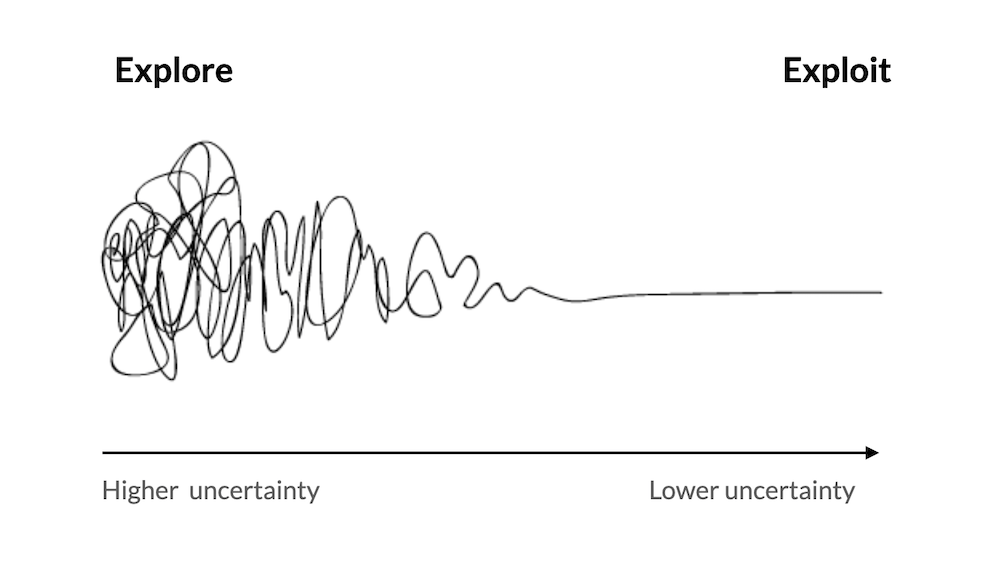
"We found that the best strategy is to briefly switch into explore mode when uncertainty is too high, and then switch back to exploit mode when uncertainty is back down." 

"If you go to a grocery store, you'll notice people standing in line will change between being stationary and moving around while waiting," Cowan said. "We think that's the same thing going on, that to maintain a stable balance you actually have to occasionally move around and excite your sensors like the knifefish. We found the statistical characteristics of those movements are ubiquitous across a wide range of animals, including humans." 

"Not a single study that we found in the literature violated the rules we discovered in the electric fish, not even single-celled organisms like amoeba sensing an electric field."

via Johns Hopkins University: Mode switching in organisms for solving explore-versus-exploit problems, Nature Machine Intelligence (2023). DOI: 10.1038/s42256-023-00745-y


Exploration—not work—could be key to a vibrant local economy
Mar 2024, phys.org

Suprise!

Infrequent trips to places like restaurants and sports facilities - not the everyday office visit or school drop-off - accounted for the majority of differences in economic outcomes between neighborhoods.

The activities with the strongest predictive power included French and New American restaurants, golf courses, hockey rinks, soccer games, and bagel shops. These kinds of activities accounted for just 2% of trips but explained more than 50% of the variation in economic outcomes between neighborhoods.

"Those irregular and infrequent activities are correlated with explorative behavior, the tendency of some groups to seek out opportunities, connect with different people, and create new businesses."

Again, trips to the office - where we earn our money - were not strongly associated with income or property values. Rather, it's how we spend our free time that drives the economic vibrancy of cities.

(Please don't tell the return-to-office people this or the people who run nyc).  

via University of Florida, MIT, and Northeastern: Shenhao Wang et al, Infrequent activities predict economic outcomes in major American cities, Nature Cities (2024). DOI: 10.1038/s44284-024-00051-7


Study uncovers neural mechanisms underlying foraging behavior in freely moving animals
Apr 2024, phys.org

They use an integrated wireless system for recording brain activity in the frontal areas of macaque brains to examine foraging tasks in real time.

Results indicate that foraging strategies are based on a cortical model of reward dynamics as animals freely explore their environment.

This research can potentially move in the direction of prosthetic devices to influence or bias choice, even noninvasively.

via Rice University Center for Neural Systems Restoration: Neda Shahidi et al, Population coding of strategic variables during foraging in freely moving macaques, Nature Neuroscience (2024). DOI: 10.1038/s41593-024-01575-w

Tuesday, January 9, 2024

Mind Reading Is Real Now And Also Your Brain Is Controlled by Lasers


Brain activity decoder can reveal stories in people's minds
May 2023, phys.org

Semantic decoder can translate a person's brain activity -- while listening to a story or silently imagining telling a story -- into a continuous stream of text to help people who are mentally conscious yet unable to physically speak, such as those debilitated by strokes, to communicate intelligibly again.

Does not require subjects to have surgical implants (ie noninvasive, holy grail of brain stuff).

Brain activity is measured using an fMRI scanner after extensive training of the decoder, in which the individual listens to 15 hours of podcasts in the scanner. 

Later, provided that the participant is open to having their thoughts decoded, their listening to a new story or imagining telling a story allows the machine to generate corresponding text from brain activity alone.

Back to reality: 

The result is not a word-for-word transcript. Instead, researchers designed it to capture the gist. Decoding worked only with cooperative participants who had participated willingly.Results for individuals on whom the decoder had not been trained were unintelligible.

If participants on whom the decoder had been trained later put up resistance -- for example, by thinking other thoughts -- results were similarly unusable. Tactics like thinking of animals or quietly imagining telling their own story let participants easily and completely thwart the system.

Afterthoughts:

So you need to insert yourself in an fMRI for this to work. You also need to give permission for it to read your thoughts. But if you think that advances in quantum materials isn't going to put fMRIs in your baseball cap within the next 20 years, then you better start reading "terms and conditions" more carefully from now on. They even mention their tech can be translated to a newer form of MRI called functional near-infrared spectroscopy (fNIRS), a "portable brain-imaging system".

via University of Texas at Austin: Semantic reconstruction of continuous language from non-invasive brain recordings, Nature Neuroscience (2023). DOI: 10.1038/s41593-023-01304-9


AI tool generates video from brain activity
May 2023, phys.org

On the heels of the UT Austin paper above, although I can't help but be skeptical of this one:

Watching 20 hours worth of movies in an fMRI, plus Stable Diffusion, gets you a dream recorder. 

Also, you heard it folks: Dream researcher Daniel Oldis, working with a colleague at the Cognitive Neuroscience Lab at the University of Texas, Austin.

Dream researcher.

via Researchers at the National University of Singapore and the Chinese University of Hong Kong: Zijiao Chen et al, Cinematic Mindscapes: High-quality Video Reconstruction from Brain Activity, arXiv (2023). DOI: 10.48550/arxiv.2305.11675

AI Art - Human brain carbon fiber cybernetic biomechanical cymatics 2 - 2023

40 Hz vibrations reduce Alzheimer's pathology, symptoms in mouse models
May 2023, phys.org

Non-invasive sensory stimulation of 40 Hz gamma frequency brain rhythms can reduce Alzheimer's disease pathology and symptoms, already shown with light and sound by multiple research groups in mice and humans, can now extend to tactile stimulation.

The MIT group is not the first to show that gamma frequency tactile stimulation can affect brain activity and improve motor function, but they are the first to show that the stimulation can also reduce levels of the hallmark Alzheimer's protein phosphorylated tau, keep neurons from dying or losing their synapse circuit connections, and reduce neural DNA damage.

"This work demonstrates a third sensory modality that we can use to increase gamma power in the brain" 

In case you were wondering:

To produce the vibration stimulation, the researchers placed mouse cages over speakers playing 40 Hz sound, which vibrated the cages. Mice received six weeks of vibration stimulation. 

And since this all sounds so dubious, we need some background:

In a series of papers starting in 2016, a collaboration led by Tsai's lab has demonstrated that light flickering and/or sound clicking at 40 Hz (a technology called GENUS for Gamma Entrainment Using Sensory stimuli), reduces levels of amyloid-beta and tau proteins, prevents neuron death and preserves synapses and even sustains learning and memory in a variety of Alzheimer's disease mouse models.

Upcoming: MIT spin-off company Cognito Therapeutics has launched stage III clinical trials of light and sound stimulation as an Alzheimer's treatment.

Reminder: You don't need FDA approval for tactile stimulation. (As opposed to light or sound pulses, and as opposed to all the Alzheimer's drugs out there trying to get to market...).

via Picower Institute for Learning and Memory and the Aging Brain Initiative at MIT: Ho-Jun Suk et al, Vibrotactile stimulation at gamma frequency mitigates pathology related to neurodegeneration and improves motor function, Frontiers in Aging Neuroscience (2023). DOI: 10.3389/fnagi.2023.1129510


Exploring how psychedelic drugs affect a rat's brain
Aug 2023, phys.org

"Simultaneous Synchronization"

Researchers at Lund University have developed a technique for simultaneously measuring electrical signals from 128 areas of the brain in awake rats. They have then used the information to measure what happens to the neurons when the rats are given psychedelic drugs. The results show an unexpected and simultaneous synchronization among neurons in several regions of the brain.

But wait, because there's more:

Pär Halje and the research team was studying rats with Parkinson's disease that had problems with involuntary movements. The researchers discovered a tone -- an oscillation or wave in the electrical fields -- of 80 hertz in the brains of the rats with Parkinson's disease. It turned out that the wave was closely connected to the involuntary movements.

Now you know, 80 hertz. Although the above study said 40 hertz.

One important note on how this was done and why it's a big deal:

"For several of these areas, it is the first time anyone has successfully shown how individual neurons are affected by LSD in awake animals." 
We see that the neurons' activity synchronizes itself in a special way -- the waves in the brain go up and down essentially simultaneously in all parts of the brain where we are able to take measurements. This suggests that there are other ways in which the waves are communicated than through chemical synapses, which are relatively slow."

via Lund University: Ivani Brys et al, 5-HT2AR and NMDAR psychedelics induce similar hyper-synchronous states in the rat cognitive-limbic cortex-basal ganglia system, Communications Biology (2023). DOI: 10.1038/s42003-023-05093-6


Tuesday, November 28, 2023

Words, for the Corpus That Has It All


The following update to the 'list of crazy words you read when scanning science press headlines', 6 months from April 2023 to October 2023. This one is a big list, an avalanche of verbal programming; start your semantic engines.

Appropriately illustrated by artificial intelligence engine-generated images of Dental Art, starting with the above image, prompted by the words "Hyperrealistic pink tissue bloody gums slippery glistening" but I just call it Dental Art.


Researchers develop the first-ever ingestible electroceutical device to control appetite by hormone modulation
Apr 2023, phys.org

"Electroceuticals" - for the neuromodulation of the gut-brain axis 

via NYU: Khalil Ramadi et al, Bioinspired, ingestible electroceutical capsules for hunger-regulating hormone modulation, Science Robotics (2023). DOI: 10.1126/scirobotics.ade9676.


Meteosat-12: Europe's new weather satellite takes first photos
Apr 2023, BBC News

"Nowcasting" - (like forecasting but better) the ability to say with greater confidence that violent winds, lightning, hail or heavy downpours are about to strike a particular area; Europe's new weather satellite Meteosat-12 flies 36,000km above the Earth and takes pictures every 10 minutes

And the word nowcasting, in the wild: "The insights gained from linking lightning intensity to eruptive activity can provide better monitoring and nowcasting of aviation-related hazards during a large volcanic eruption, including ash cloud development and movement," Van Eaton said." -New study shows Tonga's Hunga eruption produced the most intense lightning ever recorded. Jun 2023. phys.org
https://phys.org/news/2023-06-tonga-hunga-eruption-intense-lightning.html ; and via American Geophysical Union: Alexa R. Van Eaton et al, Lightning Rings and Gravity Waves: Insights Into the Giant Eruption Plume From Tonga's Hunga Volcano on 15 January 2022, Geophysical Research Letters (2023). DOI: 10.1029/2022GL102341. https://dx.doi.org/10.1029/2022GL102341


'Bioprospecting' technique uncovers viruses that can kill deadly superbugs
May 2023, phys.org

"Bioprospecting" for viruses known as phages that can kill deadly superbugs; like "bioprospector" will be a word on someone's resume soon

via Monash University: Rhys A. Dunstan et al, Epitopes in the capsular polysaccharide and the porin OmpK36 receptors are required for bacteriophage infection of Klebsiella pneumoniae, Cell Reports (2023). DOI: 10.1016/j.celrep.2023.112551


DarkBERT learns language of the Dark Web
May 2023, phys.org

Fucking "DarkBERT" - A Language Model for the Dark Side of the Internet

FYI - "Surface Web content" (as opposed to "Dark Web content") I think what this is saying, without saying it, is that the internet is English, but the Dark Web is not, so they can't use the internet as their training model like we do with all the others.

via Institute for Critical Infrastructure Technology: Youngjin Jin et al, DarkBERT: A Language Model for the Dark Side of the Internet, arXiv (2023). DOI: 10.48550/arxiv.2305.08596


Combining twistronics with spintronics could be the next giant leap in quantum electronics
Jun 2023, phys.org

I try to keep up, but -- "Twistronics", "spintronics", and "tunable moiré magnetism"

via Tohoku University: Guanghui Cheng et al, Electrically tunable moiré magnetism in twisted double bilayers of chromium triiodide, Nature Electronics (2023). DOI: 10.1038/s41928-023-00978-0


Researchers grow bio-inspired polymer brains for artificial neural networks
Jul 2023, phys.org

Neuromorphic "wetware" - based on memristive devices via electropolymerization aka growing wires

via Osaka University and Hokkaido University: Naruki Hagiwara et al, Fabrication and Training of 3D Conductive Polymer Networks for Neuromorphic Wetware, Advanced Functional Materials (2023). DOI: 10.1002/adfm.202300903


New study reveals why defense against brain corrosion declines in people with Alzheimer's disease
Jul 2023, phys.org

"Brain corrosion" - Why yes, oxidative stress corrodes the brain, and that's called oxidative damage. Some might even call it "rust", brain rust. 

via Case Western Reserve University: Sara Cazzaro et al, Slingshot homolog-1–mediated Nrf2 sequestration tips the balance from neuroprotection to neurodegeneration in Alzheimer's disease, Proceedings of the National Academy of Sciences (2023). DOI: 10.1073/pnas.2217128120


Photonic time crystals could open the door to a new branch of optics
Jul 2023, phys.org

"Photonic Time Crystals" - they are the temporal version of photonic crystals, and in the optical domain could have profound implications for the science of light, enabling truly disruptive applications in the future

Just for background, and because this will all become the new computers of the next technological revolution -- "photonic crystals have a refractive index that oscillates periodically in space causing iridescence of precious minerals and insect wings for example."

via Technion-Israel Institute of Technology, Haifa, Israel, and Purdue University:  Eran Lustig et al, Time-refraction optics with single cycle modulation, Nanophotonics (2023). DOI: 10.1515/nanoph-2023-0126


Researchers put a new twist on graphite
Jul 2023, phys.org

"Interdimensional" - mixed dimensional materials, like embedding 2D graphene into 3D graphite

via University of Washington, Osaka University and the National Institute for Materials Science in Japan: Matthew Yankowitz, Mixed-dimensional moiré systems of twisted graphitic thin films, Nature (2023). DOI: 10.1038/s41586-023-06290-3.


Spontaneous quasi-crystal self-assembly observed using tiny vibrating magnetic spheres
Jul 2023, phys.org

"Spontaneous Crystals" aka "Spontaneous Quasi-Crystal Self-Assembly" - discovered sort of by accident

via Université Paris-Saclay: Andrea Plati et al, Quasi-crystalline order in vibrated granular matter, arXiv (2023). DOI: 10.48550/arxiv.2307.01643


Zentropy and the art of creating new ferroelectric materials
Aug 2023, phys.org

"Zentropy" - The "Z" in zentropy stands for the German word Zustandssumm, meaning "sum over states" of entropy, and alternatively considered a play on the term "zen" from Buddhism, and the idea is to consider how entropy can occur over multiple scales within a system to help predict potential outcomes of the system when influenced by its surroundings. It's also a parameter-free pathway to predicting how advanced materials behave. And in other words, it can integrate top-down statistical and bottom-up quantum mechanics to predict experimental measures of the system without "fitting parameters" to closely match real-world variables.

via Penn State: Zi-Kui Liu et al, Parameter-free prediction of phase transition in PbTiO3 through combination of quantum mechanics and statistical mechanics, Scripta Materialia (2023). DOI: 10.1016/j.scriptamat.2023.115480


Researchers use 'topological gardening' to achieve unexpected spin transport
Aug 2023, phys.org

Fastest forming word cluster in the sciences, that's all --

"Topological Gardening" - Although topological insulators conduct electricity only along their edges, and strictly in one direction, new science challenges that view by uncovering a new type of edge transport by manipulating edge states through bulk-edge interactions, similar to the pruning work done in gardening routines.

via Monash University: Yuefeng Yin et al, Extracting unconventional spin texture in two dimensional topological crystalline insulator bismuthene via tuning bulk-edge interactions, Materials Today Physics (2023). DOI: 10.1016/j.mtphys.2023.101168

Also: Qile Li et al, Localized Wannier function based tight-binding models for two-dimensional allotropes of bismuth, New Journal of Physics (2021). DOI: 10.1088/1367-2630/ac04c9


This fish doesn't just see with its eyes, it also sees with its skin
Aug 2023, phys.org

"Skin Vision" -- Hogfish can change color, and carry a gene for a light-sensitive protein called opsin that is activated in their skin, and that this gene is different from the opsin genes found in their eyes. Their skin is made of cells called chromatophores which contain pigment, with opsin proteins residing in a previously unknown cell type right underneath the chromatophore, which means that light striking the skin must pass through the pigment-filled chromatophores first before it reaches the light-sensitive layer, suggesting that their skin acts like internal Polaroid film, capturing changes in the light, so that they can "literally take a photo of their own skin from the inside".

via Duke University: Lorian Schweikert, Dynamic light filtering over dermal opsin as a sensory feedback system in fish color change, Nature Communications (2023). DOI: 10.1038/s41467-023-40166-4.


Scientists develop finger sweat test to detect antipsychotic drugs in patients
Aug 2023, phys.org

"Finger Sweat Test" - Scientists have now discovered a way to test the levels of common antipsychotic drugs (clozapine, quetiapine, or olanzapine) in the sweat from patients' fingerprints (and because blood tests are invasive and uncomfortable).

via University of Surrey: Noninvasive drug adherence monitoring of antipsychotic patients via finger sweat testing, Frontiers in Chemistry (2023). DOI: 10.3389/fchem.2023.1245089


Researchers prep fentanyl, heroin vaccines for human trials
Aug 2023, phys.org

"Heroin Vaccine" - Just the words heroin vaccine.

via University of Montana: Bethany Crouse et al, A TLR7/8 agonist increases efficacy of anti-fentanyl vaccines in rodent and porcine models, npj Vaccines (2023). DOI: 10.1038/s41541-023-00697-9


Crack vaccine research on rats could help babies of mothers who use cocaine—and reduce addiction
Oct 2023, phys.org

"Crack Vaccine" - Also. I have a feeling it doesn't end here. 

via Universidade Federal de Minas Gerais in Brazil: Rachel J. Stephenson et al, Anti-cocaine Vaccine Development: Where Are We Now and Where Are We Going?, Journal of Medicinal Chemistry (2023). DOI: 10.1021/acs.jmedchem.3c00366


Team simulates collective movement of worm blobs for future swarm robotic systems
Sep 2023, phys.org

"Swarm Ball", "Worm Ball", or "Swarm Robot Worm Ball" - systems of many individual components that must work collectively, using soft-bodied agents

(click on the article above for some high octane nightmare fuel)

via Tohoku University and Hiroshima University: Taishi Mikami et al, Elongating, entwining, and dragging: mechanism for adaptive locomotion of tubificine worm blobs in a confined environment, Frontiers in Neurorobotics (2023). DOI: 10.3389/fnbot.2023.1207374


Vulnerability to different COVID-19 mutations depends on previous infections and vaccination, study suggests
Oct 2023, phys.org

"Antigenic Cartography" - compares the similarity of different variants of the SARS-CoV-2 virus to measure how well human antibodies formed in response to infection with one virus respond to infection with a variant of that virus (and because they found that a person's immune response to SARS-CoV-2 depends on the variant they were previously exposed to)

via University of Cambridge's Center for Pathogen Evolution in the Department of Zoology: Samuel H. Wilks et al, Mapping SARS-CoV-2 antigenic relationships and serological responses, Science (2023). DOI: 10.1126/science.adj0070.


Next-generation printing: Precise and direct, using optical vortices
Oct 2023, phys.org

An "Optical Vortex Laser" - "Using a special laser beam known as an optical vortex, we have achieved stable printing of high-viscosity liquids that allows for the fabrication of microdroplet laser arrays and the micropatterning of conductive nanoinks, as well as bioinks for cell scaffolds, leading to the establishment of next-generation printed photonic or electronic devices."

via Osaka Metropolitan University:  Ken-ichi Yuyama et al, Fabrication of an Array of Hemispherical Microlasers Using Optical Vortex Laser-Induced Forward Transfer, ACS Photonics (2023). DOI: 10.1021/acsphotonics.3c01005


Photonic crystals bend light as though it were under the influence of gravity
Oct 2023, phys.org

"Pseudogravity" - replicating the effects of gravity

Also, they don't say moiré but they describe it: Kitamura and her colleagues modified photonic crystals by introducing lattice distortion; gradual deformation of the regular spacing of elements, which disrupted the grid-like pattern of protonic crystals. This manipulated the photonic band structure of the crystals, resulting in a curved beam trajectory in-medium—just like a light-ray passing by a massive celestial body such as a black hole.

via Tohoku University: Kanji Nanjyo et al, Deflection of electromagnetic waves by pseudogravity in distorted photonic crystals, Physical Review A (2023). DOI: 10.1103/PhysRevA.108.033522


Sabotage tool takes on AI image scrapers
Oct 2023, phys.org

"Data poisoning" - the tool named Nightshade manipulates image pixels that will alter the output during training but are not visible to the naked eye prior to processing. The tool is meant to "poison" graphics appropriated by AI companies to train image-generating models. "A moderate number of Nightshade attacks can destabilize general features in a text-to-image generative model, effectively disabling its ability to generate meaningful images," Zhao said. 

via University of Chicago: Shawn Shan et al, Prompt-Specific Poisoning Attacks on Text-to-Image Generative Models, arXiv (2023). DOI: 10.48550/arxiv.2310.13828