Showing posts with label diamonds. Show all posts

Wednesday, January 10, 2024

The Atoms Themselves Are a Computer


Skepticism about Microsoft results regarding robust quantum bits
May 2023, phys.org

Correction -- "Researchers at the University of Basel have now dampened expectations of using Majorana particles for computation in the near future ... results published by Microsoft in 2022, according to which Majorana particles had been detected in the labs of the company, may not hold water"

Just a general reminder that not everything is true just because science says so, sometimes the true things get retracted too -- "both the current anomaly and the superconducting properties can be reproduced by a small amount of disorder from impurities inside the nanowire."

Also a reminder that Majorana fermions are an irresistible paradox of nature in that they contain both their own particle and anti-particle. They're expected to exist, but they've never been found. 

via University of Basel: Richard Hess et al, Trivial Andreev Band Mimicking Topological Bulk Gap Reopening in the Nonlocal Conductance of Long Rashba Nanowires, Physical Review Letters (2023). DOI: 10.1103/PhysRevLett.130.207001


Quantum matter breakthrough - Tuning density waves
May 2023, phys.org

Cold atomic gas can be programmed, so the atoms themselves are a computer because of the way they interact. In this case, the atoms are lithium, which were cooled, trapped in an optical cavity, and turned into a crystal, although how can a crystal be a wave, right? Quantum something.

via EPFL Ecole Polytechnique Federale de Lausanne: Jean-Phillipe Brantut, Density-wave ordering in a unitary Fermi gas with photon-mediated interactions, Nature (2023). DOI: 10.1038/s41586-023-06018-3.


Unveiling quantum gravity - New results from IceCube and Fermi data
Jun 2023, phys.org

Researchers examined a quantum-gravity model of particle propagation in which the speed of ultrarelativistic particles decreases with rising energy -- they used gamma-ray bursts observed by the Fermi telescope and ultra-high-energy neutrinos detected by the IceCube Neutrino Observatory, testing the hypothesis that some neutrinos and some gamma-ray bursts might have a common origin but are observed at different times as a result of the energy-dependent reduction in speed.

(Findings are preliminary, but) "By combining data from IceCube and Fermi, we found preliminary evidence supporting quantum gravity models that predict this effect. This marks a significant milestone in the field of quantum gravity research since it is the first time that such a level of quantum gravity-supportive statistical evidence is found," says corresponding author, Professor Giovanni Amelino-Camelia of the University of Naples on behalf of the team.

"Supportive statistical evidence" never sounded so science fiction.

via University of Naples Federico II, University of Wroclaw, and University of Bergen: Giovanni Amelino-Camelia et al, Could quantum gravity slow down neutrinos?, Nature Astronomy (2023). DOI: 10.1038/s41550-023-01993-z

AI Art - Tiny Machines - 2023

New device opens door to storing quantum information as sound waves
Jun 2023, phys.org

"Phonon" -- the sound equivalent of a light particle called a photon

To understand how a sound wave can store information, imagine an extremely echoey room. Now, let's say you need to remember your grocery list for the afternoon, so you open the door to that room and shout, "Eggs, bacon, and milk!" and shut the door. An hour later, when it's time to go to the grocery store, you open the door, poke your head inside, and hear your own voice still echoing, "Eggs, bacon, and milk!" You've just used sound waves to store information.

I mean if you can store light, you can store sound right?

via California Institute of Technology: Alkim Bozkurt et al, A quantum electromechanical interface for long-lived phonons, Nature Physics (2023). DOI: 10.1038/s41567-023-02080-w


Could quantum gravity models arising from holography explain cosmological acceleration?
Jun 2023, phys.org

"We now have fully consistent models of quantum gravity via an approach called holography, where the gravitational physics is encoded in a simpler, lower dimensional non-gravitational quantum system."

"We observed that quantum gravity models arising from holography can naturally explain cosmological acceleration in a novel way, with a changing dark energy that eventually becomes negative," Van Raamsdonk said. "We don't know for sure if our universe works this way, but it's something that we can look for in cosmological observations."

via University of Maryland and University of British Columbia: Stefano Antonini et al, Accelerating Cosmology from a Holographic Wormhole, Physical Review Letters (2023). DOI: 10.1103/PhysRevLett.130.221601


Scientists edge toward scalable quantum simulations on a photonic chip
Jun 2023, phys.org

Oh no you didn't! "quantum-correlated synthetic crystal"

What he really means: "Scientists have made an important step toward developing computers advanced enough to simulate complex natural phenomena at the quantum level. While these types of simulations are too cumbersome or outright impossible for classical computers to handle, photonics-based quantum computing systems could provide a solution."

via University of Rochester: Usman A. Javid et al, Chip-scale simulations in a quantum-correlated synthetic space, Nature Photonics (2023). DOI: 10.1038/s41566-023-01236-7
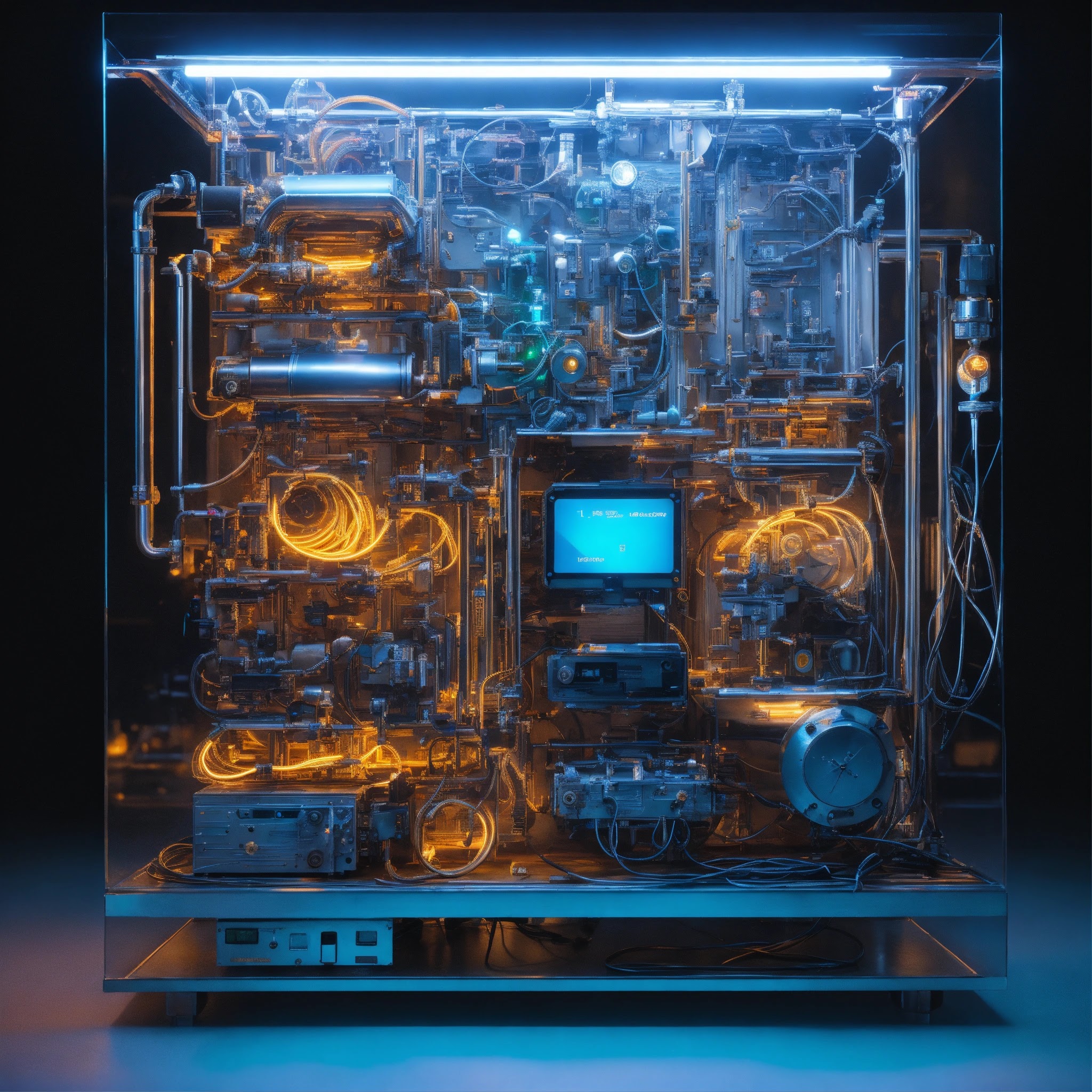
AI Art - Many Parts High Tech - 2023

Scientists observe first evidence of 'quantum superchemistry' in the laboratory
Aug 2023, phys.org

In the experiments, the scientists cooled down cesium atoms and coaxed them into the same quantum state. Next, they watched as the atoms reacted to form molecules.

In ordinary chemistry, the individual atoms would collide, and there's a probability for each collision to form a molecule. However, quantum mechanics predicts that atoms in a quantum state perform actions collectively instead.

"You are no longer treating a chemical reaction as a collision between independent particles, but as a collective process," explained Chin. "All of them are reacting together, as a whole."

One consequence is that the reaction happens faster than it would under ordinary conditions. In fact, the more atoms in the system, the faster the reaction happens.

And also, the reaction was taking place as a three-body interaction more often than as a two-body interaction (three atoms would collide; two would form a molecule, and the third remained single).

via James Franck Institute, Enrico Fermi Institute and U of Chicago: Zhendong Zhang et al, Many-body chemical reactions in a quantum degenerate gas, Nature Physics (2023). DOI: 10.1038/s41567-023-02139-8


Research team simulates super diffusion on a quantum computer
Aug 2023, phys.org

We are actually using quantum computers now, that's it -- 

Quantum physicists have successfully simulated super diffusion in a system of interacting quantum particles on a quantum computer consisting of 27 superconducting qubits and is physically located in IBM's lab in Yorktown Heights in New York and programmed remotely from Dublin.

"We were interested in a particular regime where something called super-diffusion occurs due to the underlying physics being governed by something called the Kardar-Parisi-Zhang equation. This is an equation which typically describes the stochastic growth of a surface or interface like how the height of snow grows during a snowstorm, how the stain of a coffee cup on cloth grows with time, or how a fluff fire grows. The propagation is known to give super diffusive transport." (follow the link above for a cool video of a poplar or cottonwood fluff fire)

"Consider the 27 qubits on this particular device. In quantum mechanics the state of such a system is described mathematically by an object called a wave function. In order to use a standard computer to describe this object you require a huge number of coefficients to be stored in memory and the demands scale exponentially with the number of qubits; roughly 134 million coefficients, in the case of this simulation."

"As you grow the system to say 300 qubits you would need more coefficients than there are atoms in the observable universe to describe such a system and no classical computer will be able to exactly capture the system's state. In other words we hit a wall when simulating quantum systems," Goold said.

via Trinity College of Dublin and IBM Dublin: Nathan Keenan et al, Evidence of Kardar-Parisi-Zhang scaling on a digital quantum simulator, npj Quantum Information (2023). DOI: 10.1038/s41534-023-00742-4


Researchers advance effort to turn diamonds into a quantum simulator
Oct 2023, phys.org

They bombarding diamonds with nitrogen atoms meant to dislodge the carbon atoms, creating flaws in an otherwise perfect crystal, that are then filled with electrons that have their own spin and magnetism, which are quantum properties that can be measured and manipulated for a wide range of applications.

via Washington University in St. Louis: Guanghui He et al, Quasi-Floquet Prethermalization in a Disordered Dipolar Spin Ensemble in Diamond, Physical Review Letters (2023). DOI: 10.1103/PhysRevLett.131.130401

Friday, December 16, 2022

Diamonds Are a Laser's Best Friend


Diamond mirrors for high-powered lasers
May 2022, phys.org

High-powered lasers do high-powered damage, so the materials that interact with them (like a laser gun) need to be strong. Diamonds with nano-structures etched into them do the job. 

via Harvard John A. Paulson School of Engineering and Applied Sciences: Haig A. Atikian et al, Diamond mirrors for high-power continuous-wave lasers, Nature Communications (2022). DOI: 10.1038/s41467-022-30335-2

Image credit: Thermoelectrics - Vienna University of Technology - 2022 [link]


'Life-like' lasers can self-organize, adapt their structure, and cooperate
Jul 2022, phys.org

I don't understand this at all. But I like the sound of it. 

Next, the team will study how to improve the lasers' autonomous behavior to render them even more life-like. 

via Imperial College London: Riccardo Sapienza, Self-organized lasers from reconfigurable colloidal assemblies, Nature Physics (2022). DOI: 10.1038/s41567-022-01656-2


Why lasers are being used to write inside diamonds
Oct 2022, BBC News

The laser can make atomic-scale changes to create circuitry inside the diamond. That could be useful for making instruments for radiation detection, where a diamond's durability is also an asset. Potentially such circuitry could also be used in quantum computers.


Researchers produce nanodiamonds capable of delivering medicinal and cosmetic remedies through the skin
Sep 2022, phys.org

Laser-based optical method quantifies nanodiamond penetration into layers of the skin and determines their location and concentration within body tissue in a non-invasive manner — eliminating the need for a biopsy. Much like trucks that make deliveries, artificial diamonds can deliver various medications to intended targets.

via Bar-Ilan University: Channa Shapira et al, Noninvasive Nanodiamond Skin Permeation Profiling Using a Phase Analysis Method: Ex Vivo Experiments, ACS Nano (2022). DOI: 10.1021/acsnano.2c03613

Sunday, December 8, 2019

Keeping Up with the Hertzbergs


How do you know your diamond isn't fake?
July 2019, BBC News

Being that it's not that hard to grow diamonds in a lab anymore, customers need new ways to tell whether their diamonds are real or not.

Identification codes can now be etched with lasers beneath the surface so it can't be tampered with, and small-scale diamond mines can use blockchain to prove they're not being tampered along the way to the customer.

Bottom line though, it's getting harder and harder to justify the diamond trade overall when you can just make them in a lab. Like the meatburgers made without meat - once you can no longer tell the difference, does it matter?

image source: The Z machine, the largest X-ray generator in the world, is located in Albuquerque, New Mexico. No idea what this has to do with diamonds, but it looks cool. Also, it rains diamonds on other planets.

Light Hype, Crystal Prediction, and Cerebral Diamonoids


Energy-free superfast computing invented by scientists using light pulses
May 2019, phys.org

Researchers demonstrate all-optical neural network for deep learning
Sep 2019, phys.org

Researchers teleport information within a diamond
June 2019, phys.org

Diamonds in your devices - Powering the next generation of energy storage
Dec 2019, phys.org

Boron-doped nanodiamond to be specific.

Crystal with a twist - scientists grow spiraling new material
Jun 2019, phys.org

"No one expected 2-D materials to grow in such a way. It's like a surprise gift," said Jie Yao, an assistant professor of materials science and engineering at UC Berkeley.

"While the shape of the crystals may resemble that of DNA, whose helical structure is critical to its job of carrying genetic information, their underlying structure is actually quite different. Unlike "organic" DNA, which is primarily built of familiar atoms like carbon, oxygen and hydrogen, these "inorganic" crystals are built of more far-flung elements of the periodic table, in this case, sulfur and germanium. And while organic molecules often take all sorts of zany shapes, due to unique properties of their primary component, carbon, inorganic molecules tend more toward the straight and narrow."

Cyborg organoids offer rare view into early stages of development
Aug 2019, phys.org

"If we can develop nanoelectronics that are so flexible, stretchable, and soft that they can grow together with developing tissue through their natural development process, the embedded sensors can measure the entire activity of this developmental process," said Jia Liu, Assistant Professor of Bioengineering at SEAS and senior author of the study. "

Brain waves detected in mini-brains grown in a dish
Sep 2019, phys.org

World first as artificial neurons developed to cure chronic diseases
Dec 2019, phys.org

Optimal solid state neurons, Nature Communications (2019).
DOI: 10.1038/s41467-019-13177-3 


***
We will all live inside diamonds.
Optical intelligentities in neuromorphic cerebral organoid diamonds, to be specific.

***

Scientists create a 'crystal within a crystal' for new electronic devices
Dec 2019, phys.org

Storing data in everyday objects
Dec 2019, phys.org
A method for marking products with a DNA "barcode" embedded in miniscule glass beads -- These nanobeads are used in industry as tracers for geological tests or as markers for high-quality food products, thus distinguishing them from counterfeits using a relatively short barcode consisting of a 100-bit code. This technology has now been commercialized by ETH spin-off Haelixa. 
They call the storage-form "DNA of Things" 
"All other known forms of storage have a fixed geometry: A hard drive has to look like a hard drive, a CD like a CD. You can't change the form without losing information," Erlich says. "DNA is currently the only data storage medium that can also exist as a liquid, which allows us to insert it into objects of any shape." 
A further application of the technology would be to conceal information in everyday objects, a technique experts refer to as steganography. 
Grass, Erlich and their colleagues used the technology to store a short film about this archive (1.4 megabytes) in glass beads, which they then poured into the lenses of ordinary glasses. "It would be no problem to take a pair of glasses like this through airport security and thus transport information from one place to another undetected," Erlich says. In theory, it should be possible to hide the glass beads in any plastic objects that do not reach too high a temperature during the manufacturing process.
Substance found in fossil fuels can transform into pure diamond
Mar 2020, phy.org

Wednesday, September 26, 2018

Smoke and Mirrors

Diamonds are forever.

If you don't know what a deep learning neural network is by now, I can no longer tell you, because there's enough buzz out there already.

If you like the idea of neural nets, quantum mechanics, photons, and metamolecular diamonds are going to take over our world and our bodies in the next 20 years, then you're in the right place, at the right time.

Because today makes an appearance of a neural net that uses light instead of electricity, and they even have a new name for their proof-of-concept device - a diffractive neural net. So get with it.

Image Source: The Crystal Dome at Swarovski in Kristallwelten, Austria


Notes:
Xing Lin et al. All-optical machine learning using diffractive deep neural networks, Science (2018). DOI: 10.1126/science.aat8084 

A neural network that operates at the speed of light
July 2018, Techxplore.com

Wednesday, March 28, 2018

Twisted Crystals


Japanese Kagome baskets inspired a new kind of super-crystal.

Japanese basket pattern inspires new material
Mar 2018, BBC

The molecules of this new electrically conducting crystal resemble the arrangement of traditional Japanese basket-weaving patterns. (Can we call this a metacrystal, as in superconducting metamaterial + crystal? Are all metamaterials crystals?).

Also note the talk about quantum computers in this article. Supercomputing 2-dimensional quantum crystals; you can't talk about one without the other. And you can't think about the future without seeing humanity as a bunch of data-pushing filaments stretching across the solar system.

Let's not forget Alex Grey's Universal Mind Lattice, also a point of inspiration, although less practical than a Japanese basket.


Monday, March 5, 2018

News These Days


Sometimes it's just too hard to keep up:


Walking crystals may lead to new field of crystal robotics
Feb 2018, phys.org

Researchers have demonstrated that tiny micrometer-sized crystals—just barely visible to the human eye—can "walk" inchworm-style across the slide of a microscope.

Other crystals are capable of different modes of locomotion such as rolling, flipping, bending, twisting, and jumping. In the future, these moving crystals may open the doors to the development of crystal-based robots. -phys.org


Scientists observe a new quantum particle with properties of ball lightning
Mar 2018, phys.org

"It is remarkable that we could create the synthetic electromagnetic knot, that is, quantum ball lightning..."


Want more efficient simulators? Store time in a quantum superposition
Mar 2018, phys.org

Want more efficient simulators? Store time in a quantum superposition.

[Really not following this one, but quantum time simulators? Yes.]


Graphene material strengthens nerve signaling in the brain
Mar 2018, phys.org

Just when you thought we were done talking about graphene for a while...

Not only can you grow brain cells on a sheet of graphene, but it also enhances signaling of those brain cells, AND, no surprise that all this comes as a complete surprise to the researchers (this happens a lot with graphene).

Thursday, June 8, 2017

Liquid Crystals


I'm thinking the shapeshifting liquid nitrogen guy from Terminator, but this time it's made of crystals.

New quantum liquid crystals may play role in future of computers
Apr 2017, phys.org

"Liquid crystals fall somewhere in between a liquid and a solid: they are made up of molecules that flow around freely as if they were a liquid but are all oriented in the same direction, as in a solid. Liquid crystals can be found in nature, such as in biological cell membranes. Alternatively, they can be made artificially—such as those found in the liquid crystal displays commonly used in watches, smartphones, televisions, and other items that have display screens."

Sunday, August 7, 2016

More Crystals Still


Crystal
Gizmodo, 2016

(Please excuse the fact that I’m posting my science news via gizmodo, I just take it as it comes.)

Quasi crystals have been known for a bit, but "nobody had found a naturally occurring quasicrystal until Princeton physicist Paul Steinhardt stumbled upon one in 2007" (Gizmodo, 2016)

Also, Neal Stephenson, in his mindf***ing Anathema, makes reference to a similar aperiodic repetition in his telling of a mindgame similar to chess where one tries to arrange different tiles in a crazy complex pattern that looks random but in fact uses some deep math to get there...(I think the game is called a tangram.)

Interlinks from Network Address:
The Extended Phenotype: The Long Reach of the Gene

New type of animated crystal structure discovered

“The trio readily acknowledges that they have no idea if such crystals actually exist in the real world but suggest it might be possible that they are in atomic nuclei or in electrons in solids—finding them would be a challenge, however, because they would have to be seen in action, a single snapshot would not convey the motion required to see the symmetry. They also suggest that their new crystal structure could lead to some new math as was the case when static crystal structure math led to applications in number theory and even error correction in computer applications.”

Teaching a machine to spot a crystal
Jun 2018, phys.org

Crystallizing proteins is hard—really hard. Unlike the simple atoms and molecules that make up common crystals like salt and sugar, these big, bulky molecules, which can contain tens of thousands of atoms each, struggle to arrange themselves into the ordered arrays that form the basis of crystals.

"What allows an object like a protein to self-assemble into something like a crystal is a bit like magic," Charbonneau said.