Showing posts with label paradigms. Show all posts

Monday, April 14, 2025

Post-Post Consumerism


What point are we at in the breakdown of the consumer economy, I forget. Here the tech sector bubble begins to pop, which is probably the least surprising development in the past couple years:

Apple working to update AI feature after BBC complaint
Dec 2024, BBC News

Apple, the one company who waited to jump into the artificial arena of artificial intelligence, finally jumps, and day one produces completely hallucinated and outright dangerous headlines about world news, but while pretending to be the BBC, because when the average person reads a headline summary as coming from the BBC, they will assume it comes from the BBC, go figure. BBC asks Apple to stop, and they refuse, and this reminds us who is really in control. Large corporations are in control. Until they aren't large anymore, of course.  

Unrelated image credit: AI Art - Sandwich Man 1 - 2024

Thomson Reuters Wins First Major AI Copyright Case in the US
Feb 2025, Wired Magazine

“None of Ross’s possible defenses holds water. I reject them all,” wrote US Circuit Court Judge Stephanos Bibas in a summary judgement. (Bibas was sitting by designation in the US District Court of Delaware.) [Ross is the AI startup that stole from Reuters.]

The main argument was this: "Ross “meant to compete with Westlaw [Reuters' legal branch] by developing a market substitute.” And that's not considered fair use under copyright law. 

Here's some notes of my own while reading law blogs on the decision:
unexpected, landmark case, pivotal, substantial, significant implication; licensing could become critical; financial burden forced Ross to cease operation; major distinction between NLP (Ross) and LLM (all the rest, like Cohere)

Google parent Alphabet’s earnings disappoint Wall Street amid stiff AI competition
Feb 2025, The Guardian

“Although it’s still well insulated, Google’s advantages in search hinge on its ubiquity and entrenched consumer behavior." This year “could be the year those advantages meaningfully erode as antitrust enforcement and open source AI models change the game. And Cloud’s disappointing results suggest that AI-powered momentum might be beginning to wane just as Google’s closed model strategy is called into question by DeepSeek.”

Closed model strategy!! Fightin words


And here's a list; keeping track of the history, as it happens: 

Ford Motor Co sues Blue Cross Blue Sheild in anti-trust case over 'astronomical' profits
Jun 2023, Reuters

Google accuses Microsoft of antitrust violations over Azure cloud platform
Sep 2024, Ars Technica

Google accused of shadow campaigns redirecting antitrust scrutiny to Microsoft
Oct 2024, Ars Technica

FTX sues Binance for $1.76B in battle of crypto exchanges founded by convicts
Nov 2024, Ars Technica

Albertsons calls off merger and sues Kroger
Dec 2024, CNN Business

Beyonce and Adele publisher accuses firms of training AI on songs
May 2024, BBC News

Horizon insurance drops N.J.’s largest hospital system as in-network provider
Jan 2025, nj.com

Saturday, April 12, 2025

Quantums Incoming


This is the only time you will read an article about quantum physics where it's presented as not totally crazy, but "just like thermodynamics"

Quantum theory and thermodynamics: No contradiction with new entropy definition, study says
Jan 2025, phys.org

via Vienna University of Technology: Florian Meier et al, Emergence of a Second Law of Thermodynamics in Isolated Quantum Systems, PRX Quantum (2025). DOI: 10.1103/PRXQuantum.6.010309

Image credit: Artwork by Antoly Fomenko


Gravity from entropy: A radical new approach to unifying quantum mechanics and general relativity
Mar 2025, phys.org

A novel approach that derives gravity from quantum relative entropy works by treating the metric of spacetime as a quantum operator, a concept from quantum information theory, 

It's a new entropic action which quantifies the difference between the metric of spacetime and the metric induced by matter fields.

A key feature of the theory is the introduction of the G-field, an auxiliary field that acts as a Lagrangian multiplier.

"This work proposes that quantum gravity has an entropic origin and suggests that the G-field might be a candidate for dark matter. Additionally, the emergent cosmological constant predicted by our model could help resolve the discrepancy between theoretical predictions and experimental observations of the universe's expansion."

via Queen Mary, University of London: Ginestra Bianconi, Gravity from entropy, Physical Review D (2025). DOI: 10.1103/PhysRevD.111.066001


AI and adaptive optics propel free-space quantum communication by solving atmospheric turbulence challenges
Mar 2025, phys.org

TAROQQO is a a turbulence prediction tool based on Recurrent Neural Networks. By employing real-time weather data - including humidity, solar radiation, temperature, pressure, and a turbulence parameter known as Cn²— TAROQQO can accurately predict turbulence strength up to 12 hours in advance, offering a time resolution as precise as one minute. 

via University of Ottawa, National Research Council Canada and the Max Planck Institute for the Science of Light: Tareq Jaouni et al, Predicting atmospheric turbulence for secure quantum communications in free space, Optics Express (2025). DOI: 10.1364/OE.546606

Also: Lukas Scarfe et al, Fast adaptive optics for high-dimensional quantum communications in turbulent channels, Communications Physics (2025). DOI: 10.1038/s42005-025-01986-6


First operating system for quantum networks paves the way for practical internet applications
Mar 2025, phys.org

Steps must be taken - The quantum network operating system, known as QNodeOS, is fully programmable, meaning that applications can be run at a high level, just like on classical operating systems such as Windows or Android. 

via Quantum Internet Alliance at TU Delft, QuTech, University of Innsbruck, INRIA and CNRS: Stephanie Wehner, An operating system for executing applications on quantum network nodes, Nature (2025). DOI: 10.1038/s41586-025-08704-w.


A new approach to reduce decoherence in superconducting qudit-based quantum processors
Feb 2025, phys.org

Another reminder they're doing these as experiments in real systems that work today, these aren't just theory: "and experimentally verified on a superconducting transmon processor"

via University of Southern California and University of California-Berkeley: Vinay Tripathi et al, Qudit Dynamical Decoupling on a Superconducting Quantum Processor, Physical Review Letters (2025). DOI: 10.1103/PhysRevLett.134.050601. 
https://dx.doi.org/10.1103/PhysRevLett.134.050601 

Saturday, January 11, 2025

We Are Not Ready for the Topological Universe


If you are like me, then you think the universe is like a big box, with all the things in it. And if you, like me, learned about Einstein and gravity and relativity in grade school, then you know that inside the big box, the space isn't exactly uniform, that it warps as it nears objects, because gravity. 

But one day soon, in grade school, people will learn that the big box isn't just warped by gravity, but that it's not a box at all. The universe might be more like a jumbled mess of intersecting toroids, bubbles and tubes. 

Anticipating future discoveries: Scientists explore nontrivial cosmic topology
May 2024, phys.org

Discussing his motivation to pursue this work, he said, "The possibility that the universe has 'interesting' topology is entirely within our Standard Model of physics but is nevertheless typically regarded as exotic."

"I have long been concerned that we would miss an extraordinary discovery about our universe by just looking the other way. In the meantime, there is growing evidence that the universe is not 'statistically isotropic,' i.e. that physics is the same in all directions. Topology is a very natural way for anisotropy to creep into our universe."

via the COMPACT collaboration of scientists including from from Case Western Reserve University: Yashar Akrami et al, Promise of Future Searches for Cosmic Topology, Physical Review Letters (2024). DOI: 10.1103/PhysRevLett.132.171501

Image credit: The above image is the "first topological frequency comb", and is (ostensibly) a photograph taken by Emily Edwards for the University of Maryland and National Institute of Standards and Technology Joint Quantum Institute, where she is recognized for her ability to communicate with the public about quantum science. (I say the image is ostensibly a photograph, because it just looks way too good to be real, and part of me thinks it's just not properly cited. [link]


New measurements of gravitational anomaly at low acceleration favor modified gravity, researcher claims
Sep 2024, phys.org

When Kuhn talked about revolutions, this is what he was talking about. I'm too young to have felt the excitement upon discovering that E equals MC2, or that gravity affects time. But now I see. 

They keep finding it between binary stars - It's the breakdown of Newtonian gravity at low acceleration, and it's called modified Newtonian dynamics, or MoND, or Milgromian dynamics, because it was introduced 40 years ago by Mordehai (Moti) Milgrom.

While these consistent results are arresting, unlimited reproductions and confirmations are needed for the reported gravitational anomaly to become a true scientific fact. Also, the reported gravitational anomaly will have to be better characterized continually to provide useful constraints on theories.

via Sejong University: Kyu-Hyun Chae, Measurements of the Low-acceleration Gravitational Anomaly from the Normalized Velocity Profile of Gaia Wide Binary Stars and Statistical Testing of Newtonian and Milgromian Theories, The Astrophysical Journal (2024). DOI: 10.3847/1538-4357/ad61e9

Also: Hernandez et al, A critical review of recent Gaia wide binary gravity tests, Monthly Notices of the Royal Astronomical Society (2024). DOI: 10.1093/mnras/stae1823


Observational study supports century-old theory that challenges the Big Bang
Sep 2024, phys.org

Big Bang theory suggests the universe started to expand 13.8 billion years ago. At the same time, preeminent astronomer Fritz Zwicky proposed that galaxies that were more distant from Earth did not really move faster, but the red shift was because the light photons lose their energy as they travel through space. And it's called the Tired Light theory.

"The tired light theory was largely neglected, as astronomers adopted the Big Bang theory as the consensus model of the universe," Shamir said. "But the confidence of some astronomers in the Big Bang theory started to weaken when the powerful James Webb Space Telescope saw first light.

via Kansas State University: Lior Shamir, An Empirical Consistent Redshift Bias: A Possible Direct Observation of Zwicky's TL Theory, Particles (2024). DOI: 10.3390/particles7030041


Post Script:
New photonic chip spawns nested topological frequency comb
Jun 2024, phys.org
https://phys.org/news/2024-06-photonic-chip-spawns-topological-frequency.html

The First Topological Frequency Comb - shines with evenly spaced pristine frequency spikes, relies on a small silicon nitride chip patterned with hundreds of microscopic rings arranged in a two-dimensional grid; a complex pattern of interference takes input laser light and circulates it around the edge of the chip while the material of the chip itself splits it up into many frequencies.

via the University of Maryland and National Institute of Standards and Technology Joint Quantum Institute: Christopher J. Flower et al, Observation of topological frequency combs, Science (2024). DOI: 10.1126/science.ado0053

Sunday, August 4, 2024

Paradigms Afoot


AKA To Kuhn the Universe

Yes this is old news, but it's a big deal so it can't be ignored. The first article is like the basis of teleportation, where we make molecules dance from a million miles away, but instantly. The second article is about how the paradigm that's scripted science fo the past 300 hundred years or so (gravity and classical physics) is collapsing... "Shifting" if you prefer your revolutions to sound less hyperbolic. 

Physicists 'entangle' individual molecules for the first time, hastening possibilities for quantum computing
Dec 2023, phys.org

They first picked a molecular species that is both polar and can be cooled with lasers. Individual molecules were then picked up with optical tweezers. Next, they encoded a qubit into a non-rotating and rotating state of the molecule. Then they used microwave pulses to make individual molecules interact with one another. Then they implement a two-qubit gate that entangled two molecules.

via Princeton: Connor M. Holland et al, On-demand entanglement of molecules in a reconfigurable optical tweezer array, Science (2023). DOI: 10.1126/science.adf4272.

Also: Yicheng Bao et al, Dipolar spin-exchange and entanglement between molecules in an optical tweezer array, Science (2023). DOI: 10.1126/science.adf8999.

Also: Augusto Smerzi et al, Entanglement with tweezed molecules, Science (2023). DOI: 10.1126/science.adl4179.


Scientists closer to finding quantum gravity theory after measuring gravity on microscopic level
Feb 2024, phys.org

Scientists  have successfully detected a weak gravitational pull on a tiny particle using superconducting traps and levitating magnets to detect a weak gravitational pull of 30aN, on a tiny particle measuring 0.43mg, and at a hundredth of a degree above absolute zero.

via University of Southampton and Leiden University in the Netherlands: Tim Fuchs et al, Measuring gravity with milligram levitated masses, Science Advances (2024). DOI: 10.1126/sciadv.adk2949. 


New research suggests that our universe has no dark matter
Mar 2024, phys.org

Rajendra Gupta, a physics professor at the Faculty of Science, used a combination of the covarying coupling constants (CCC) and "tired light" (TL) theories (the CCC+TL model) to reach this conclusion.

This model combines two ideas—about how the forces of nature decrease over cosmic time and about light losing energy when it travels a long distance. It's been tested and has been shown to match up with several observations, such as about how galaxies are spread out and how light from the early universe has evolved.

This discovery challenges the prevailing understanding of the universe, which suggests that roughly 27% of it is composed of dark matter and less than 5% of ordinary matter, remaining being the dark energy.

"In standard cosmology, the accelerated expansion of the universe is said to be caused by dark energy but is in fact due to the weakening forces of nature as it expands, not due to dark energy."

via University of Ottawa: Rajendra P. Gupta, Testing CCC+TL Cosmology with Observed Baryon Acoustic Oscillation Features, The Astrophysical Journal (2024). DOI: 10.3847/1538-4357/ad1bc6


Wednesday, January 10, 2024

Gravity Is Dead


AKA Kuhning the Universe

Smoking-gun evidence for modified gravity at low acceleration from Gaia observations of wide binary stars
Aug 2023, phys.org

Conclusive evidence for the breakdown of standard gravity in the low acceleration limit from a verifiable analysis of the orbital motions of long-period, widely separated, binary stars.

Them fightin words.

(Although this was suggested 40 years ago by theoretical physicist Mordehai Milgrom at the Weizmann Institute in Israel in a new theoretical framework called modified Newtonian dynamics (MOND) or Milgromian dynamics in current usage.)

The significance is very high meeting the conventional criteria of 5 sigma for a scientific discovery.

via Sejong University in Seoul: Kyu-Hyun Chae, Breakdown of the Newton–Einstein Standard Gravity at Low Acceleration in Internal Dynamics of Wide Binary Stars, The Astrophysical Journal (2023). DOI: 10.3847/1538-4357/ace101

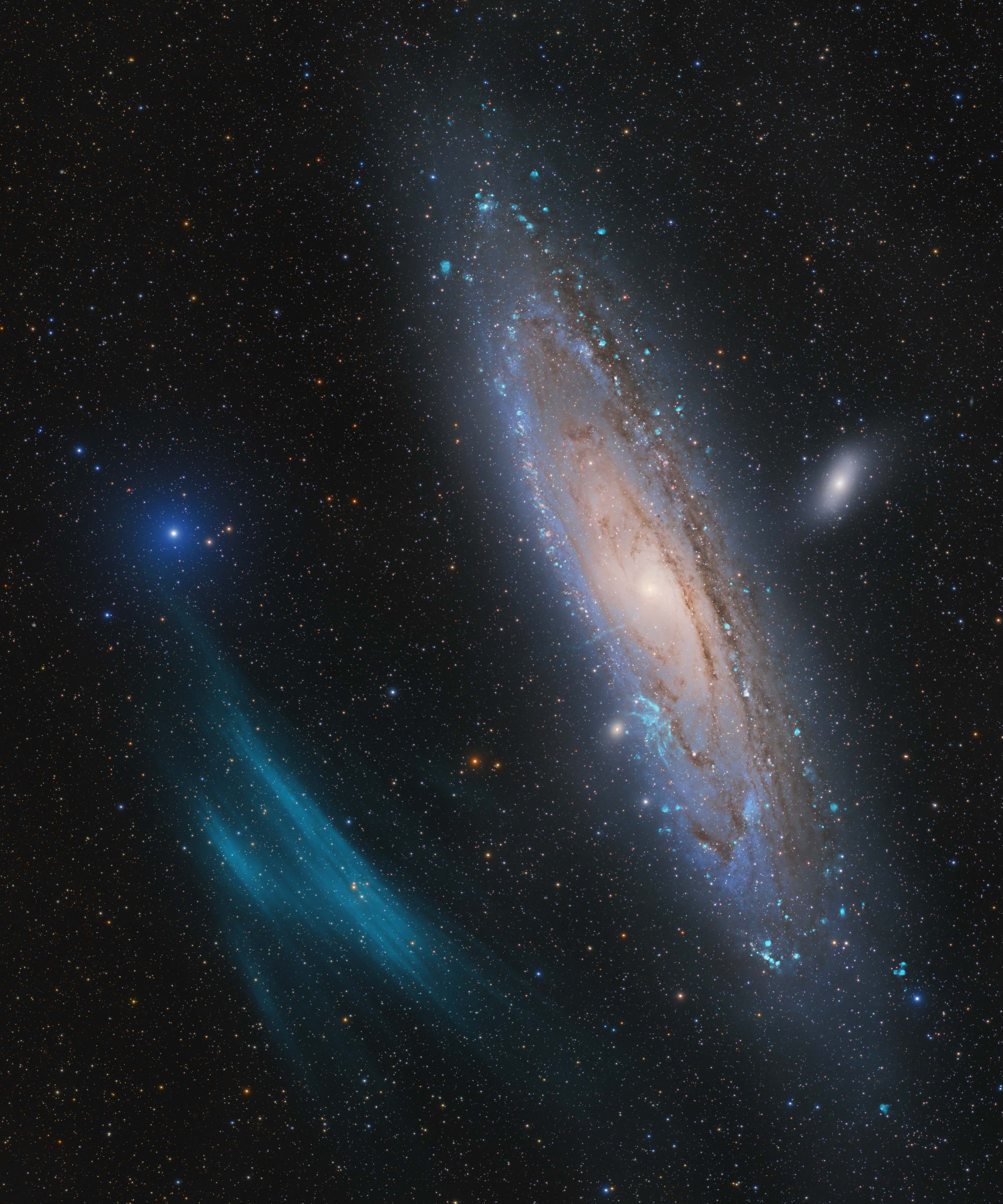
Image credit: Andromeda, Unexpected - Plasma Arc and Winner of the Astronomy Photographer of the Year by Marcel Drechsler, Xavier Strottner, Yanin Sainty - 2023 [link]

Mostly Unrelated Post Script: 
Evidence found of electromagnetic fields from electrical towers disrupting pollinating honeybees
May 2023, phys.org

Man come on.

Thursday, April 6, 2023

The Superluminal Observer


From the "rebel physicist" at University of Warsaw, and posted back in 2020, here's an attempt to explain what it's like to be the object that moves faster than light. 

Three time dimensions, one space dimension: Relativity of superluminal observers in 1+3 spacetime
Dec 2022, phys.org

The Superluminal World - Stretch your brain into this, the collapse of 3D space into 1D, or rather the flip from space to time dimensions.

I don't know why we had to wait for someone to say this, but why not? Why can't superluminal objects exist?

What happens when we assume—at least theoretically—that the world could be observable from superluminal frames of reference? There is a chance that this would allow the incorporation of the basic principles of quantum mechanics into the special theory of relativity. This revolutionary hypothesis of prof. Andrzej Dragan and prof. Artur Ekert from the University of Oxford presented for the first time in the article "Quantum principle of relativity" published two years ago in the New Journal of Physics. the latest conclusion is in the journal Classical and Quantum Gravity, titled "Relativity of superluminal observers in 1 + 3 spacetime", and is authored by a group of 5 physicists.

In their latest publication in the journal Classical and Quantum Gravity, titled "Relativity of superluminal observers in 1 + 3 spacetime", a group of 5 physicists goes a step further, presenting conclusions about the full four-dimensional spacetime.

via University of Warsaw and Center for Quantum Technologies of the National University of Singapore: Andrzej Dragan et al, Relativity of superluminal observers in 1+3 spacetime, Classical and Quantum Gravity (2022). DOI: 10.1088/1361-6382/acad60

Image credit: Neutron star merger - NASA's Goddard Space Flight Center, CI Lab - 2022


Post Script:
Time-synchronization is hard:
Network-crashing leap seconds to be abandoned by 2035, for at least a century
Nov 2022, Ars Technica

International Bureau of Weights and Measures (BIPM in its native French) just decided that Coordinated Universal Time, or UTC, would run without a leap second until 2135. 

Leap seconds in 2012 and 2017 caused multi-hour outages at companies including Reddit, Qantas, and Cloudflare. Many companies implemented a version of "leap smearing" to smooth out a leap second addition into micro-seconds spread across the globe throughout a day.


Monday, March 13, 2023

Scientists Startled, Puzzled and Shocked Over New Discoveries


Astrophysicists make observations consistent with the predictions of an alternative theory of gravity
Oct 2022, phys.org

"Puzzling discovery"

New method developed for counting stars:
MOND - MOdified Newtonian Dynamics, also called
MoND - Modified Newtonian Dynamics, (see what they did there)

"According to Newton's laws of gravity, it's a matter of chance* in which of the tails a lost star ends up," explains Dr. Jan Pflamm-Altenburg of the Helmholtz Institute of Radiation and Nuclear Physics. "So both tails should contain about the same number of stars. However, in our work we were able to prove for the first time that this is not true: In the clusters we studied, the front tail always contains significantly more stars nearby to the cluster than the rear tail."
*I thought they said God doesn't roll dice?!

via University of Bonn: Pavel Kroupa et al, Asymmetrical tidal tails of open star clusters: stars crossing their cluster's práh challenge Newtonian gravitation, Monthly Notices of the Royal Astronomical Society (2022). doi.org/10.1093/mnras/stac2563


Unique features of octopus create 'an entirely new way of designing a nervous system'
Nov 2022, phys.org

Totally unexpected about the octopus nervous system: a structure by which the intramuscular nerve cords (INCs), which help the animal sense its arm movement, connect arms on the opposite sides of the animal. The startling discovery provides new insights into how invertebrate species have independently evolved complex nervous systems.

via University of Chicago Medical Center: Adam Kuuspalu et al, Multiple nerve cords connect the arms of octopuses, providing alternative paths for inter-arm signaling, Current Biology (2022). DOI: 10.1016/j.cub.2022.11.007


Researcher finds a sweet new way to print microchip patterns on curvy surfaces
Nov 2022, phys.org

It was only as a last resort that he had even tried burying microscopic magnetic dots in hardened chunks of sugar—hard candy, basically—and sending these sweet packages to colleagues in a biomedical lab. The sugar dissolves easily in water, freeing the magnetic dots for their studies without leaving any harmful plastics or chemicals behind.

By chance, Zabow had left one of these sugar pieces, embedded with arrays of micromagnetic dots, in a beaker, and it did what sugar does with time and heat—it melted, coating the bottom of the beaker in a gooey mess.

"No problem," he thought. He would just dissolve away the sugar, as normal. Except this time when he rinsed out the beaker, the microdots were gone. But they weren't really missing; instead of releasing into the water, they had been transferred onto the bottom of the glass where they were casting a rainbow reflection.

Could regular table sugar be used to bring the power of microchips to new and unconventional surfaces?

(Yes)

via National Institute of Standards and Technology: G. Zabow, Reflow transfer for conformal three-dimensional microprinting, Science (2022). DOI: 10.1126/science.add7023


New measurements of galaxy rotation lean toward modified gravity as an explanation for dark matter
Dec 2022, phys.org

Modified Newtonian dynamics (MoND) or modified gravity model: 

Rather than the force of attraction as a pure inverse square relation, gravity has a small remnant pull regardless of distance. This remnant is only about 10 trillionths of a G, but it's enough to explain galactic rotation curves.

So the author of this paper looked at high-resolution velocity curves of 152 galaxies as observed in the Spitzer Photometry and Accurate Rotation Curves (SPARC) database. He found a shift in agreement with AQUAL. The data seems to support modified gravity over standard dark matter cosmology.

via Sejong University Department of Physics and Astronomy, Korea: Kyu-Hyun Chae, Distinguishing Dark Matter, Modified Gravity, and Modified Inertia with the Inner and Outer Parts of Galactic Rotation Curves, arXiv (2022). DOI: 10.48550/arxiv.2207.11069


Post Script:
A subtitled world: Uncovering the secrets of tickertape synesthesia
Feb 2023, phys.org

Tickertape synesthesia - transcribing the speech of others into text, automatically and involuntarily, these sounds will appear as imaginary subtitles floating before your eyes

A previous study estimated that up to 1.4% of the population could experience involuntary subtitles when hearing a human voice, but this figure remains uncertain. It's challenging to detect TTS subjects, who are generally unaware that they are distinguishable from the average person.

"Several participants in the study were shocked to learn that not everyone has built-in subtitles,"

Even more surprising: some subjects report that when they watch a foreign movie, a second level of subtitles—a product of their synesthesia—appears above the subtitles embedded in the video. Others have subtitled dreams and nightmares, which provide their oneiric activity with a cinematic dimension. Finally, since one-third of the participants knew of other cases of TTS in their family, the emergence of this form of synesthesia might have a genetic basis.

AKA "Orthographic representations"

via Paris Brain Institute: abien Hauw et al, Subtitled speech: Phenomenology of tickertape synesthesia, Cortex (2022). DOI: 10.1016/j.cortex.2022.11.005

Monday, February 27, 2023

The Revolution Will Be Fermions


Team develops graphene-based nanoelectronics platform
Dec 2022, phys.org

In metals, electric currents are carried by negatively charged electrons. But contrary to the researchers' expectations, their measurements suggested that the edge currents were not carried by electrons or by holes (a term for positive quasiparticles indicating the absence of an electron). Rather, the currents were carried by a highly unusual quasiparticle that has no charge and no energy, and yet moves without resistance. The components of the hybrid quasiparticle were observed to travel on opposite sides of the graphene's edges, despite being a single object.

The unique properties indicate that the quasiparticle might be one that physicists have been hoping to exploit for decades — the elusive Majorana fermion predicted by Italian theoretical physicist Ettore Majorana in 1937.

"Developing electronics using this new quasiparticle in seamlessly interconnected graphene networks is game changing," de Heer said.

via Georgia Institute of Technology: Vladimir S. Prudkovskiy et al, An epitaxial graphene platform for zero-energy edge state nanoelectronics, Nature Communications (2022). DOI: 10.1038/s41467-022-34369-4

Image credit: Anatoly Fomenko


Monday, September 19, 2022

Cyborg Team Convergence


Destiny of science modeled and explained in new study
Jul 2022, phys.org

Researchers modeled the evolution of convergence by analyzing millions of scientific works using machine learning etc. to identify several stages in the evolution of science, each characterized by a different form of convergence:
  1. Polymathic Convergence - early science to the Renaissance period, polymaths Aristotle and da Vinci, knowledge integration within the minds of singular scholars
  2. Disciplinary Divergence - theories developed within specific disciplines turned into generalized templates with broader applications, "convergence through divergence", Darwin's theory of evolution in biology
  3. Multi-Disciplinary Team Convergence - mid-20th century, experts from different disciplines work  together, knowledge integration takes place across teams of scientists with diverse expertise, the Manhattan Project.
  4. Polymathic Team Convergence - knowledge integration both within and across scholars, a mix of individual polymathic and multi-disciplinary team convergence, recent brain science research.
  5. Cyborg Team Convergence - polymathic scientists collaborate with artificial intelligence in mixed human-machine teams.
Note to Self: We are already at stage 5, because machine learning networks, although designed by scientists, are discovering things that we never knew, and sometimes things that we didn't even ask about, such as the Foodome project at Barabási Labs that discovered an unknown formula in the nutrient profiles of food, or the UC Berkeley crew that discovered a formula related to exoplanets hidden in the math of general relativity, or the DeepMind project that revealed a new theorem about knots (yes knots, trust me).

via University of Houston: From Polymaths to Cyborgs - Convergence Is Relentless. Ioannis Pavlidis, Ergun Akleman, Alexander M Petersen. American Scientist, July 2022. 

Image credit: Black Hole Merger Gravitational Waves - NASA C Henze - 2022

When I see the picture above, which somes to us via NASA, I think to myself "Arthur Dove meets Charles Burchfield", and now that we've figured out how to make robots metabolize and regurgitate our cultural artifacts back to us in visual form, we can see what that looks like:


Post Script: Good News
Government-funded scientific research reflects public interest, study finds
Jul 2022, phys.org

Jones and Wang also noted that the study emphasizes the value of using the large datasets available today to study other high-level questions about science as a public good in ways that were not previously possible.

via Northwestern University: Yian Yin et al, Public use and public funding of science, Nature Human Behaviour (2022). DOI: 10.1038/s41562-022-01397-5

Wednesday, July 24, 2019

Quantum Futures

It's been a while since we saw "Wegman Reading Two Books". This is one of my favorite pictures ever; I thought it made sense here.
I'm reading about quantum computers on the commute home from work. It's not the computers I'm interested in, and it's not the quantum part either. I'm not a computer scientist, or a quantum scientist. But I do like to think about the future, and if anything says "future", it's quantum computers.

There's a strong theme running in these articles though, the kind of thing I look for in articles about technology. In this case, the problem with quantum computing is that it works so differently from a classical computer, that we kind of don't even know what to do with it.

When tasked with devising a test to evaluate the performance of a quantum computer, a moment is revealed:
"I quickly ran into trouble trying to figure out how to run these [scripts] on the D-Wave machine. You need a huge shift in the way you think about problems, and I am a very straightforward thinker."
-Chris Lee for Ars Technica, 2019
It's a casual statement in a casual popular science article, but it's the unassuming bits like this that may be revealed as prescient in years to come. Like in 1890, "Why the heck would you want to screw anything else besides a lightbulb into this electrical light bulb socket??"
It's true, stuff like washing machines would be plugged into the 'light socket' via a cord designed specifically for a light socket; the dual-pronged plug that we are used to, in the US at least, didn't come until much later, and required a drastic paradigm shift in order to see electricity as serving anything but electric light.

Back to quantum computers. Things like this, when the technology forces us to reshape not only our thinking and not only the answers, but more importantly the questions that we ask, and the way we ask, and then ultimately the things we want and the things we care about, are what Kuhn was writing about in his Structures of Scientific Revolution.

Notes:
D-Wave 2000Q hands-on - Steep learning curve for quantum computing
Mar 2019, Ars Technica

Post Script:
The Structure of Scientific Revolutions
Thomas Kuhn, 1962

Science does not progress via linear accumulation of new knowledge, but undergoes periodic revolutions, also called "paradigm shifts" in which the nature of scientific inquiry within a particular field is abruptly transformed.

Thomas Kuhn - the man who changed the way the world looked at science
John Naughton, The Guardian, 2012


Sunday, June 3, 2018

Ripe Not Hype

MCEscher envisions Dyson Spheres long before graphene.

Slowly but surely, the promise of the metamaterial graphene is being fulfilled.

MIT engineers have developed a continuous manufacturing process that produces long strips of high-quality graphene.

Meanwhile, check out Isaac Arthur's far out futurism videos for ideas on what to do with all that magical metamaterial.

Scalable manufacturing process spools out strips of graphene for use in ultrathin membranes.
Apr 2018, MIT News

Monday, June 20, 2016

Beyond the Physical Horizon


This is a visual representation of the internet. Image source

phys.org, June 2016

Sometimes when I think about Kuhn’s paradigm shifts in science, I wonder if physics will ever be supplanted by something else, especially when considering that we are in the Information Age, one pivot away from the Industrial Age. Is information ultimately physical, or does it transcend the physical? Can information exist apart from the physical world?

Back on track, we have here in this mention of a quantum web is a glimpse of a potential future where network science (part graph science) is the new edge of science.

In this new study, thinking about quantum networks in light of abstract mathematical graphs really optimizes the architecture of the network. (A Scientist in the article declares that “a network is a physical system,” by the way.)

Notes:
Albert-László Barabási, head of Barabási Labs and author of two major books on network science as well as a full textbook on the subject:
Network Science [the textbook]

Inter-links from Network Address:
-on Barabási’s Bursts

Current News in Network Science (aka Connection Science?)
April 2016, phys.org


Sunday, December 23, 2012

Culture as Learned Probability System

Music, the Arts and Ideas
Leonard B. Meyer, U. of Chicago, 1967

CULTURE
“It is impossible to stand outside of culture, for the models and categories we use on conceptualizing and ordering the world are necessarily limited to, if not determined by, those which are provided by our particular culture.” (viii)

“A culture, like a musical style, is a learned probability system.” (p17, footnote 21)


MEANING
“Meaning is when stimulus does not fit expectation.”

“Meaning is the difference between expectation and actual.”

Meaning, being also a measure of the uncertainty between antecedent and consequent is also related to probability.

PROBABILITY SYSTEMS
“Once a musical style has become part of the habit responses of composers, performers, and practical listeners it may be regarded as a complex system of probabilities. That musical styles are internalized probability systems is demonstrated by the rules of musical grammar and syntax found in textbooks on harmony, counterpoint, and theory in general.”
In the Tonal Harmony of Western Music, the tonic chord is
-most often followed by the dominant
-frequently by the subdominant
-sometimes by the subdominant
In Counterpoint, after a large melodic skip, the melody
-usually moves in the opposite direction, filling in the tones passed over.

DEVIATION
occurs by:
Delay – of expectation/norm
Antecedent Ambiguity/Uncertainty – equally probably constituents may be envisaged
Unexpected/Improbable – within the specific context
-deviation requires meaning, or more specifically: active creation of new meaning, which occurs within the temporal/tonal expectations


INFORMATION
Information is measured by the randomness of the choices possible in a given situation. If a situation is highly organized and the possible consequents in the pattern process have a high degree of probability, the information (or entropy) is low.

If, however, the situation is characterized by a high degree of shuffledness so that the consequents are more or less equi-probable, then information (or entropy) is said to be high.

Perception:
“What we perceive as the present is the vivid fringe of memory tinged with anticipation.”
-A.N. Whitehead, The Concept of Nature, in G.J. Whitrow, The Natural Philosophy of Time, p83, in Meyers, p89.

“The practically cognized present is no knife-edge, but a saddle-back, with a certain breadth of its own in which we sit perched, and from which we look in two directions in time.”
-William James, Principles of Psychology, 1950, p609

Predictions create the future:
“Prediction itself – that is, belief about the probable future – may make an incalculable difference in it.”
-Herbert J. Muller, “Misuses of the Past”, p12, Horizon 1 (March 1959), on Meyer, p90


The Determinism vs. Free Will Problem
Might it not be that the problem stems from a failure to distinguish between the relatively undetermined, non-statistical processes characteristic of the level of individual choice and those forces which, more determined and quasi-statistical, are operative on the higher levels of sociocultural history. It may be that the problem of determinism vs. free will stems from a confusion of hierarchic levels of analysis. (p97)

SATURDAY, OCTOBER 6, 2012
TUESDAY, DECEMBER 4, 2012
TUESDAY, JULY 10, 2012