Monday, September 19, 2022

Cyborg Team Convergence


Destiny of science modeled and explained in new study
Jul 2022, phys.org

Researchers modeled the evolution of convergence by analyzing millions of scientific works using machine learning etc. to identify several stages in the evolution of science, each characterized by a different form of convergence:
  1. Polymathic Convergence - early science to the Renaissance period, polymaths Aristotle and da Vinci, knowledge integration within the minds of singular scholars
  2. Disciplinary Divergence - theories developed within specific disciplines turned into generalized templates with broader applications, "convergence through divergence", Darwin's theory of evolution in biology
  3. Multi-Disciplinary Team Convergence - mid-20th century, experts from different disciplines work  together, knowledge integration takes place across teams of scientists with diverse expertise, the Manhattan Project.
  4. Polymathic Team Convergence - knowledge integration both within and across scholars, a mix of individual polymathic and multi-disciplinary team convergence, recent brain science research.
  5. Cyborg Team Convergence - polymathic scientists collaborate with artificial intelligence in mixed human-machine teams.
Note to Self: We are already at stage 5, because machine learning networks, although designed by scientists, are discovering things that we never knew, and sometimes things that we didn't even ask about, such as the Foodome project at Barabási Labs that discovered an unknown formula in the nutrient profiles of food, or the UC Berkeley crew that discovered a formula related to exoplanets hidden in the math of general relativity, or the DeepMind project that revealed a new theorem about knots (yes knots, trust me).

via University of Houston: From Polymaths to Cyborgs - Convergence Is Relentless. Ioannis Pavlidis, Ergun Akleman, Alexander M Petersen. American Scientist, July 2022. 

Image credit: Black Hole Merger Gravitational Waves - NASA C Henze - 2022

When I see the picture above, which somes to us via NASA, I think to myself "Arthur Dove meets Charles Burchfield", and now that we've figured out how to make robots metabolize and regurgitate our cultural artifacts back to us in visual form, we can see what that looks like:


Post Script: Good News
Government-funded scientific research reflects public interest, study finds
Jul 2022, phys.org

Jones and Wang also noted that the study emphasizes the value of using the large datasets available today to study other high-level questions about science as a public good in ways that were not previously possible.

via Northwestern University: Yian Yin et al, Public use and public funding of science, Nature Human Behaviour (2022). DOI: 10.1038/s41562-022-01397-5

On Food


Has your food been chemically altered? New database of 50,000 products provides answers
May 2022, phys.org

From the lab that brought you the Food Network (not the television channel), aka the Foodome:

This new database is like x-ray vision for food processing.

Since concentrations of different nutrients in food follow a fixed pattern, and a mathematical formula, machine learning can tell how much that food has been changed from its natural state.

One example is some orange juices that are labeled "natural" but are actually divided into three different chemicals before being stored separately and remixed later. 

And we care about this because ultra-processed foods have been associated with poor health outcomes. Also we care because their study showed that 73% of the U.S. food supply is ultra-processed. 

They're calling it the "dark matter" of food (chemical components not listed in the nutrition facts), and we now have a public database on 50,000 food products selected at random from stores in the U.S. So they just ripped the hood off, Scooby Doo style.

Each food is given a score from 0 to 100 (ultra-processed to less processed), and users can compare different products. For example, Triscuits with a hint of sea salt have a score of 89, original Cheez-Its score 57, and whole wheat Ritz crackers score 29. Meanwhile, reduced fat Wheat Thins received a 3. Meanwhile...

Online Database:

via Northeastern University Network Science Institute: Giulia Menichetti et al, Nutrient concentrations in food display universal behaviour, Nature Food (2022). DOI: 10.1038/s43016-022-00511-0

Post Script:
Menichetti's findings take a step toward a better understanding of all food chemicals. In her paper, she observes that natural nutrients exhibit common patterns, well captured by a single equation.

The finding is unprecedented, Barabasi says. "The very existence of this formula was the most surprising thing," he says. "No one has even realized that that is possible."

(Albert-László Barabási blew up the world of network science as far back as 2002 with his book Linked, which explained for a general audience novel phenomena at the time like Friendster and the Six Degrees of Kevin Bacon.) Note the reason the formula is such a big deal is because nobody had any idea it existed, and it wasn't until a massive computer digested tens of thousands of scientific articles about food that it just burped out this thing. And now, this thing allows us to bust right through that silky veil of marketing to see what's really in that food (or should I say "food product").


And now, on the other end:
'You are what you eat,' and now researchers know exactly what you're eating
Jul 2022, phys.org

Untargeted Metabolomics - to understand how what we eat translates into products and byproducts of metabolism, using an unprecedented catalog (based on the Global FoodOmics initiative) of the molecule signatures created by consuming food or by processing it in our gut.

This is a big deal because most food science is based on questionnaires, which suck, because we suck at paying attention to what we eat, and suck even more at telling the truth about it.

via Collaborative Mass Spectrometry Innovation Center at Skaggs School of Pharmacy and Pharmaceutical Sciences at the University of California San Diego: Rob Knight, Enhancing untargeted metabolomics using metadata-based source annotation, Nature Biotechnology (2022). DOI: 10.1038/s41587-022-01368-1


Also see:
Nutriome–metabolome relationships provide insights into dietary intake and metabolism
Jun 2020, Nature Food


Image credit above: AI Art - Sandwich Horror - 2022
Prompt: cosmic horrors on my sandwich, close up of sandwich, by zdzislaw beksinski, by dariusz zawadzki, by john jude palencar, gothic, surrealism, cosmic horror, lovecraftian, cold hue's, warm tone gradient background, concept art, first person view, scene in dining room, beautiful composition. https://lexica.art/prompt/d2903f03-1f03-4519-bf0d-584ac8c98fb1


AI-Generated Food Image Gallery:

Sandwich Dripping with Diamonds - a crystal hamburger centerpiece, digital art, dramatic jewelry photography. https://lexica.art/prompt/ae4a1bcb-c54c-47bc-8cdc-2a1d2225e0f5

Eating Sandwiches Twice - amazing very detailed photorealistic painting of a beautiful woman enjoying a delicious mean. vibrant in color, very funny, personal, positive, visually pleasing and engaging. high resolution. high quality. hq hd. trending on artstation. https://lexica.art/prompt/c131cf2a-3743-4d8f-a219-2931d09a6515

Holy McDonald - An extremely psychedelic portrait of McDonalds, surreal, LSD, face, detailed, intricate, elegant, lithe, highly detailed, digital painting, artstation, concept art, smooth, sharp focus, illustration. https://lexica.art/prompt/4a33f9e6-4b56-4dd8-8f10-b67cbb424ec7

Painting of a Sandwich by MC Escher - a painting of a sandwich by m. c. escher. https://lexica.art/prompt/38d0c3f1-5ff6-4cfd-bfb0-1fe2f06304f2


Anatomical Diagram of Instant Ramen Cup - Maria Sibylla Merian - 2022 - anatomical diagram of instant ramen cup, by maria sibylla merian [the entire series is amazing honestly]. https://lexica.art/prompt/82394ec7-df9a-4834-b567-d433775279ff


Wednesday, September 14, 2022

Based Pairs


A 'factory reset' for the brain may cure anxiety, drinking behavior, study suggests: Gene editing reverses brain genetic reprogramming caused by adolescent binge drinking 
May 2022, ScienceDaily

CRISPR Cocktail:
"Early binge drinking can have long-lasting and significant effects on the brain and the results of this study offer evidence that gene editing is a potential antidote to these effects, offering a kind of factory reset for the brain, if you will," 

via University of Illinois Chicago: Targeted epigenomic editing ameliorates adult anxiety and excessive drinking after adolescent alcohol exposure. John Peyton W. Bohnsack, et al. Science Advances, 2022; 8 (18) DOI: 10.1126/sciadv.abn2748


Researchers find CRISPR-Cas9 gene editing approach can alter the social behavior of animals
May 2022, phys.org

The old switcheroo:
"We were really surprised at the results," Albers said. "We anticipated that if we eliminated vasopressin activity, we would reduce both aggression and social communication. But the opposite happened."

via Georgia State University: Jack H. Taylor et al, CRISPR-Cas9 editing of the arginine–vasopressin V1a receptor produces paradoxical changes in social behavior in Syrian hamsters, Proceedings of the National Academy of Sciences (2022). DOI: 10.1073/pnas.2121037119


Image credit: No credits, a computer made it! But I call it "Lobotomy in Alaska", from Lexica's library.


Captain Obvious vs Major Surprise


Erratic temperatures causing more deaths than heatwaves, study finds
May 2022, phys.org

Similar to the axiom, "It's not the crime that gets you caught; it's the coverup", and yet in opposition to "It's not the heat; it's the humidity", we've got another reason to be concerned about the climate apocalypse -- It's not the absolute heat that kills you, it's the rapid fluctuations in temperature. 

This is well-known in the occupational health world, where it is expected that businesses who send their workers to faraway places allow those workers to acclimate to that faraway environment for one to two weeks prior to starting work. 

That sounds like a lot of time, but that's how long it takes our bodies to adjust. From Death Valley to Denver? You better adjust to that mile-highness, otherwise you won't be able to get enough oxygen to your brain to avoid passing out. Minnesota to Miami? You better adjust, or your heart won't be able to pump your blood around your body fast enough to cool you off, and you could have a heart attack. 

Up to two weeks! Here the summer of New Jersey, the temperature went from a daily high of 85 F for a whole month to one week of temps above 95 (longest heat wave on record, until it got broken again the following week), with some days above 105. But it happened all of the sudden. When the temperatures, and entire seasons, jump back and forth like this, our body can't adjust fast enough, and your heart has to work a lot harder to keep you cool. And for some of us, that might be harder than we can handle. 

via Monash University: Yao Wu et al, Global, regional, and national burden of mortality associated with short-term temperature variability from 2000–19: a three-stage modelling study, The Lancet Planetary Health (2022). DOI: 10.1016/S2542-5196(22)00073-0


New data reveals climate change might be more rapid than predicted
May 2022, phys.org

Storm intensification over recent decades has already reached levels projected to occur in the year 2080.

via Weizmann Institute of Science: Rei Chemke, The intensification of winter mid-latitude storm tracks in the Southern Hemisphere, Nature Climate Change (2022). DOI: 10.1038/s41558-022-01368-8


A fresh look into grasslands as carbon sinks
Aug 2022, phys.org

"This is the first review which applies the new paradigm of soil organic matter formation and persistence to both discuss the effect of global changes on grasslands' soil organic carbon and estimate the potentials of soil organic carbon sequestration of global grasslands," 

Because "either the amount of carbon coming out of the atmosphere from the plants is wrong or the amount coming out of the soil is wrong".

And don't forget that "roughly a quarter of all human greenhouse gas emissions are from land use".

Also, Gabe Brown would like a word. 

via Chinese Academy of Sciences Institute of Botany and Colorado State University: Yongfei Bai et al, Grassland soil carbon sequestration: Current understanding, challenges, and solutions, Science (2022). DOI: 10.1126/science.abo2380


Scientists evaluate Earth-cooling strategies with geoengineering simulations
Aug 2022, phys.org

Solar radiation modification, i.e., injecting sulfate aerosols into the stratosphere, a la, Ministry for the Future and Terminal Shock.

"Anybody who has not heard of this strategy before, the first reaction should be 'Wow, you can't be serious. That sounds horrible,'" MacMartin said. "And it might be, but climate change isn't good either.

via Cornell University: D. G. MacMartin et al, Scenarios for modeling solar radiation modification, Proceedings of the National Academy of Sciences (2022). DOI: 10.1073/pnas.2202230119

A depiction of Trantor, a fictional ecumenopolis from Isaac Asimov's Galactic Empire

Post Script: Heating and Cooling
Heat waves aren't going away. Here's how we can prepare
Aug 2022, phys.org

A lack of shade in broad swaths of urban areas adds to the heat burden, making it harder for people to find relief. 

Cooling neighborhoods down by adding trees and vegetation and using more reflective outdoor materials could save up to nearly one in four lives currently lost to heat waves, and delay climate change-induced warming by approximately 40-70 years.

In Los Angeles, one project reducing heat in cities is Cool Streets LA. It focuses on the hottest and most-vulnerable neighborhoods in the city by planting 2,000 trees and adding 60 miles of cool pavement, using various special materials, including one known as CoolSeal. Originally developed by the military, CoolSeal was designed to keep spy planes cool and hide them from infrared cameras. The city reports that these cool pavements can lower surface temperatures by as much as 10 degrees on a summer afternoon.

Adding tree cover can provide much needed shade and help naturally cool the air. But it doesn't work everywhere. Urban planners should consider how to bring shade to areas like bus shelters, school playgrounds and other highly trafficked areas

"My team looked at municipal plans from the 50 largest cities in the U.S., and we found that the overwhelming majority don't even include shade in any of their heat planning documents," Turner says.

Note: While it is illegal to rent an apartment in California that doesn't provide heat, there are no standards that require adequate cooling. The state legislature could soon take up the issue. Cooling will likely need to be subsidized.

via Applied Climatologists Inc, UCLA School of Medicine, UCLA Fielding School of Public Health, UCLA Institute of the Environment & Sustainability, School of Geographical Science and Urban Planning at Arizona State University: Laurence S. Kalkstein et al, Increasing trees and high-albedo surfaces decreases heat impacts and mortality in Los Angeles, CA, International Journal of Biometeorology (2022). DOI: 10.1007/s00484-022-02248-8


Tuesday, September 13, 2022

Attoclock My Blogspot


All these things have to do with time. We're getting better at seeing smaller time intervals. Back when femtosecond spectroscopy came out, someone used it to suggest a quantum nature of photosynthesis, as if the photons take all the routes possible through the leaf until they find the optimal route, and then all collapse onto that one (although this has since been revisited in 2020). 

Now we can see in attoseconds. 

We're getting better at coordinating on smaller time scales. Back before there were cross-continental railroads, we didn't need time zones. Now we need to periodically "smear" the clock at the micro-second scale just to keep all the world's computers in perfect synchrony. And big platforms are developing their own Time Cards to keep in sync with itself via radio wave oscillations from satellites. 

But then there's the far out stuff, the kind of phenomena that the average person, including myself, cannot understand. We're talking about time crystals and extra time dimensions. No idea what these really are, but they seem to be hanging around with the quantum computer news a lot.

Oh let's not forget that crazy but intuitive theory of Quantum Exoticism -- that we need to just get over it and accept that things move faster than the speed of light; the subluminal and the superluminal can co-exist [links and links].


A new window into the world of attosecond phenomena
May 2022, phys.org

X-Ray Free-Electron Lasers (XFEL) and chronoscopy.

via The Henryk Niewodniczanski Institute of Nuclear Physics Polish Academy of Sciences: Wojciech Błachucki et al, Approaching the Attosecond Frontier of Dynamics in Matter with the Concept of X-ray Chronoscopy, Applied Sciences (2022). DOI: 10.3390/app12031721


Time crystals 'impossible' but obey quantum physics
Jun 2022, phys.org

Sounds like a challenge.

Scientists have created the first "time-crystal" two-body system in an experiment that seems to bend the laws of physics.

First theorized in 2012 by Nobel Laureate Frank Wilczek and identified in 2016, time crystals exhibit the bizarre property of being in constant, repeating motion in time despite no external input. Their atoms are constantly oscillating, spinning, or moving first in one direction, and then the other.

They cooled superfluid helium-3 to about one ten thousandth of a degree from absolute zero (0.0001 K or -273.15 C). The researchers created two time crystals inside the superfluid, and brought them to touch. The scientists then watched the two time crystals interacting as described by quantum physics.

Time crystals could be used to build quantum devices that work at room temperature.

via Lancaster University, Landau Institute, and Aalto University in Helsinki:  Nonlinear two-level dynamics of quantum time crystals, Nature Communications (2022). DOI: 10.1038/s41467-022-30783-w


Researchers observe continuous time crystal
Jun 2022, phys.org

In their experiment, the scientists used a Bose-Einstein condensate inside an optical high-finesse cavity. Using a time-independent pump, they observed a limit cycle phase which is characterized by emergent periodic oscillations of the intracavity photon number accompanied by the atomic density cycling through recurring patterns.

I'm just reading it for the words, and I see "time pump" in there. 

via University of Hamburg Institute of Laser Physics: Phatthamon Kongkhambut et al, Observation of a continuous time crystal, Science (2022). DOI: 10.1126/science.abo3382


As Earth spins faster, Meta joins fight against leap seconds
Jul 2022, Ars Technica

"Leap Smearing"

Facebook, like many large-scale tech companies, is tired of trying to time a global network of servers against leap seconds, which add between 0.1 and 0.9 seconds to Coordinated Universal Time (UTC) every so many years. There have been 27 leap seconds added since 1972. In a post on Meta’s engineering blog, Oleg Obleukhov and Ahmad Byagowi say 27 is quite enough for non-solar-scientist types—"enough for the next millennium."

International timekeeping bodies add leap seconds at unpredictable intervals because the things that cause them—the braking action of tides on rotation, moon position, the distribution of ice caps on mountaintops, mantle flow, earthquakes—are unpredictable. When the Earth’s speed varies too much from atomic time-keeping, a leap second is called for by the International Earth Rotation and Reference Systems Service (IERS).

At midnight on the designated day, clocks are set to tick from 23:59:59 to 23:59:60 to 00:00:00. That uncommon middle timestamp drives coordinated systems bonkers. A leap second in 2012 took down Reddit, Gawker, and Australian airline Qantas. Cloudflare took the hit on New Year’s 2017 (and detailed why). Since then, many technologies have prepped themselves for the next leap second with “leap smearing,” or using micro-second slowdowns over a long, global-server-friendly span leading up to midnight.

-"We encourage anyone smearing leap seconds to use a 24-hour linear smear from noon to noon UTC."
Google Developers, Public NTP, Aug 2022 

Image credit: Cold Atoms in an Optical Resonator Forming a Time Crystal, University of Hamburg, 2022


Where Color Comes From


Toward 4D printing with structural colors
Jun 2022, phys.org

While you were sleeping, 3D printing makes a huge evolutionary leap - now making "structural colors" directly into the nanoscopic surface textures of the materials. What better name to call it than 4D printing:

3D printing with stimuli-responsive materials, called 4D printing. 4D printing enables 3D printed structures to change its configurations over time and is used in a wide variety of fields such as soft robotics, flexible electronics, and medical devices.

Structural coloration occurs on surfaces with a nanostructure with dimensions similar to those of the wavelength of the incident light (typically below a micron). These ordered nanostructures are known as photonic crystals.

But it's not just about printing structurally-memetic dragonfly iridescence that changes depending on the light. It's about the surface textures changing over time, and in response to any number of stimuli in the environment. Too hot? Turns red. Cyanide gas in the air? Turns green.

Humidity-responsive color changing ink for extrusion 3D printing reversibly changes volume and reflected color based on hydration state.


But again it's not just about changing colors, it's about the materials sensing its environment and changing its structure in response:

"Ideally, by including responsive elements in these polymers, we can create materials that can both sense and respond to their environment, perhaps even allowing communication between individual devices as well to generate a level of autonomy for a collection of individual units," Debije concludes.

via Eindhoven University of Technology: Jeroen A. H. P. Sol et al, Direct Ink Writing of 4D Structural Colors, Advanced Functional Materials (2022). DOI: 10.1002/adfm.202201766


Natural mineral hackmanite demonstrates highly repeatable color change ability
Jun 2022, phys.org

"Structural Breathing" he says.

Also, radiation exposure detection:
Hackmanite changes color when it's exposed to ultraviolet radiation, and without wearing out, but until now we didn't know why.

It can do this repeatedly without wearing out because it does not use the change in color of the organic molecules the make it up, like similar minerals, but by using structural color -- a change in the position of the molecules, but not their composition.

"In this research, we found out for the first time that there is actually a structural change involved in the color change process, as well. When the color changes, sodium atoms in the structure move relatively far away from their usual places and then return back. This can be called 'structural breathing,' and it does not destroy the structure even if it is repeated a large number of times,"
 
via Intelligent Materials Research Group at the Department of Chemistry of the University of Turku, Finland: Pauline Colinet et al, The structural origin of the efficient photochromism in natural minerals, Proceedings of the National Academy of Sciences (2022). DOI: 10.1073/pnas.2202487119


Engineers repurpose 19th-century photography technique to make stretchy, color-changing films
Aug 2022, phys.org

By applying a 19th-century color photography technique to modern holographic materials, an MIT team has printed large-scale images onto elastic materials that when stretched can transform their color, reflecting different wavelengths as the material is strained.

The eureka:
While puzzling over how to resolve this challenge of getting microscale control and scalability together in structural color technology, Miller happened to visit the MIT Museum, where a curator talked him through an exhibit on holography, a technique that produces three-dimensional images by superimposing two light beams onto a physical material. "I realized what they do in holography is kind of the same thing that nature does with structural color."

via MIT: Benjamin Harvey Miller et al, Scalable optical manufacture of dynamic structural colour in stretchable materials, Nature Materials (2022). DOI: 10.1038/s41563-022-01318-x


Post Script:
Researchers add antireflection coatings to complex 3D printed micro-optical systems
Apr 2022, phys.org

Another nod to the future where everything becomes a computer -- the mirrors (for optical circuits, for optical computers) are sprayed right onto the 3D printed objects themselves. 

Imagine being skinned in nanocrystal photon routers.  

via University of Stuttgart: Simon Ristok et al, Atomic layer deposition of conformal anti-reflective coatings on complex 3D printed micro-optical systems, Optical Materials Express (2022). DOI: 10.1364/OME.454475


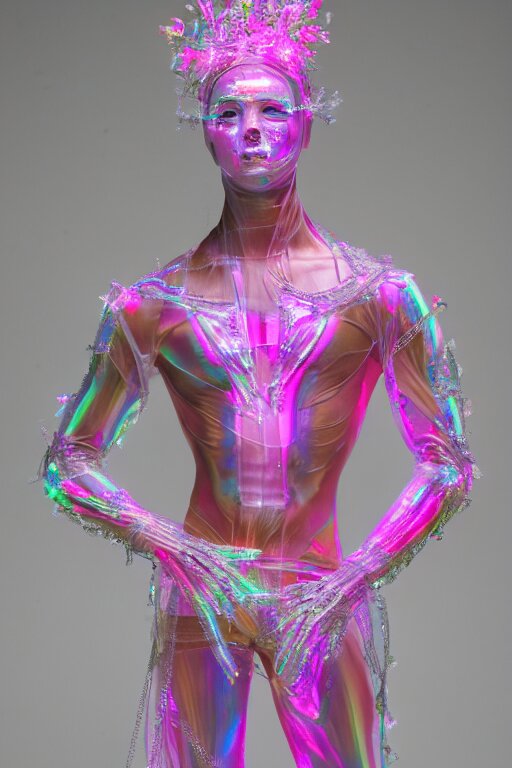
Image credit: AI Art - Skinned in Nanocrystals

Prompt: full-body rococo and cyberpunk delicate neon crystalline sculpture of (((muscular slender Nick Jonas))) as an iridescent humanoid deity wearing a thin see-through ((plastic hooded cloak)) sim roupa, reclining con (las piernas abiertas), glowing pink face, crown of (((white lasers))), large diamonds, swirling black silk fabric. futuristic elements. oozing glowing liquid, full-length view. space robots. (((human skulls))). throne made of bones, intricate artwork by caravaggio. Trending on artstation, octane render, cinematic lighting from the right, hyper realism, octane render, 8k, depth of field, 3D

Bonus: AI Art - Optical Computer Skin


Thoughts and Thinking


International collaboration reveals how the human brain evolved to harness abstract thought
Apr 2022, phys.org

"Surprisingly, our results showed that in all species other than humans, the brain areas that comprise the default mode network involve two systems not strongly connected with each other," Constantinidis said. "These regions, one responsible for suppression of external events and one for more cognitive tasks, appear to be linked only recently in evolution. It is this linkage that may have facilitated the capacity for abstract thought that led to the rapid evolution of human cognitive abilities."

via Vanderbilt University: Christos Constantinidis & collegaues, An evolutionary gap in primate default mode network organization, Cell Reports (2022). DOI: 10.1016/j.celrep.2022.110669.


Exploring how abstract concepts are represented in the brain across cultures, languages
May 2022, phys.org

"We wanted to look across languages to see if our cultural backgrounds influence how we understand, how we perceive abstract ideas like justice."

Brain scans from 20 participants, with equal representation from those who speak English and Mandarin. Participants were given 28 individual abstract concepts that spanned seven categories: social, emotion, metaphysics, law, religiosity, mathematics and scientific. While in the fMRI machine, participants would think about a prompt from one of these categories, like sacrilege in the religiosity category, for three seconds. Between each prompt, the participant would clear their mind by staring at a shrinking, blue ellipse for seven seconds. The series was repeated six times to provide multiple datasets for statistical analyses and to train and test models.

The study shows that a common neural infrastructure does exist between languages. While the underlying neural regions are similar, how the areas light up is more specific to each individual.

"Despite each culture developing its own somewhat differing conceptions of the world, all brains organize the abstract concepts the same way, using the same brain systems."

(Not sure if it's appropriate to apply it here, but remember that all brain studies of less than 1,000 people are subject to noisy data? This study has 20.)

via Carnegie Mellon University: Robert Vargas et al, Similarities and differences in the neural representations of abstract concepts across English and Mandarin, Human Brain Mapping (2022). DOI: 10.1002/hbm.25844


Completely unrelated image above: 

Pickled fetus found inside ancient Egyptian mummy
Feb 2022, phys.org

A closer look at the mummy and her fetus showed that she did not die in childbirth. They also found the mummy had been preserved with natron, a type of salt found in dry lake beds. When used to mummify a corpse, it dries out the body and also works as a disinfectant, preventing bacteria from eating the remains. The fetus remained untouched by those who had mummified the remains, which kept the womb pristine.

via the Warsaw Mummy Project: Wojciech Ejsmond et al, Further evidence to confirm the 'pregnant mummy': A reply to Saleem (2021), Journal of Archaeological Science (2021). DOI: 10.1016/j.jas.2021.105504

Also: Wojciech Ejsmond et al, A pregnant ancient egyptian mummy from the 1st century BC, Journal of Archaeological Science (2021). DOI: 10.1016/j.jas.2021.105371