Friday, April 29, 2022

The Hacker Crackdown


I got this book because the author, Bruce Sterling, is a science fiction writer, so I thought he would have an interesting point of view on the topic of computers and criminals. Soon it became apparent that the book is required reading for anyone who uses a computer. It's also a captivating genesis story of the Electronic Frontier Foundation. 

The Hacker Crackdown: Law and Disorder on the Electronic Frontier
Bruce Sterling, Bantam, 1992

  • The ghost in the machine was another person: on the other end: When you picked up a telephone, you were not absorbing the cold output of a machine -- you were speaking to another human being. Once people realized this, their instinctive dread of the telephone as an eerie, unnatural device swiftly vanished. A "telephone call" was not a "call" from a "telephone" itself, but a call from another human being, someone you would generally know and recognize. The real point was not what the machine could do for you (or to you), but what you yourself, a person and citizen, could do through the machine. (p7)
  • GURPS Cyberpunk was thought real by secret service and taken as evidence in the great Hacker Crackdown. (It was science fiction). (p148)
  • "ad-hocracy" (bureaucracy) (p192)

The E911 Document and the Trial of Craig Neidorf aka Knight Lightening
Neidorf had deliberately and recklessly distributed a dangerous weapon. ... Neidorf had put people's lives in danger. In pretrial maneuverings, Cook had established that the E911 Document was too hot to appear in the public proceedings of the Neidorf trial. The jury itself would not be allowed to ever see the Document, lest it slip into the official court records and thus into the hands of the general public and, thus, somehow, to malicious hackers who might lethally abuse it.  Hiding the E911 Document from the jury may have been a clever legal maneuver, but it had a severe flaw.

There were, in point of fact, hundreds, perhaps thousands, of people already in possession of the Document, just as Phrack had published it. It's true nature was already obvious to a wide section of the interested public (all of whom, by the way, were at least theoretically , party to a gigantic wire-fraud conspiracy.) Most everyone in the electronic community who had a modem and any interest in the Neirdorf case --already-- had a copy of the Document. It had already been available in Phrack for over a year. (p260)


Oh Behave


This book was written in the 60's, and appears to me as California-centric, written at Berkeley, and between the Universities of Chicago and Pennsylvania. The author, Ervin Goffman, spent a lot of time in mental institutions, observing the residents there. 

Partially related image credit: Perseverance on Mars - 2021

He wrote lots of books, and this isn't the most popular. I'm not sure how I came to it. It's supposed to be about deviance, but really it's everyday social interactions, broken down to a level of analysis and explanation that will make you feel like the alien, looking back at yourself.

I read the whole thing sitting outside a cafe, across from a public park, watching in real time as the hypotheses in the book were being confirmed over and over. 

Behavior in Public Places: Notes on the Social Organization of Gatherings
Ervin Goffman, The Free Press, New York, 1963. 

  • On Co-Working Spaces and Assigning Non-Person Status - involvement shield, darkness for sex, for darkness can allow participants to enjoy some of the liberty of not being in a situation at all...Thus the sharing of an office with another often means a limit on work, because extreme concentration and immersion in a task will become an improper handling of oneself in the situation. Some coworkers apparently resolve the issue by gradually according each other the status of nonperson, thus allowing a relaxation of situational properties and an increase in situated concentration. This may even be carried to the point where one individual allows himself half-audible "progress grunts" such as "What do you know!" "Hm hm," "Let's see," without excusing himself to his coworker. -Edgar Schein has suggested that if an individual feels obliged to affect deep immersion in some focus of attention, he may of course affect these expressions. (p62-63)
  • On Women in the Factory (and Masturbating with the Sewing Machine) - "a suffocated cry, followed by a long sigh, was lost in the noise of the work room." The foreman advised her to "sit fully on her chair, and not on its edge." As I was leaving I heard another machine at another part of the room in accelerated movement. The foreman smiled at me and remarked that this was so frequent that it attracted no notice. (p68) -Havelock Ellis, Studies in the Psychology of Sex, Random House, 1936; -L'Onanisme chez la Femme, Pouillet, Paris, 1880
  • On Social Clothing: A class of auto-involvements, "creature releases," fleeing acts that slip through the individual's self control and momentarily assert their "animal nature." They appear to provide a brief release from the tension experienced by the individual in keeping himself steadily and entirely draped in social clothing -- momentary capitulations to the itches that plague a performer who does not want to sneeze in his role. (p87ish)
  • On Civil Attention (and Social Clothing) - for example, it's bad form for a newly married couple when going to a party to enter the room together. Someone else should take her in. ... On all occasions appearing in public, the pair should not be exactly together. The recognition of that relation should as much as possible be confined to the fireside. It is not pleasant to see persons thrusting their mutual devotedness into the eye of society. (p169)
  • On Handshakes (and Avoiding Situational Impropriety) - for example, should long separated friends meet [at a funeral] it would be difficult for them to do justice to their relationship without committing a situational impropriety. ... Apparently the very warm handshake provides a solution to this problem, allowing a strict situational solemnity to be maintained in appearance, while in fact a shielded involvement is occurring whose depth and alienation from the occasion can be sensed only by the two participants. 
  • On the Transcending of the Workplace via Clothing in Blue Collar vs White Collar Workers: Tightness, looseness, and social rigidity...fitting into social gatherings, alienation...In this context it is worth considering the relation of work and clothing to the problem of fitting into gatherings. Some clothing, like that worn by deep-sea divers or firemen, is inextricably geared to the task at hand. These personal fronts can hardly serve in nonoccupational situations nor can the possessor, unless he changes clothes. Even during the coffee break, we will be showing a certain kind of devotion to the job. In the case of white collar tasks however, work clothes transcend the workplace and enable the worker to merge into gatherings occurring off the job. Correspondingly, when he is on the job, there will be part of himself that he need not submerge into the work, and this in fact provides him with one basis for self possession and dignity. Those who must wear a uniform at work, and who cannot leave it in the locker room when they leave the premises, are likely to feel that they are under special constraint to give much of themselves to work and to carry this contribution to any nonwork situation in which they happen to find themselves. (p205)
  • On Pajamas in Class vs Pajamas in Finals: A male college student who enters the classroom in need of a shave and in trunks, or a female who enters with her hair in curlers, is nakedly showing lack of attachment to the behavior setting; but when an exam is being held, and all students in the exam hall are engrossed quite deeply in school work, having studied devotedly for the previous two weeks, then there is already sufficient sign of involvement in schooling, and thus the informalities of appearance I have mentioned may well be permitted, no longer being symbols of alienation. ... The lawyer dressed with no jacket is disoriented, but on the weekend, "his mere presence in the office at an off hour is sign enough of regard for the work world." (p213)
  • Drunk, Bums and Ambulatory Psychotics: Parks may maximize the acceptability of nefarious acts, minimizing the price of being caught. (p215)
  • On the Implication of a Beard: And the status symbolism of personal front, Church of England's clergymen wearing laymen's clothing only while playing lawn-tennis, ... individual insignias such as uniforms in erupting social movements meant to proclaim distance from the ordinary course of social life, in sailors who use tattoos to express solidarity to each other and separation from land society, "Something of the same effect is obtained by college students and beatniks (and their fellow-travellers) who express distance from the employed adult population by a full beard, or a two-day growth, and by bedraggled clothes (p222) -The Holy Barbarians, L Lipton, Messner New York, 1959

Baselines, Biases and Big Data Problems - The Secrets of Statistics and the Magic of Metrology


The paradox of big data spoils vaccination surveys
Dec 2021, phys.org

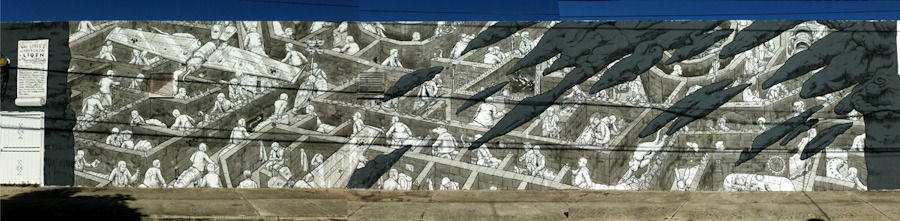
Image credit: Labyrinth by Liqen, Miami 2011

So guess what -- big data is really good at minimizing sample size errors, but also at magnifying systematic biases such as nonresponse bias like how vaccinated people are more likely to respond and marginalized groups less so -- in other words, bad data. Yet because the sample size is so large, we are tricked even more into thinking it must be good data. "Biases in the data get worse with bigger sample size." -phys.org

Here's an example: "Two in 10 respondents did not have a college degree, compared with four in 10 of all U.S. adults—and race and ethnicity—the fraction of black and Asian respondents was only half of what it is in the general population."

"Worse than no survey at all" they say.

Thanks Facebook, but you can keep your invasive mass surveillance system of the entire American population to yourself. 

via Harvard: Seth Flaxman, Unrepresentative big surveys significantly overestimate US vaccine uptake, Nature (2021). DOI: 10.1038/s41586-021-04198-4


On research methods and data quality:

Meng said he began thinking about the problems posed by big data during a visit to Harvard a decade ago by a U.S. Census Bureau official. The official met with a group of statisticians and asked them about the handling of data sets that were becoming available covering large percentages of the U.S. population. Using the hypothetical example of tax data collected by the IRS, he asked whether the statisticians would prefer a sample covering 5 percent of the population that they knew was representative of the larger population or IRS data that they weren't sure was representative but covered 80 percent of the population. The statisticians chose the 5 percent. "What if it was 90 percent?" the Census Bureau official asked. The statisticians still chose the 5 percent, because if they understood the data, their answer would likely be more accurate than even a much larger set with unknown biases.

And now for the hard stuff:
Completely unrelated image; I'm just collecting pictures from science articles of people holding vials in their fingers: Wastewater Filtration, Pacific Northwest National Laboratory and Andrea Starr, 2022

Drinking alcohol to stay healthy? That might not work, says new study
Nov 2021, phys.org

This is such a great example of how statistics works (and how it doesn't). The key word is "baseline".

We've been told for years, forever?, that one glass of red wine a day is not only not-bad, it's actually good for you. In health-speak, they call that "protective".

But this study shows us that there is no group of people that we can use as a baseline, who ---doesn't--- drink and yet who also ---doesn't--- have other health issues caused by having a history of substance abuse. In other words, when the only people who don't drink are people who are recovering from being addicted to alcohol (gross exaggeration), it means you can't find a baseline for a "normal" person. And if you can't find a baseline, then you can't measure anything. 

The majority of the alcohol abstainers at baseline were former alcohol consumers and had risk factors that increased the likelihood of early death. Former alcohol use disorders, risky alcohol drinking, ever having smoked tobacco daily, and fair to poor health were associated with early death among alcohol abstainers. Those without an obvious history of these risk factors had a life expectancy similar to that of low to moderate alcohol consumers. The findings speak against recommendations to drink alcohol for health reasons.

I tell my friends this story, and they ask the first question, a good question -- what about people like Seventh Day Adventists, or Muslims, they don't drink, why can't we use them? And the answer is the reason why health science is hard.

The reason you can't use groups of people who don't drink, is because that group would likely not represent the much larger group of, let's say, all the people in America. It doesn't even matter if it's a small group; making it bigger won't help. It doesn't work because it doesn't match. You can't compare the two groups because the people aren't the same. 

Another way we see this, and one which is becoming more evident to those who can fix it, is how certain groups of people (like undocumented immigrants) are under-represented in the data. If the majority of the datapoints are White, Christian and middle class, and you're none of those, then it's possible that the data is not relevant to you. Your baseline isn't represented, so whatever health effects you're trying to measure, they aren't being compared to someone like you. 

via Public Library of Science: John U, Rumpf H-J, Hanke M, Meyer C (2021) Alcohol abstinence and mortality in a general population sample of adults in Germany: A cohort study. PLoS Med 18(11): e1003819. doi.org/10.1371/journal.pmed.1003819

Partially Related:
This is also a correlate to the story of how lead was discovered in the air -- a geochemist was trying to do such sensitive work (to measure the age of the Earth!) that he kept picking up extra lead in his results, and could not figure out where it was coming from. But it turns out that it was in the air, having been vaporized in the internal combustion engines in our cars. And that story implies that until then, all other experiments being done were "wrong" because they didn't exclude the excess lead from the otherwise "normal" background. 

Last One -- Palmar Sweating:
During a nuclear war scare (1950's), all experiments into palmar sweating at a research institute had to be abandoned because the base level of the response had become so abnormal that the tests would have been meaningless.  (p188)
-The Naked Ape, Desmond Morris, 1967

Collective Computing and Manipulating Possibility Space


I'm watching a presentation by David Krakauer at the Santa Fe Institute. They do complexity theory, and he gives a good lecture. 

These pictures are screenshots of his presentation. I'm keeping them here for my own notes, because I thought there was some pretty deep stuff in here. 


First -- noise is essential to the system, because, as written here, it allows for the exploration of all possible states. How else are you going to optimize?? Noise delineates the operation-space.


Next, he gives us a picture of what I would refer to as a Lévy flight, but which simply be called "foraging behavior"; it's where you take a semi-random approach to exploring your environment, whether it's a field of blackberries or the information-space of artistic production. Artists do this throughout their career, where they spend a lot of time exploring -places, ideas, themes and then an abrupt and explosive execution of work that seems to crystallize out of all their recent experience. So the exploratory Lévy flight graph is paired with a more tightly integrated graph, the execution graph.  


Then he tells us that neurons are doing the same thing when we think, and especially when we make decisions. 


But this is where shit got crazy for me. Not only do our brains do this, but we as organisms in the larger superorganism of society are doing it also. 


He's saying that society is a circuitboard, where each of our relationships with each other creates a network of information flows, complete with bottlenecks and critical junctures, and evolving in real-time as it tries to optimize the flow of information. He is visualizing, and schematizing, the noosphere in action. 


And then the needle drops, and you remember why you like watching people like David Krakauer and places like the Sante Fe Institute: He calls these relationships "social circuits" and says we can predict the individual behaviors in the group: duration of a fight, who will fight who, who needs to be removed from the group for the fight to stop...

As we develop more sophisticated sensor networks, we will accumulate more and more data on bigger and bigger groups, and learn how to integrate that data into more complex network graphs like these.

And then we'll be able to predict adoption or rejection of social movements, of occupying military forces, of environmental regulations...

The private sector will have a half-assed understanding, yet sell it to all of us via third party business consultants who eat hype-flakes for breakfast, and we'll buy it all and use it and let it take over our lives, disrupt our hormones and dissolve our social fabric, even though it doesn't work (think AI today), while  governments will be years ahead, using it to gently manipulate its population into maintaining a society that disproportionately redistributes its resources to the already rich and powerful. The only way to respond is to get familiar in advance, and so thanks to people like this, we are. That is, if we're paying attention at all.    

If you're looking for more insights into the future, you can listen to David Krakauer, and a whole bunch of other thought-provoking, future-proofing professionals, on the behind the scenes marketing material called Science Fact vs Science Fiction, for the science fiction series Raised By Wolves on HBO (Season 2). They cover the topics of Robots, Space Travel, Human Engineering, Synthetic Biology, Metamaterials, AI, and Cosmology. 

Notes:
Collective Computing and Learning from Nature
David Krakauer of the Santa Fe Institute at the Foresight Intelligent Cooperation Group, Sep 2021

What was really the secret behind Van Gogh's success?
(Exploration and exploitation lead to "hot streaks")
Sep 2021, phys.org

Chaotic Lévy walks are a good strategy for animals
Sep 2020, phys.org

Pedestrians at crosswalks found to follow the Lévy walk process
Apr 2019, phys.org

Musical melodies obey same laws as foraging animals
Jan 2016, phys.org


Thursday, April 28, 2022

Frankensteining the Built Environment and the Internet of Occupants


Taking a look at this book, about the place where we all share 90% of our time, the great indoors. 

Image credit: Negative capacitance engineered crystals, Ella Maru Studio, University of California Berkeley, 2022 [link]

The Great Indoors: The Surprising Science of How Buildings Shape Our Behavior, Health and Happiness
Emily Anthes, Ferrar Straus and Giroux New York, 2020

This book is about how buildings shape our behavior, but I'd like to think about how we, as users in an increasingly omniscient complex of distributed sensors and datacrunchers, will become the driving force in shaping our buildings. 

A few loosely related ideas webbed between the indoor microbiome, the coming avalanche of chemical sensor technologies, and the never ending and insatiable appetite that humans have for more information, are all converging on a building that is designed, operated and improved by the Internet-of-Occupants. 

Fossil diatom Anthodiscina floreata - Michael Landgrebe for Nikon Small World Competition - 2021

Let's start with the reminder that our buildings are already alive -- they're filled with micro-organisms, which will one day be seen as legitimate occupants sharing our indoor space with us. (SARS-CoV-2 would like to have a word)

  • Microbial Forensics: Researchers tracked 3 families as they moved into new homes; each family's distinct blend of microbes colonized its new residents within hours. (p16-17) *Note: the residents didn't colonize the house, the house colonized the residents.
  • The bacteria come from us, the fungi from the building; a stone house feeds different fungi from a wooden house. "Because unlike the bacteria, they're eating the house." -Dunn (p18)
  • New techniques for reading DNA, which we're all now familiar with (PCR) is what allows us to finally do surveys like this, along with shotgun genomics for sequencing all the organisms in a random sample [link] 
  • They conducted the biggest indoor microbial survey ever, and here's what they found: "more than forty thousand species of fungi, a number larger than the number of named fungal species in North America. We have found more than eighty thousand kinds of bacteria. We have found more kinds of Archaea (once thought to be denizens exclusively of extreme environments such as hot springs and belly buttons) than were known from Earth just a decade ago. And there is more. We have not yet gotten to the insect legs (though Anne Madden is working on it). We are only beginning to consider the plants." [link]  
  • The Universal Sample Location: "Participants were instructed to sample the upper door trim on an interior door in the main living area of the home and the upper door trim on the outside surface of an exterior door" because a it's a sampling location that is found in every home, is unlikely to be cleaned frequently, and serves as a passive collector of indoor and outdoor aerosols and dust with little to no direct contact from the home occupants [link] 
  • Persistent Omniscient Surveillance: "The fungi on the outside of the house are a measure of where the house is and what is going on around it, so much so that if you give us a sample of dust from anywhere in the United States we can tell you where it came from within about 100 km. We can tell you based on the composition of fungal life."
This makes it hard to ignore the value of nothing more than dirt for conducting geographically precise forensics. Think about this -- the dirt on your shoe can now tell us where you were in the past few days. And that's today. Extrapolate that a few years. In 2030, I will be able to swab a doorknob and find out every person who touched it, and then one level deeper to every person those people touched that day. Fingerprints?? That's some 20th century sh** right there. Give me your belly button and I will tell you your entire life's history. (Except for the guy with the dust very specifically from Japan in his belly button, who had never been to Japan in his life.) [link] 
  • And further: They can tell whether you have a dog in the house, and what the male to female ratio is, and the secret is out, men, your lack of personal hygiene is showing up in the data: "Skin- and fecal-associated taxa were relatively more abundant in homes with fewer women. This pattern is probably driven by differences between the skin biology (and perhaps to body size and hygiene practices) of men and women." [link] 

Sources and further reading:

"Inner Life of Network" - Hard time finding a source on this one.

Next, a reminder that the extent of the datastream coming from a building, today, is basically a thermometer in an HVAC duct. Sure there are occupant sensors for smart lights and CO2-based ventilation, but this is nothing compared to what can and hopefully will happen when we start using the small, cheap chemosensors being refined in labs today and tomorrow marketed to facilities managers, and maybe even the human resources department (and hopefully not federal and local authorities! just kidding Clearview).

  • Montoring real-time environmental conditions inside: "Buildings are the last black boxes of the information age" -Marc Syp, architect (p99)

This guy is talking about thermal comfort like temperature and humidity. But I'm talking about microbiomes and biomarkers. Datalogging exhaled isoprene can tell you about rising levels of employee stress. Profiling microbiomes on door handles can give you some idea of different diseases floating around in the air. Monitoring sewage data can tell you how many of your staff members are taking drugs like amphetamines, caffeine, nicotine, anti-depressants, wow you name it. And the sensors won't have to be in the sewer, they can be deployed right on the fixtures. 

And why would you want to know all these things? Your imagination will have to take over from here. 

Breathing BioMetal Regulates Building Temperature - A Moonshot Project w Doris Kim Sung 2013

Finally, the end result of all this integration between occupant behavior and building design and operation looks like a building that really is alive. Nothing says "I'm alive" like a heaving hunk of Frankenbricks:

  • The Breathing Building (Adaptive Buildings) matches your own breathing pattern, a tent-like structure "inhales and exhales" with you ... strong occupant reactions ... when the system shut off abruptly, one person felt a jolt in his chest. -Holger Schnadelbach and the Exo Building via Nottingham University (p178-179) [link]

Notes:
How indoor environmental quality affects occupants’ cognitive functions: A systematic review. Chao Wang, et al. Building and Environment, Volume 193, 2021, 107647, ISSN 0360-1323.

Wednesday, April 27, 2022

Calling All Biophiles


Biophilia: The Human Bond with Other Species 
E. O. Wilson, Harvard University Press, 1984


This book is full of inspiration, and quotes so good they should be etched in stone:

  • In the Prologue - Biophilia - the innate tendency to focus on life and lifelike processes.
  • Also in the Prologue - existential = exotic - "The word extraterrestrial evokes reveries about still unexplored life, displacing the old and once potent exotic that drew earlier generations to remote islands and jungled interiors."
  • On an ecosystem he observes, and on "the uncounted products of evolution" - "Their long cenazoic history was encyphered into a genetic code I could not understand." (p7)
  • Caprophage (eat, shit)
  • "Penetralia of the soil" (things in the dirt) (p9)
  • "Coexistence was an incidental by-product of Darwinian advantage that accrued from the avoidance of competition." (p9) "During the long span of evolution the species divided the environment among themselves so that now each tenuously preempted certain of the capillaries of energy flow. Through repeated genetic changes they sidestepped competitors and built elaborate defenses against the host of predator species that relentlessly tracked them through matching genetic countermoves. The result was a special array of specialists, including moths that live in the fur of three-toed sloths." (p9-10)
  • But further - "The unique operations of the brain are the result of natural selection operating through the filter of culture." (p12)
  • New York, greatest of machines (p12)
  • On Superorganisms and Agency-Flipping (a la What Technology Wants and the Extended Phenotype) - The leafcutter ant colony is a superorganism. ... The social master plan is partitioned into the brains of the all-female workers, whose separate programs fit together to form a balanced whole. ... The superorganism's brain is the entire society; the workers are the crude analog of its nerve cells. ... Through a unique step in evolution taken millions of years ago, the ants captured a fungus, incorporated it into the superorganism, and so gained the power to digest leaves or perhaps the relation is the other way around: perhaps the fungus captured the ants and employed them as a mobile extension to take leaves into the moist underground chambers. (p36-37)
  • On Sudden Perception: "One commanding image synthesized from several units, such that a single complex idea is attained not by analysis but by the sudden perception of an objective revelation." (p67) ... He then goes on to explain how science is a combination of creative imagination and scientific process. "Through the repeated alternation between flights of the imagination and the accretion of hard data, a mutual agreement of the workings of the world is written, in the form of natural law." (p67)
  • On the First Stages of Original Thought (a la Fleck) - "It is controlled growth, a disciplined spread of the mind into hidden recesses where concepts and linkages are still embryonic or non-existent." (p78)
  • The 20% Redundancy Rule?! - Using electroencephalograms in the study of response to graphic designs the Belgian psychologist Gerda Swets found the maximal arousal (measure by the blockage of the aplpah wave) occurs when the figure contains about 20 percent redundancy. That is the amount present in a spiral with two or three turns, or a relatively simple maze, or a neat cluster of ten or so triangles. Less arousal occurs when the figure consists of only one triangle or square, maze or an irregular scattering of twenty triangles. (p79) (This is some art theory I've never heard of.)
  • Culture in turn is a product of the mind, which can be interpreted as an image-making machine that recreates the outside world through symbols arranged into maps and stories. (p101)

Tuesday, April 26, 2022

Electronic Drugs and Addiction by Design


I ran an image search for the word "panopticon", looking for a good thumbnail for this post. This picture looks great, but I have no idea what it is, and it's not sourced. Is it an artificially intelligent big data brain? A neutrino chamber? Does it have anything to do with panopticon design (think Eastern State Penitentiary in Philadelphia)? No.

It's a building, called L’Hemisfèric, in the City of Arts and Sciences in Valencia, Spain, designed by architect Santiago Calatrava circa 2015. The reflection in the water makes it look like one big eye, and it does. So maybe it's partially related here.

Back on track -- Commercials for online gambling end with a disclaimer about where to call if you have a gambling problem.

I always thought it was strange that you could have a commercial for addictive things. If they're already addictive, why do we need to advertise them? Or better yet, if something is addictive, shouldn't we not be allowed to advertise for them? Especially in today's world of targeted advertising; we're literally using the word "targeted". 

In China, they call video games "electronic drugs", and they have new regulations against private companies targeting their citizens with addictive algorithms (governments not so much). 

Ten years ago, this book was written about slot machines, and today it will blow your mind. That is, if you can handle some basic ideas of statistics, probability, and randomness:

  • Machine gambling as an example of flipping the workplace organizational psychology of the 1900's factory back on the "new product" (you) -- the user, and analysing them, the new worker, to get them to "work" longer, better, faster (by getting sucked-in to the machine and controlled by it), for you! (the employer or the owner). (p57, Foucault, Marx)
  • "The gambler not only can't win but isn't playing to win, while the gambling industry is playing to win all along." (p75)
  • Random number generators (RNGs) are at the heart of every slot machine.
  • From hardware to software - Between the actual reel that you see spinning and stopping in front of you, and the automated RNG that actually decides your fate, there is now a virtual reel, which weights the outcome by mapping a pre-planned algorithm ahead of your actual reels, so that it's no longer about the machine, the reels, the lever, the hardware. It's about crafting a perfect probability for both the industry and for the gambler. 
The Virtual Reel Map - Figure 3.2a - Educational illustration of virtual reel mapping for a machine containing 32 virtual stops and 22 actual stops. The first 11 positions on the 32-stop virtual reel are mapped to the 11 symbols on the actual reel, but the rest are mapped to blanks, such that the odds of hitting a winning symbol are less than they appear to be. In addition, via a disproportionate number of virtual stops are mapped to blank spaces just above or below the jackpot symbols. This ensures that they will appear more often above or below the payline than they would by chance alone, enhancing the "near miss" sensation among players. Courtesy of Game Planit, Inc. (p88)

  • Note that in the image above, which represents an actual reel map, positions 1,3,5,7 are "real", whereas 2,4,6 are not; they're blanks. Yet they're doubled by the map loading, so you "almost" get it more often than chance (out of the actual 11 symbols). AKA Phantom Symbols, AKA Loading the Dice (p92)
  • On the new machines (which are designed to hack your nervous system to bits and then feed it back to you as a dopamine drip) - "They love them; They can literally play all day." (p126) -IGT Game Developer
  • "Tracked gamblers are treated less as individual subjects than as "dividuals" in the Deleuzian sense -- bundles of traits and habits (associated with pin numbers, codes, passwords and personal algorithms) that can be systematically compared with those of others, allowing casinos to more precisely identify and market to distinct customer niches (ft 15). Casinos also can triangulate any given gambler's player data with her demographic data, piecing together a profile that can be used to customize game offerings and marketing appeals specifically for her; although she has been broken down into discrete data points in the process of tracking in the moment of marketing she is reassembled as a distinct individual who can be examined form every angle." -The Rise of Player Tracking, Chapter 5 Matching the Market
From the book, Addicted by Design

"I am watching everything. I see it all."
-Executive at Harrah's

This quote feels like it could be the introduction to this book on marketing and advertising:
The Panoptic Sort: A Political Economy of Personal Information
Oscar H. Gandy Jr., 1993