Tuesday, September 13, 2022

Where Color Comes From


Toward 4D printing with structural colors
Jun 2022, phys.org

While you were sleeping, 3D printing makes a huge evolutionary leap - now making "structural colors" directly into the nanoscopic surface textures of the materials. What better name to call it than 4D printing:

3D printing with stimuli-responsive materials, called 4D printing. 4D printing enables 3D printed structures to change its configurations over time and is used in a wide variety of fields such as soft robotics, flexible electronics, and medical devices.

Structural coloration occurs on surfaces with a nanostructure with dimensions similar to those of the wavelength of the incident light (typically below a micron). These ordered nanostructures are known as photonic crystals.

But it's not just about printing structurally-memetic dragonfly iridescence that changes depending on the light. It's about the surface textures changing over time, and in response to any number of stimuli in the environment. Too hot? Turns red. Cyanide gas in the air? Turns green.

Humidity-responsive color changing ink for extrusion 3D printing reversibly changes volume and reflected color based on hydration state.


But again it's not just about changing colors, it's about the materials sensing its environment and changing its structure in response:

"Ideally, by including responsive elements in these polymers, we can create materials that can both sense and respond to their environment, perhaps even allowing communication between individual devices as well to generate a level of autonomy for a collection of individual units," Debije concludes.

via Eindhoven University of Technology: Jeroen A. H. P. Sol et al, Direct Ink Writing of 4D Structural Colors, Advanced Functional Materials (2022). DOI: 10.1002/adfm.202201766


Natural mineral hackmanite demonstrates highly repeatable color change ability
Jun 2022, phys.org

"Structural Breathing" he says.

Also, radiation exposure detection:
Hackmanite changes color when it's exposed to ultraviolet radiation, and without wearing out, but until now we didn't know why.

It can do this repeatedly without wearing out because it does not use the change in color of the organic molecules the make it up, like similar minerals, but by using structural color -- a change in the position of the molecules, but not their composition.

"In this research, we found out for the first time that there is actually a structural change involved in the color change process, as well. When the color changes, sodium atoms in the structure move relatively far away from their usual places and then return back. This can be called 'structural breathing,' and it does not destroy the structure even if it is repeated a large number of times,"
 
via Intelligent Materials Research Group at the Department of Chemistry of the University of Turku, Finland: Pauline Colinet et al, The structural origin of the efficient photochromism in natural minerals, Proceedings of the National Academy of Sciences (2022). DOI: 10.1073/pnas.2202487119


Engineers repurpose 19th-century photography technique to make stretchy, color-changing films
Aug 2022, phys.org

By applying a 19th-century color photography technique to modern holographic materials, an MIT team has printed large-scale images onto elastic materials that when stretched can transform their color, reflecting different wavelengths as the material is strained.

The eureka:
While puzzling over how to resolve this challenge of getting microscale control and scalability together in structural color technology, Miller happened to visit the MIT Museum, where a curator talked him through an exhibit on holography, a technique that produces three-dimensional images by superimposing two light beams onto a physical material. "I realized what they do in holography is kind of the same thing that nature does with structural color."

via MIT: Benjamin Harvey Miller et al, Scalable optical manufacture of dynamic structural colour in stretchable materials, Nature Materials (2022). DOI: 10.1038/s41563-022-01318-x


Post Script:
Researchers add antireflection coatings to complex 3D printed micro-optical systems
Apr 2022, phys.org

Another nod to the future where everything becomes a computer -- the mirrors (for optical circuits, for optical computers) are sprayed right onto the 3D printed objects themselves. 

Imagine being skinned in nanocrystal photon routers.  

via University of Stuttgart: Simon Ristok et al, Atomic layer deposition of conformal anti-reflective coatings on complex 3D printed micro-optical systems, Optical Materials Express (2022). DOI: 10.1364/OME.454475


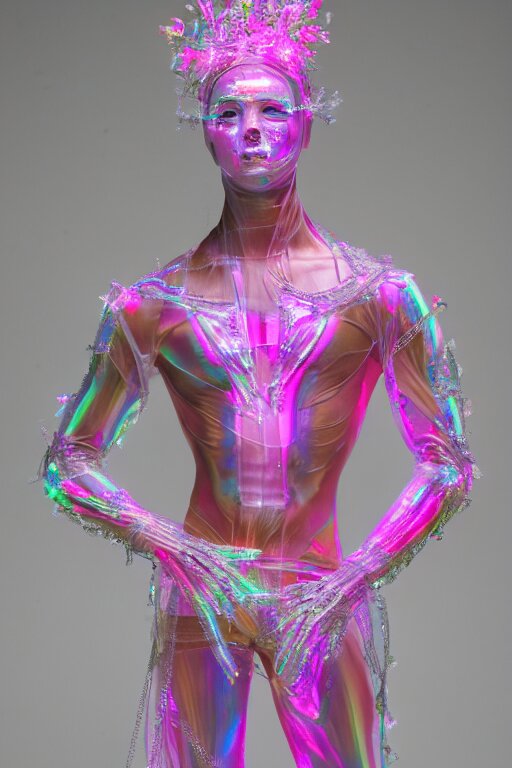
Image credit: AI Art - Skinned in Nanocrystals

Prompt: full-body rococo and cyberpunk delicate neon crystalline sculpture of (((muscular slender Nick Jonas))) as an iridescent humanoid deity wearing a thin see-through ((plastic hooded cloak)) sim roupa, reclining con (las piernas abiertas), glowing pink face, crown of (((white lasers))), large diamonds, swirling black silk fabric. futuristic elements. oozing glowing liquid, full-length view. space robots. (((human skulls))). throne made of bones, intricate artwork by caravaggio. Trending on artstation, octane render, cinematic lighting from the right, hyper realism, octane render, 8k, depth of field, 3D

Bonus: AI Art - Optical Computer Skin


Thoughts and Thinking


International collaboration reveals how the human brain evolved to harness abstract thought
Apr 2022, phys.org

"Surprisingly, our results showed that in all species other than humans, the brain areas that comprise the default mode network involve two systems not strongly connected with each other," Constantinidis said. "These regions, one responsible for suppression of external events and one for more cognitive tasks, appear to be linked only recently in evolution. It is this linkage that may have facilitated the capacity for abstract thought that led to the rapid evolution of human cognitive abilities."

via Vanderbilt University: Christos Constantinidis & collegaues, An evolutionary gap in primate default mode network organization, Cell Reports (2022). DOI: 10.1016/j.celrep.2022.110669.


Exploring how abstract concepts are represented in the brain across cultures, languages
May 2022, phys.org

"We wanted to look across languages to see if our cultural backgrounds influence how we understand, how we perceive abstract ideas like justice."

Brain scans from 20 participants, with equal representation from those who speak English and Mandarin. Participants were given 28 individual abstract concepts that spanned seven categories: social, emotion, metaphysics, law, religiosity, mathematics and scientific. While in the fMRI machine, participants would think about a prompt from one of these categories, like sacrilege in the religiosity category, for three seconds. Between each prompt, the participant would clear their mind by staring at a shrinking, blue ellipse for seven seconds. The series was repeated six times to provide multiple datasets for statistical analyses and to train and test models.

The study shows that a common neural infrastructure does exist between languages. While the underlying neural regions are similar, how the areas light up is more specific to each individual.

"Despite each culture developing its own somewhat differing conceptions of the world, all brains organize the abstract concepts the same way, using the same brain systems."

(Not sure if it's appropriate to apply it here, but remember that all brain studies of less than 1,000 people are subject to noisy data? This study has 20.)

via Carnegie Mellon University: Robert Vargas et al, Similarities and differences in the neural representations of abstract concepts across English and Mandarin, Human Brain Mapping (2022). DOI: 10.1002/hbm.25844


Completely unrelated image above: 

Pickled fetus found inside ancient Egyptian mummy
Feb 2022, phys.org

A closer look at the mummy and her fetus showed that she did not die in childbirth. They also found the mummy had been preserved with natron, a type of salt found in dry lake beds. When used to mummify a corpse, it dries out the body and also works as a disinfectant, preventing bacteria from eating the remains. The fetus remained untouched by those who had mummified the remains, which kept the womb pristine.

via the Warsaw Mummy Project: Wojciech Ejsmond et al, Further evidence to confirm the 'pregnant mummy': A reply to Saleem (2021), Journal of Archaeological Science (2021). DOI: 10.1016/j.jas.2021.105504

Also: Wojciech Ejsmond et al, A pregnant ancient egyptian mummy from the 1st century BC, Journal of Archaeological Science (2021). DOI: 10.1016/j.jas.2021.105371
 

Monday, September 12, 2022

Poor Man's Qubit


Physics-inspired graph neural networks to solve combinatorial optimization problems
May 2022, phys.org

Uses graph neural networks (GNNs) to tackle combinatorial optimization problems.

"Given their inherent scalability, physics-inspired GNNs can be used today to approximately solve (large-scale) combinatorial optimization problems with quantum-native models, while helping our customers get quantum-ready by using the mathematical representation that quantum devices understand," Brubaker said.

Solves optimization problems without the need for training labels.

Caveat: Brought to you by Amazon - "Our work was very much inspired by customer needs"

On the topic of optimization problems and quantum computing, it's getting easier to understand (since every other article is on this topic) that quantum computers will be good at optimization, but the key word is "will". And so for now, we're figuring out how to do optimization problems using regular computers, but in a funny way they sort of weren't meant ot be used, but which becam ereally uselful with the advent of big data. And that half-way of using regular computers like quantum computers is to use the graphics processors in parallel to create neural nets. 

via Amazon Quantum Solutions Lab: Martin J. A. Schuetz et al, Combinatorial optimization with physics-inspired graph neural networks, Nature Machine Intelligence (2022). DOI: 10.1038/s42256-022-00468-6

Image credit: Gyroid for manipulating light into topological states, Nik Spencer for Nature, 2017 [link]


The potential of p-computers
Jun 2022, phys.org

Probablistic computers, P-computers, are powered by probabilistic bits (p-bits), which interact with other p-bits in the same system. Unlike the bits in classical computers, which are in a 0 or a 1 state, or qubits, which can be in more than one state at a time, p-bits fluctuate between positions and operate at room temperature.

Camsari describes the Ising machine (sIm) as a collection of probabilistic bits which can be thought of as people. "The people can make decisions quickly because they each have a small set of trusted friends and they do not have to hear from everyone in an entire network," he explained. 

The researchers showed that their sparse architecture in field-programmable gate arrays was up to six orders of magnitude faster and had increased sampling speed five to eighteen times faster than those achieved by optimized algorithms used on classical computers.

via University of California Santa Barbara Institute for Energy Efficiency: Navid Anjum Aadit et al, Massively parallel probabilistic computing with sparse Ising machines, Nature Electronics (2022). DOI: 10.1038/s41928-022-00774-2


Also this:
'Poor man's qubit' can solve quantum problems without going quantum

Friday, September 9, 2022

Quantum Update


Quantum physics in proteins - AI affords unprecedented insights into how biomolecules work
Nov 2021, phys.org

I hear the quantum biology headlines humming.

via Deutsches Elektronen-Synchrotron: Abbas Ourmazd, Few-fs resolution of a photoactive protein traversing a conical intersection, Nature (2021). DOI: 10.1038/s41586-021-04050-9


Physicists create compressible optical quantum gas
Mar 2022, phys.org

Calling BECs (Bose-Einstein Condensate) a "super photon" by the way.

via University of Bonn: Erik Busley et al, Compressibility and the equation of state of an optical quantum gas in a box, Science (2022). DOI: 10.1126/science.abm2543.


Physicists report on first programmable quantum sensor
Mar 2022, phys.org

"In the development of quantum computers, we have learned to create tailored entangled states." 
("Custom Quantum", am I right?)

via University of Innsbruck: Christian Marciniak, Optimal metrology with programmable quantum sensors, Nature (2022). DOI: 10.1038/s41586-022-04435-4.

Also: Quantum Variational Optimization of Ramsey Interferometry and Atomic Clocks, Physical Review X (2021). DOI: 10.1103/PhysRevX.11.041045.


Chinese team breaks distance record for quantum secure direct communication
Apr 2022, phys.org

Distance of 102.2 km.
Prior to this new effort, the record was just 18 km.

via Tsinghua University in China: Haoran Zhang et al, Realization of quantum secure direct communication over 100 km fiber with time-bin and phase quantum states, Light: Science & Applications (2022). DOI: 10.1038/s41377-022-00769-w

Tying Quantum Knots - TU Delft - 2022

It takes three to tangle: Long-range quantum entanglement needs three-way interaction
May 2022, phys.org

The researchers' findings are consistent with previous observations that long-range entanglement survives at a non-zero temperature only when more than three subsystems are involved.

via RIKEN: Tomotaka Kuwahara et al, Exponential Clustering of Bipartite Quantum Entanglement at Arbitrary Temperatures, Physical Review X (2022). DOI: 10.1103/PhysRevX.12.021022


Tunable quantum traps for excitons
May 2022, phys.org

Physicists can now string together many such trapped excitons and adjust them in such a way that they emit photons having exactly the same properties. "That would allow one to create identical single photon sources for quantum information processing," 

via ETH Zurich: Deepankur Thureja et al, Electrically tunable quantum confinement of neutral excitons, Nature (2022). DOI: 10.1038/s41586-022-04634-z


Scientists use quantum computers to simulate quantum materials
May 2022, phys.org

"Computational Materials" sounds like another way of saying "active matter"?

Also "Hardware Noise":
Performing calculations of the properties of materials and molecules on quantum computers faces a problem that one does not experience with a classical computer, a phenomenon known as hardware noise. Noisy calculations return slightly different answers each time a calculation is performed; a noisy addition operation might return values slightly different from 4 each time for the question, "What is 2 plus 2?"

via Argonne National Laboratory's Midwest Integrated Center for Computational Materials and University of Chicago: Benchen Huang et al, Simulating the Electronic Structure of Spin Defects on Quantum Computers, PRX Quantum (2022). DOI: 10.1103/PRXQuantum.3.010339


Researchers achieve record entanglement of quantum memories
Jul 2022, phys.org

Again with the "quantum memories" term:
Researchers coupled two atomic quantum memories using two optically trapped rubidium atoms in two laboratories on the LMU campus connected via a 700-meter-long fiber optic cable.

via Ludwig Maximilian University of Munich: Tim van Leent et al, Entangling single atoms over 33 km telecom fibre, Nature (2022). DOI: 10.1038/s41586-022-04764-4


Scientists invent 'quantum flute' that can make particles of light move together
Jul 2022, phys.org

Ah yes, the quantum flute, we've been waiting for that one.

via University of Chicago: Srivatsan Chakram et al, Seamless High- Q Microwave Cavities for Multimode Circuit Quantum Electrodynamics, Physical Review Letters (2021). DOI: 10.1103/PhysRevLett.127.107701


Strange new phase of matter created in quantum computer acts like it has two time dimensions
Jul 2022, phys.org

First, the time thing:
By shining a laser pulse sequence inspired by the Fibonacci numbers at atoms inside a quantum computer, physicists have created a remarkable, never-before-seen phase of matter. The phase has the benefits of two time dimensions despite there still being only one singular flow of time, the physicists report July 20 in Nature.

Information stored in the phase is far more protected against errors than with alternative setups currently used in quantum computers. As a result, the information can exist without getting garbled for much longer, an important milestone for making quantum computing viable, says study lead author Philipp Dumitrescu.

The approach's use of an "extra" time dimension "is a completely different way of thinking about phases of matter."

Next, never seen this phrasing til now:
"stayed quantum"

via Simons Foundation: Philipp Dumitrescu, Dynamical topological phase realized in a trapped-ion quantum simulator, Nature (2022). DOI: 10.1038/s41586-022-04853-4


Researchers explore a new connection between topology and quantum entanglement
Aug 2022, phys.org

"Our work ties two big ideas together," says Charles Kane, the Christopher H. Browne Distinguished Professor of Physics in Penn's School of Arts & Sciences. "It's a conceptual link between topology, which is a way of characterizing the universal features that quantum states have, and entanglement, which is a way in which quantum states can exhibit non-local correlations, where something that happens in one point in space is correlated with something that happens in another part in space. What we've found is a situation where those concepts are tightly intertwined."
The eureka, and one of the pandemic sort:
The seed for exploring this connection came during the long hours Kane spent in his home office during the pandemic, pondering new ideas. One train of thought had him envisioning the classic textbook image of the Fermi surface of copper, which represents the metal's potential electron energies. It's a picture every physics student sees, and one with which Kane was highly familiar.

"Of course, I learned about that picture back in the 1980s but had never thought about it as describing a topological surface," Kane says. ...

via University of Pennsylvania: Pok Man Tam et al, Topological Multipartite Entanglement in a Fermi Liquid, Physical Review X (2022). DOI: 10.1103/PhysRevX.12.031022


Unexpected quantum effects in natural double-layer graphene
Aug 2022, phys.org

Again with the unexpected:
At temperatures just above absolute zero of minus 273.15 degrees Celsius, the electrons in the graphene can interact with each other—and a variety of complex quantum phases emerge completely unexpectedly. 

via University of Göttingen and University of Texas at Dallas: Anna M. Seiler et al, Quantum cascade of correlated phases in trigonally warped bilayer graphene, Nature (2022). DOI: 10.1038/s41586-022-04937-1


Post Script on the Sub- and Super-Luminal:
Listen to this guy Andrzej Dragan  talk about the "Quantum principle of relativity" at the Centrum Fizyki Teoretycznej, 2020-05-20

(the visuals come in at 19:40)

Fake Things Bonanza


Trying to come up with a theme for the imagery in this post -- too many fake things to report, and we need some visual release in between. 

Why not some AI-generated art? It's in the news as of this week because of the first public release of an AI generator that allowed someone to win a local art contest without painting a damn thing.  

This is kind of a big deal because for reference, the text-generating tool GPT-3 was deemed too dangerous to release to the public for fear it would, I don't know, topple susceptible governments (maybe we could call them immunocompromised governments instead, to take the edge off). 

This newest generation of image generation software is equally as effective, and it's use has been limited to select users, usually researchers and engineers working for either governments (that we don't hear about) or for commercial enterprise (that we do hear about). But now it's open to everyone. 

The above image, well, I'll admit I'm not sure how the heck it was made. The artist (the human part at least) titles the work "Stress", but it's likely they used a much more extensive and nuanced text prompt to get the image, and they ran that prompt through a dataset of 5 billion captioned-images and this is what came out. It looks like a much more interesting heart, if not accurate, and perhaps illustrated by MARS1 for a cyberpunk medical school anatomy textbook. ,

Here's a quick timeline of how we got here:
And here's the actual post, about fake things in general, interspersed with AI-generated imagery:


Fake Publishers:
Man arrested in thefts of unpublished books
Jan 2022, Associated Press

Authorities say they’ve solved a publishing industry whodunit with the arrest of a man accused of numerous literary heists in recent years. An Italian citizen working in publishing in London is accused of impersonating others in the industry, using phishing schemes to amass a veritable library of unpublished works. Filippo Bernardini was arrested Wednesday after arriving at John F. Kennedy International Airport. He faces charges including wire fraud and aggravated identity theft. He’s expected to appear in federal court on Thursday. No information on an attorney for him was available. 


Fake Whiskey:
With a whiff, 'e-nose' can sense fine whiskey
Apr 2022, phys.org

The real story is that the fake whiskey game is so strong, we need an e-nose to fight it. 

And let's not forget the famous wine forger Rudy Kurniawan, he was a wine savant who reproduced rare and exorbitantly priced wines out of a mixture of cheaper wines. What's more mind-mashing -- that he can figure the exact recipe, or that it's even possible to take 5 good wines and mix them in just the right proportion that they taste just like a world-class winner.
[Rudy Kurniawan]
https://en.wikipedia.org/wiki/Rudy_Kurniawan

via University of Technology Sydney: Wentian Zhang et al, The Use of Electronic Nose for the Classification of Blended and Single Malt Scotch Whisky, IEEE Sensors Journal (2022). DOI: 10.1109/JSEN.2022.3147185


Fake Headline:
Spanish police seize huge haul of illegal stuffed animals
Apr 2022, BBC News

Spanish police have seized what is thought to be one of the largest hauls of animal taxidermy in Europe, worth €29m (£24.2m).


Fake Science:
Computer scientists suggest research integrity could be at risk due to AI generated imagery
May 2022, phys.org

It's never the robots, always the humans who are the real problem:
A small team of researchers at Xiamen University has expressed alarm at the ease with which bad actors can now generate fake AI imagery for use in research projects. They have published an opinion piece outlining their concerns in the journal Patterns. (Using a generative adversarial network, obviously)

via Xiamen University: Liansheng Wang et al, Deepfakes: A new threat to image fabrication in scientific publications? Patterns (2022). DOI: 10.1016/j.patter.2022.100509


Real Problems with Fake Science:
Flawed research not retracted fast enough to prevent spread of misinformation, study finds
Jun 2022, phys.org

Makes sense - Retracted papers receive more attention than comparable nonretracted papers even before retraction. One possible reason is that retracted papers may contain sensational or novel findings, which could lead to increased attention, they say.

Using Retraction Watch and Altmetric data databases, the team compared the online footprints of 2,830 retracted papers to 13,599 nonretracted control papers that had similar publication venues, dates, numbers of authors and authors' citation counts. The researchers compared the amount of attention between the two groups of papers measured in mentions in social media and news media databases, and both six months after publication and again post-retraction.

Solutions - Through their hand-labeling process of critical and non-critical mentions, the researchers also found that discourse about retracted papers tended to be more critical overall on Twitter.

via University of Michigan: Hao Peng et al, Dynamics of cross-platform attention to retracted papers, Proceedings of the National Academy of Sciences (2022). DOI: 10.1073/pnas.2119086119


Fake Families:
Used by corporate real estate purchases of residential housing stock, to trick homeowners into selling to a "family" and not a corporation? (This sounds entirely plausible, but I can't find any more info on this beyond an internet forum chat, and aside from the practice by a Dallas-based real estate firm called Centex back in 2006 where they put fake families in the house while they show it, to produce a more "natural vibe" to the place?)


Fake Candy:
Fake 'potentially dangerous' chocolate seized in Oxford Street American candy shop raids
Jun 2022, ITV News London

The council said the raid was part of its investigation into 30 American-style candy and souvenir shops on Oxford Street for business rates evasion amounting to £7.9 million.

The council said it believed that very few of the shops were serving sufficient customers to be commercially viable and were instead being used to avoid business rate bills and possibly commit other offences.

Westminster City Council recently wrote to 28 freeholders urging them to consider the impact of US sweet shops on Oxford Street and has so far seized around £574,000 worth of counterfeit and illegal goods from American candy and souvenir stores.

[Randon Redditor explanation] Covid - only essential businesses could be open, so all the drug fronts switched to become candy stores that were technically food stores that could be classified as essential and continue laundering money. They're american candy because they price things at like 15 pounds for a bag of twizzlers because of the novelty. They're all owned by people and entities from Afghanistan as well, which seems to insinuate they're fronts for heroin. But like the high street in the documentary was like 30% american candy stores with absolutely no one going in and buying anything from any of them. It's pretty wild.


Fake Data:
'Fake' data helps robots learn the ropes faster
Jul 2022, phys.org

How to be a human. We're getting there:
For the rope-looping simulation and experiment, Mitrano and Berenson expanded the data set by extrapolating the position of the rope to other locations in a virtual version of a physical space — so long as the rope would behave the same way as it had in the initial instance. Using only the initial training data, the simulated robot hooked the rope around the engine block 48% of the time. After training on the augmented data set, the robot succeeded 70% of the time.

via  University of Michigan: Data Augmentation for Manipulation, arXiv:2205.02886v3 [cs.RO] 
https://doi.org/10.48550/arXiv.2205.02886


Fake Lodgings:
Booking.com scam - Tourists descend on north London private home
Aug 2022, BBC News

A woman in north London says she feels victimised after dozens of tourists turned up at her home when her private address was placed on the Booking.com accommodation website.

Travellers from Hong Kong, Saudi Arabia and Los Angeles turned up at the home of Gillian, whose full name is not being given, throughout July.


What kind of fake even is this?
Viagra and Cialis are in certain honey products
Aug 2022, NJ Advanced Media

It's funny because you can bet most of this "honey" is rice syrup: 
Honey is one of the most faked foods in the world, and the US government isn't doing much to fix it

And would you look at that, the original announcement from the FDA calls them "honey-based products"
Tainted Honey-based Products with Hidden Active Drug Ingredients


Fake Accents:
Start-up denies using tech to turn call centre accents 'white'
Aug 2022, BBC News

A Silicon Valley start-up has developed technology that can change the accents of call centre workers in real time. The company, Sanas, has told the BBC that its technology could overcome accent-based prejudice and reduce racist abuse faced by staff.

A former call centre agent himself, Mr Narayana said in his experience agents would be abused or discriminated against because of how they sound - abuse the company believes its technology can prevent.

Sanas - Breaking Barriers One Conversation At A Time


Fake Healthcare:
Cutting down vitamin D tests could help lower carbon cost of health care
Aug 2022, phys.org

"Low-value health care", i.e., unnecessary vitamin D tests, because:
"There are high rates of vitamin D testing of healthy individuals who are not at risk of vitamin D deficiency—with previous research estimating that 76.5% of vitamin D tests did not meet any of the Medicare indications for testing. We need to reduce low-value care such as over-testing and overtreatment."

via University of Sydney: Matilde Breth-Petersen et al, Health, financial and environmental impacts of unnecessary vitamin D testing: a triple bottom line assessment adapted for healthcare, BMJ Open (2022). DOI: 10.1136/bmjopen-2021-056997


Fake News (About Spiders)
What fake news about spiders can teach us about the global spread of (mis)information
Aug 2022, phys.org

A similar exercise would allow comparing if the levels of misinformation and sensationalism are the same across a broad spectrum of taxa, testing the prediction if a negative framing by the traditional and social media translates to a lower chance of being prioritized for conservation, and vice versa."

The "Fake Index" perhaps? "The quality of spider information in the global press is rather poor—errors and sensationalism are rampant." 

I grew up thinking "eating spiders in your sleep" was an early viral meme created on purpose to measure the network dynamics of the young internet while watching the meme spread. But that's not true. The common answer to where this came from (that you will even find on Britannica unfortunately) is that it was in an article about our susceptibility to misinformation, given as a stupid example of an idea that is easily spread. But that's not true either. Turns out that was a meta-meme, created by Snopes back in 2001, as they pretended to provide the origin story. It's just a perennial urban legend. 

via National Research Council of Italy and University of Helsinki's Finnish Museum of Natural History: Stefano Mammola, The global spread of misinformation on spiders, Current Biology (2022). DOI: 10.1016/j.cub.2022.07.026


Fake Influencers:
Real money, fake musicians - A million-dollar Instagram verification scheme
Aug 2022, ProPublica

Fake market always reinventing itself. It's easier to get yourself "verified" as a musician than as an influencer, so they make you a fake album, some fake likes, etc., and you're in business.


Fake Attempts At Correction:
Economists have a method for reducing fake news on social media
Aug 2022, phys.org

"For example, Twitter could limit the breadth of sharing on its site by limiting how many people see any given retweet in their Twitter feeds," he says.

But sharing is a metric for engagement, and engagement is the primary metric for their revenue.

Both Facebook and WhatsApp, two apps owned by parent company Meta that allow users to message each other, have used methods similar to the researchers' model to limit the spread of misinformation.

And that's why it "didn't work", i.e., they didn't really do it.

"If you limit sharing, you could also be limiting the spread of good information, so you might be throwing the baby out with the bathwater and that doesn't really help you," McAdams warns. "Our analysis explores how to strike that balance."

This is the crux of the matter.

via Duke University: Matthew O. Jackson et al, Learning through the grapevine and the impact of the breadth and depth of social networks, Proceedings of the National Academy of Sciences (2022). DOI: 10.1073/pnas.2205549119
Wednesday, September 7, 2022

Falling Down


AKA Data Miners Go on Strike

Amazon targets 10,000 fake review Facebook groups
Jul 2022, BBC News
 
Amazon is taking legal action against the administrators of more than 10,000 Facebook groups, the BBC has learned.

It says the groups are generating fake reviews on Amazon marketplaces in the US, UK, Germany, France, Italy, Spain, and Japan.

The tech sector has finally started to cannibalize itself. 


First ever sales fall for Facebook owner Meta
Jul 2022, BBC News
https://www.bbc.com/news/business-62322862

"When you look at the ad space right now...growth is deteriorating at a very fast pace, much faster than most people had anticipated," Mr Zino said.

Meta's reliance on small and medium-sized businesses - which are "spooked" about the economy - makes it particularly vulnerable to any market slowdown, said Nikhil Lai senior analyst for performance marketing at Forrester Research.

The company's fine-tuned model for targeting adverts was also disrupted last year when Apple overhauled its privacy settings.

Let's just accept it now, in a pretty unexpected turn of events, the Roe decision has pushed the American populace off the privacy cliff. 

Let's also recall the 2014 paper that followed the disease model on a social network and predicted Facebook would run out of users by 2018 (which then happened, although the balance was being replaced by bots at the same time so nobody cared to acknowledge it).
-Epidemiological modeling of online social network dynamics, John Cannarell, Joshua A. Spechler. Department of Mechanical and Aerospace Engineering, Princeton University. arxiv:1401.4208v1 [cs.SI] 17 Jan 2014. https://arxiv.org/pdf/1401.4208v1.pdf

Weaponized Delivery Packages for Misinformation


One day customers will only want to do business with those who harvest their data sustainably.

Twitter pays $150M fine for using two-factor login details to target ads
May 2022, Ars Technica

"As the complaint notes, Twitter obtained data from users on the pretext of harnessing it for security purposes but then ended up also using the data to target users with ads," Federal Trade Commission Chair Lina Khan said. "This practice affected more than 140 million Twitter users, while boosting Twitter's primary source of revenue."


Feds seize SSNDOB marketplace that listed personal data of 24 million people
Jun 2022, Ars Technica

Social Security Number Date of Birth (SSNDOB) like the walmart of personal data.

More fallout from the Chainalysis revelation, which is basically that every transaction you make on the blockchain is public knowledge, so with some good network software, you can track people and money like a first grade math problem. 

Further readings:
Inside the Bitcoin Bust That Took Down the Web’s Biggest Child Abuse Site
Apr 2022, Mike McQuade, WIRED [soft paywall]


Facebook is receiving sensitive medical information from hospital websites
Jun 2022, The Markup via Ars Technica

Experts say some hospitals’ use of an ad tracking tool may violate a federal law protecting health information. (You don't say)

A tracking tool installed on many hospitals’ websites has been collecting patients’ sensitive health information — including details about their medical conditions, prescriptions, and doctor’s appointments — and sending it to Facebook.

The Markup tested the websites of Newsweek’s top 100 hospitals in America. On 33 of them we found the tracker, called the Meta Pixel, sending Facebook a packet of data whenever a person clicked a button to schedule a doctor’s appointment. 

Clicking the “Schedule Online” button, filling in the booking form, or clicking the “Finish Booking” button on a doctor’s page sent the following information:
  • text of the button clicked
  • doctor’s name
  • doctor's field of medicine
  • search term used to find doctor: “pregnancy termination"
  • condition selected from dropdown menu: “Alzheimer’s”
  • first name
  • last name
  • email address
  • phone number
  • zip code
  • city of residence  entered into the booking form,
  • names of patients’ medications
  • descriptions of their allergic reactions
  • upcoming doctor’s appointments
  • name and dosage of a medication in our health record
  • notes we had entered about the prescription
  • response to a question about sexual orientation
The Markup also found the Meta Pixel installed inside the password-protected patient portals of seven health systems. 
You heard the man; this is a stick up. 

Technical sidenote:
“The evil genius of Facebook’s system is they create this little piece of code [the pixel] that does the snooping for them and then they just put it out into the universe and Facebook can try to claim plausible deniability,” said Alan Butler, executive director of the Electronic Privacy Information Center. “The fact that this is out there in the wild on the websites of hospitals is evidence of how broken the rules are.” (So the pixel is like a dematerialized AirPod?)

Further reading on body brokers and biodata:
Sapiens For Sale, Network Address, Aug 2022

Network structure of Agents in Tsuchiyu Onsen, Tohoku University, 2022


Kochava faces legal action over sale of location data
Aug 2022, BBC News

The company, founded in 2011, says on its website that it "complies with all user data privacy and consent regulations".

And they do, because there aren't any.


Data privacy bill would give you more control over info collected about you
Aug 2022, The Conversation via Ars Technica

"Excludes deidentified data"
-American Data and Privacy Protection Act (Frank Pallone, hello NJ)

How hard is it to 'de-anonymize' cellphone data? 

Not hard:

We study fifteen months of human mobility data for one and a half million individuals and find that human mobility traces are highly unique. In fact, in a dataset where the location of an individual is specified hourly and with a spatial resolution equal to that given by the carrier's antennas, four spatio-temporal points are enough to uniquely identify 95% of the individuals.
-Unique in the Crowd: The privacy bounds of human mobility. Yves-Alexandre de Montjoye et al. Sci Rep 3, 1376 (2013). https://doi.org/10.1038/srep01376

Four datapoints. That's 2013 by the way.

Post Script:
Here's the thing: we've all watched the promise of tech and the internet curdle into (at best) invasive, advertisement-saturated, rent-seeking bullshit and/or (at worst) weaponized delivery packages for misinformation, bigotry, and occasional incitements to genocide and violence. I think we're all reaching our saturation limit for being monetized, marketed to, invasively tracked, and charged a premium for devices and services that enable those things. I think we're looking for relief from all that, not variety of opportunities to experience it. -Snark128, "Meta sparks anger by charging for VR apps", Financial Times via Ars Technica, Jun 2022 https://www.ft.com/content/e8910bad-b873-407d-b1ca-46eb4ceb3db2