Tuesday, July 4, 2017

Natural vs Artificial


So if we enslave mountains of bacteria to be forcefed glucose while we reap their colorful shit, is that natural or artificial?

Four strains of bacteria work together to produce pigment for food and cosmetics industry
Jul 2017, phys.org

Researchers at Rensselaer Polytechnic Institute have shown that four strains of E. coli bacteria working together can convert sugar into the natural red anthocyanin pigment found in strawberries, opening the door to economical natural colors for industrial applications.

"We feed the bacteria glucose and they do the rest."
-Mattheos Koffas, a professor of chemical and biological engineering at Rensselaer, and member of the Center for Biotechnology and Interdisciplinary Studies

image credits: Air bubbles formed from melted ascorbic acid (vitamin C) crystals (50x), Marek Miś, 2016 Nikon Small World Micrography Competition

To Shape the Future

Crystal balls over here

Predicting the future with the wisdom of crowds
Jun 2017, phys.org

Don Moore and a team of researchers found a new way to improve that outcome by training ordinary people to make more confident and accurate predictions over time as superforecasters.

The team, working on The Good Judgment Project, had the perfect opportunity to test its future-predicting methods during a four-year government-funded geopolitical forecasting tournament sponsored by the United States Intelligence Advanced Research Projects Activity. The tournament, which began in 2011, aimed to improve geopolitical forecasting and intelligence analysis by tapping the wisdom of the crowd. Moore's team proved so successful in the first years of the competition that it bumped the other four teams from a national competition, becoming the only funded project left in the competition.

The study differs from previous research in overconfidence in forecasting because it examines accuracy in forecasting over time, using a huge and unique data set gathered during the tournament. That data included 494,552 forecasts by 2,860 forecasters who predicted the outcomes of hundreds of events.

The Wisdom of Crowds
James Surowiecki, 2004

Swarm A.I. Correctly Predicts the Kentucky Derby, Accurately Picking all Four Horses of the Superfecta at 540 to 1 Odds
Yahoo Finance, April 2016

The Chinese Flesh Engine
BBC 2014

POST SCRIPT

This kind of thing always reminds me of a passage from Levy-Bruhl's Primitive Mentality - the indigenous people he writes about are perplexed at the ability of the white scientists to "predict" a lunar eclipse.

They live in a timeless world. Hence, for example, an omen doesn’t just reveal what will happen, it is evidence that it is already happening.

They ask of the whites – how could you predict it (a lunar eclipse) if it was not you who caused it?

I have also found, among some folks who have less of a functioning prefrontal cortex if you know what I'm saying will tend to blame the person who predicts the situation as if they caused it. Take for example, an angsty adolescent - you tell them not to do something because of some probable result (don't smoke pot in the high school bathroom because you'll probably get caught) they will blame you as if your prediction actually caused the outcome. Some of us are no different from Levy-Bruhl's "primitives".

Primitive Mentality, Lucien Levy-Bruhl, 1923, trans 1966

Primitive Mentality
Network Address 2012

Monday, July 3, 2017

So Easy a Caveman Could Do It


I would like to take a moment here to mourn the passing of an opportunity, and one that may not come again for too long. We are talking here about the Geico Caveman, debuted in 2004ish, gone within a few years, and never to be seen again, except by those who have that strong sense of maintaining cultural posterity.

I really believe that, to this day, the Geico Caveman stunt is the most culturally sophisticated thing ever produced by American consumerist society (slight hyperbole). And so, for those who didn't catch it the first time around: The Geico Caveman had nothing to do with Geico car insurance; he was created simply as a funny character, and a preposterous idea, to help you remember Geico the next time you think you should be saving money on your car insurance.

Really there were a bunch of cavemen, still living in modern society, and they were pissed because of Geico's temporary tagline, "so easy even a caveman could do it [use the Geico website to sign up for car insurance]". The cavemen were offended because the ad implies that they're stupid, but they're humans just like everyone else, so why should they be singled out?? They were pissed and demanded an apology in successive commercials. They even got their own tv show, a sitcom, I think it lasted like one episode.

It was created as a stab at the current state of political correctness. I should remind folks this was happening at the same time Queer Eye for the Straight Guy came out (no pun, well maybe a little pun), a tv show about gay guys helping straight guys to comb their hair and brush their teeth. This is also the same time the word 'metrosexual' entered the mainstream lexicon, referring to a straight man who takes on the visual aesthetics of a gay man, but without the homophobia. This was also the same time the NJ Governor Jim McGreevy came out, as gay, and which led to the phrase "no homo", as in "yo I really like that new tattoo on your inner thigh bro, no homo".

So yes, there we were, in a heightened state of social awareness, at least in regards to sexuality. The tide is turning, it might actually be ok to be gay, or god forbid, black (US first black president isn't elected for another 4 years).

But then what happened. It's now 2017 and it's not even ok to be a woman anymore for f sake.

All I'm saying is, that caveman may have been our way out. You can make fun of cavemen all you want! They're stupid, they're hairy, they smell, they went extinct for christ's sake; they are inferior! They are the only thing we can make fun of that is enough 'like us' to make it hurt, but are enough -not- like us to make it feel good when we make fun of them. I really think the caveman should be adopted as the pan-cultural hate symbol. People can't not hate; they have to hate something. White people gonna hate black people, straight people gay people, rich people poor people, society is gonna subconsciously hate women, but openly hate men, we can't not hate. So why can't we all just hate cavemen? It shows how stupid we are to hate on people in the first place, and it doesn't hurt anybody, because CAVEMEN ARE ALREADY EXTINCT.

I thought the caveman was our way out, an escape hatch from our incessant need to find difference between 'us and them'. We dropped the ball. Maybe we'll get a second chance. BUT we better hurry up, before we Jurassic-Park an actual caveman, and then we'll never be able to make fun of them again!

Post Script:
Why are there no cavewomen?

Post Post Script:
Check out this movie about one kind of caveman showing another kind of caveman how to make fire. Nobody speaks English, yet they all have names with anglicized spellings (according to the credits at the end). And fyi, Rae Dawn Chong was one hot cavewoman.

Sunday, June 18, 2017

Psychedelic Time Lapse


Any story about LSD experiments from the 50's is urban legend by now and should be taken with a grain of salt, or a microgram, as it were. There's the video of the dosed soldiers climbing trees and wrapping themselves in the field-telephone cord, that's a good one, and it's on video, so I guess that's less legend and more real.

Here is a series of pictures that was supposedly done by an artist after taking a dose of LSD. Maybe they were done by dozens of artists over the course of many years and even by different scientists, and only the best were chosen to narrate this story. Maybe the whole thing is made up! Who cares!?

BEGIN

1.  --  0 hr 20 min
Patient chooses to start drawing with charcoal. The subject of the experiment reports - 'Condition normal... no effect from the drug yet'.

2.  --  1 hr 30 min
The patient seems euphoric. 'I can see you clearly, so clearly. This... you... it's all... I'm having a little trouble controlling this pencil. It seems to want to keep going.'

3.  --  2 hr 30 min
Patient appears very focused on the business of drawing. 'Outlines seem normal, but very vivid - everything is changing colour. My hand must follow the bold sweep of the lines. I feel as if my consciousness is situated in the part of my body that's now active - my hand, my elbow... my tongue'.

4.  --  2 hr 32 min
Patient seems gripped by his pad of paper. 'I'm trying another drawing. The outlines of the model are normal, but now those of my drawing are not. The outline of my hand is going weird too. It's not a very good drawing is it? I give up - I'll try again...'

5.  --  2 hr 35 min
Patient follows quickly with another drawing. 'I'll do a drawing in one flourish... without stopping... one line, no break!' Upon completing the drawing the patient starts laughing, then becomes startled by something on the floor.

6.  --  2 hr 45 min
Patient tries to climb into activity box, and is generally agitated - responds slowly to the suggestion he might like to draw some more. He has become largely non verbal. 'I am... everything is... changed... they're calling... your face... interwoven... who is...' Patient mumbles inaudibly to a tune (sounds like 'Thanks for the memory'). He changes medium to Tempera.

7.  --  4 hr 25 min
Patient retreated to the bunk, spending approximately 2 hours lying, waving his hands in the air. His return to the activity box is sudden and deliberate, changing media to pen and water colour.) 'This will be the best drawing, like the first one, only better. If I'm not careful I'll lose control of my movements, but I won't, because I know. I know' - (this saying is then repeated many times) Patient makes the last half-a-dozen strokes of the drawing while running back and forth across the room.

8.  --  5 hr 45 min
Patient continues to move about the room, intersecting the space in complex variations. It's an hour and a half before he settles down to draw again - he appears over the effects of the drug. 'I can feel my knees again, I think it's starting to wear off. This is a pretty good drawing - this pencil is mighty hard to hold' - (he is holding a crayon).

9.  --  8 hr 0 min
Patient sits on bunk bed. He reports the intoxication has worn off except for the occasional distorting of our faces. We ask for a final drawing which he performs with little enthusiasm. 'I have nothing to say about this last drawing, it is bad and uninteresting, I want to go home now.'

POST SCRIPT

Check out this series, again debatable authenticity, by an artist who developed mental illness, but continued to do cat drawings all his life...

Louis Wain and the Evolution of Schizophrenia
2013, Network Address

Comedy of the Commons

Balinese rice patties

Fractal patterns

Fractal planting patterns yield optimal harvests, without central control
Jun 2017, phys.org

Balinese rice farmers make some crazy patterns with their rice fields, but they don't do this on purpose. The rice fields plant themselves in this pattern, using the rice farmers. Just kidding, or not.

These farmers are all part of the same group, using the same resources, that being their rice patties. They plant their rice based on a whole bunch of variables, including the planting patterns of the other farmers who share the patties, and the amount of water flowing down the river. All of these variables are interdependent, such that the farmers in one area may change the amount of water in the river depending on when they plant, which in turn changes when other farmers will plant.

All of this decision-making, however, does not go through a centralized process, and although the farmers are making their own decisions, the final pattern of planted rice fields was not decided by them alone, but by the interaction and feedback of the system as a whole.

from the article:

"What is exciting scientifically is that this is in contrast to the tragedy of the commons, where the global optimum is not reached because everyone is maximizing his individual profit. This is what we are experiencing typically when egoistic people are using a limited resource on the planet, everyone optimizes the individual payoff and never reach an optimum for all," he says.

The scientists find that under these assumptions, the planting patterns become fractal, which is indeed the case as they confirm with satellite imagery. "Fractal patterns are abundant in natural systems but are relatively rare in man-made systems," explains Thurner. These fractal patterns make the system more resilient than it would otherwise be. "The system becomes remarkably stable, again without any planning—stability is the outcome of a remarkably simple but efficient self-organized process. And it happens extremely fast. In reality, it does not even take ten years for the system to reach this state," Thurner says.

notes:
The Tragedy of the Commons

Photonic Cognition


Researchers investigate decision-making by physical phenomena
Jun 2017, phys.org

The Illusion of Control is a common theme here on Network Address. So every once in a while we see something  about how things inhuman, and things not even alive, are making decisions just like us. This forces us to consider whether "we" make decisions at all.

From the article:

"Decision-making is typically thought of as something done by intelligent living things and, in modern times, computers. But over the past several years, researchers have demonstrated that physical objects such as a metal bar, liquids, and lasers can also "make decisions" by responding to feedback from their environments. And they have shown that, in some cases, physical objects can potentially make decisions faster and more accurately than what both humans and computers are capable of.

...
"In a new study, a team of researchers from Japan has demonstrated that the ultrafast, chaotic oscillatory dynamics in lasers makes these devices capable of decision making and reinforcement learning, which is one of the major components of machine learning. To the best of the researchers' knowledge, this is the first demonstration of ultrafast photonic decision making or reinforcement learning, and it opens the doors to future research on "photonic intelligence."

"In our demonstration, we utilize the computational power inherent in physical phenomena," coauthor Makoto Naruse at the National Institute of Information and Communications Technology in Tokyo told Phys.org.

...
[and by the way, when we take this further, like to the inevitable AI overlord conclusion...]

"Such systems provide huge potential for our future intelligence-oriented society. We call such systems 'natural Intelligence' in contrast to artificial intelligence."

"In experiments, the researchers demonstrated that the optimal rate at which laser chaos can make decisions is 1 decision per 50 picoseconds (or about 20 decisions per nanosecond)—a speed that is unachievable by other mechanisms. With this fast speed, decision making based on laser chaos has potential applications in areas such as high-frequency trading, data center infrastructure management, and other high-end uses.

Saturday, June 17, 2017

Arts Squabble

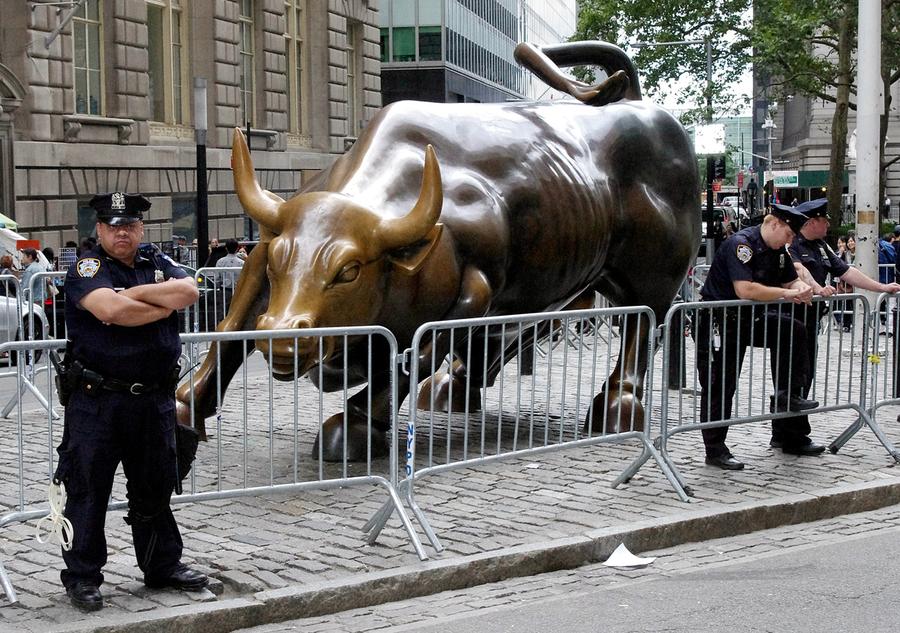
Occupy Wall Street, September 2011. Barricades remained for three years following the protests.

Urinating dog joins Wall Street statue row
May 2017, BBC

The Merrill Lynch 'Charging Bull' is the focus of some public/art controversy, after someone put a sculpture of a 'fearless girl' staring-down the bull, and then someone else put a 'pissing pug,' pissing on the girl. A timeline should help:

1987
Stock market crash.

1989
Artist Arturo Di Modica puts the 7,000-pound bronze bull right there in front of the New York Stock Exchange without telling anyone or getting any permission. (That's called guerilla art). Later that day it gets removed by police, placed in an impound lot, but later reinstalled a couple blocks away. The bull was meant to symbolize financial optimism and prosperity.

March 2017
Kristen Visbal puts Fearless Girl right in front ot the Bull. The Girl was commissioned by State Street Global Advisers for a fund on the market that considers itself gender-diverse. The Bull was paid for by Di Modica, the artist himself. The Girl was paid for by a firm. Di Modica calls it a dis to his bull, an act of commerce, not of altruism. She, the Girl, was commissioned to highlight gender inequality, but she was paid for by a firm that trades on the stock exchange.

May 2017
Alex Gardega makes a little dog sculpture, and has it pissing on the girl. He calls the Girl "corporate nonsense."

Now
It's really hard to argue that the statue of the girl has to do with gender inequality when you look at who commissioned it.

Unfortunately, because gender equality IS an issue, lots of people get lots of pissed when the girl gets dissed. Un-further-fortunately, because income inequality and corporate takeover are an even bigger problem than gender inequality, people are more upset that the symbolic girl is getting pissed on by a dog than they are that we as a society are getting pissed on by the entities that constitute the stock market, for example.

It does seem like a cheap trick, the Girl, that is.

But let's not forget that the Bull was already the voodoo doll of the Occupy Wall Street movement back in 2011, such that it was protected by barricades for three years following the protest. It represents the thing that has shaken the moral compass of Western society - corporate greed and power.

Personally, I would really, really, really like to see a bronze barricade placed around that bull.

image source: link