 |
| The artifact dematerializes from the discrete physical object to the veritably infinite and fuzzy-formed set of memetic iterations. |
On the Artifact:
Herein, “artifact” refers to the leftover, the by-product of
some human activity. We might call that activity “the creation of art”, but we
may as well not, and call it instead the worshipping of a god, or the solving
of a problem, or the contemplation of an essence. The artifact herein is a
discrete object, which means there is only one that is consensually recognized
by most observers, and any re-interpretation or reproduction is measured
against a standard, or the ‘original’. (The reproductions will not be
considered artifacts, only the original.)
Starry Night, in
this case, is a physical painting, and there is only one. “Starry Night” (the idea of Starry Night), on the other
hand, can exist in a re-interpreted or reproduced form, either physical or
non-physical – existing, for example, in the mind of the viewer who interprets
it. Regardless, whatever its permutation, “Starry Night” still comes from or is
measured against a zero-point, that being the discrete artifact of Starry Night, which was created by a
specific person at a specific time and location (with all the specific
socio-cultural parameters they indicate).
A macro image series (MIS) is not discrete. She Knows* is a set of iterations, and when
trying to trace “She Knows” back to its origin, one is confounded. There is no
single creator, and no specific time or place at which it was created. The
nature of a meme-set (shorthand, here, for MIS) is that it is collectively
created. Reciprocally, She Knows and
“She Knows” are one and the same. So, not only does a macro image series not have an origin in the material
world, per se, but it never really
comes into a physical existence at any point**. In trying to pin-down its
essence, one is confronted with myriad false kernels, a shell game where the eignemother we seek is hidden under both
all and none of the shells.
*She Knows is not a Macro
Image Series proper, because it usually doesn’t
have an embedded caption, but is rather an internet-meme of the family Rage
Comic. Both a Macro Image Series and a Rage Comic are internet memes, but the
former just sounds better. Further down the taxonomic highway, all internet
memes can be more appropriately classed as meme-sets, distinguished as such by
their predominant mode of transmission being the internet.
**MIS are not meant to be
printed our or even stored electronically – as evidenced by the extreme
difficulty one would face in attempting to find a specific instance of a meme
(such as Philosoraptor’s “if money is
the root of all evil, why do they ask for it in church”), although the
difficulty in finding it may be more of indexing habits/search algorithms. They
are never meant to be fixed; they are meant to be absorbed by the viewer,
modified and passed-on, all within the technologically-mediated environment of
the internet (as opposed to the passing-on of cave painting via the very
high-entropy system of the cave ritual).
There is no finalized, formalized version of an MIS.
Instead, any example of She Knows is an iteration – a modified copy that has no
single source, and one that does not represent the meme-set in its entirety. When
speaking of artifacts as discrete objects, the MIS is confusing.
On Consciousness:
Perhaps it is best to avoid altogether use of the word consciousness within a spectrum of kinds of consciousness. In this
presentation, “consciousness” refers to an autonomy residing in an individual,
and could otherwise be called the ‘self’ or the subjective consciousness. Unconscious, then, means there is no
autonomy (no ‘self’). The artist does not operate under its own control.
Something else (genetic programming, a deity, a collective unconscious) does the art-making through the artist. Quasi-conscious
simply functions to make explicit the attempt to avoid the label of
consciousness proper. Meta-conscious
simply demarcates the shift beyond the unconscious.
Maybe the Egyptians and the Greeks were conscious, maybe
they weren’t. But when Velazquez paints himself in his own painting, Las Meninas is definitely an example of
a conscious act emanating from the individual entity performing the act. This
certainly yields the term “meta-conscious”. By the time we get to the MIS,
despite it’s correlative to any Folk Art that came before it*, we have reached
co-creation – a kind of collaborative consciousness, or collectivized
consciousness. [disambiguate: collective unconscious.]
*Folk Art is very similar to
the MIS, except that it is iterative only by the defaults set in its physical
transmission and not necessarily by the agents of the transmission themselves.
“Folk Art” seems to only exist within a culture that doesn’t have the means to
reproduce its artifacts with high fidelity. (Early Hip-Hop, for example, isn’t
usually considered a folk art, though it would surely fit most of the
criteria). Folk-Artists aren’t necessarily trying
to change the form of the piece, or, at least, it is unverifiable because they
couldn’t not change a piece that by its transmission brings
with it enough changes (mutations, perhaps) to make attempts at fidelity
futile. MIS-makers, on the other hand, are very consciously trying to change
the MIS; it’s inherent; it must change, by its definition.
On Platforms:
The word “platform” can be thought of as an information
system, and the two in question are mimetics* and memetics [link to
disambiguation]. Mimetics is based on
the transmission of information by mimicry, and it is ultimately the body that
does the mimicking (even in the sense of somatic simulation emotional theory,
see
Damasio). Thoughts are involved,
and perhaps can be said to have the supremacy, but in the end, the origin and
terminus must exist in the material world.
Abstract Art marks an inflection point between the two
platforms. Most [European] art prior to ~1900 uses people to communicate ideas
(e.g. reference to people, not people
in themselves, that’s obvious). Meta-physical things, like Religion, were still
expressed using stories that figured anthropomorphic characters. Anytime [a
reference to] a human body is used to convey information, we have mimetic
transmission. When there is no body, there is no mimetics.
The appearance of artists painting themselves in their own
work, and even of still-life paintings (in the case of Vanitas substituting for
the body as the main character), point to a shift away from the body. Black Square, or
simply non-representational art as a whole, marks the deactivation of the mimetic process, the ‘human-copying’
process, and the activation of the memetic
process, or ‘idea-copying’ process. Also note the coincidence of (take a deep
breath here) post-human, non-human information-copying systems (i.e.,
computers) in relation to the platform shift.
*the terms are very easily
confused because meme- is a conflation of “mime-“ and “gene”. Also, note that mimesis is the more accepted term; mimetics is used instead to purposely
emphasize the difference between the two (which, in this case, is only one
letter).
 |
This is an Image Macro Series.
If you run a search for “image macro series” in order to
find an explicit definition, it doesn’t really work.
It is referred to, but rarely defined.
More importantly, if you try to search for the prime
example of a particular series, you will fail.
Note that these different pictures here, they are called
‘iterations’ of the She Knows meme - not ‘reproductions’ - because they are not
identical to eachother. Some of them have text added, some don’t…some of them
are very much like the “original”, some of them are actually a completely
different series altogether [trollface] (which may just be a side-effect of the
search algorithm).
|
 |
But it’s ok, we all know what it is. [assuming an audience
of ‘millenials’]
It is the meme.
And it kind of only exists in your mind (if we can
say that anything really exists in a mind).
After all, it leaves behind no physical artifact, and it
does not originate with a physical thing either.
It lives out its entire existence in the virtual
world, the non-physical, dematerialized world of the internet.
[define MACRO]
a chunk of a programming code that allows someone to embed
in a webpage or a thread this image that has embedded in it some text.
Notice the double-talk already, the text is embedded in the
image, and the whole thing – the “macro” – is embedded in a webpage via the
programming code.
|
 |
This is Starry Night.
But not really. What you are actually looking at, right now,
is a projected image, of patterns of pixilated light,
from a digital picture file, a jpg
which comes from a photographic reproduction
of a painting - a REAL painting -
Hanging somewhere, accumulating value.
(But not really, actually, because it’s priceless.)
|
 |
And this is Starry Night, also.
But now where is it, really?
It’s in this room, projected onto this wall,
or onto your computer screen at home.
It’s in all these places now. And so what does that
say about the artifact?
Is this the artifact of Starry Night? Are
reproductions also artifacts? What about digitally mediated reproductions like
these here from this search result? We don’t usually call these artifacts
because they aren’t physically embodied – they’re on the internet, they’re
virtual, dematerialized.
What about that feeling that you get when you look at
it, or the idea in your head after you’ve walked away;
Is it any different when you see this Starry Night
vs. the real artifact?
And if not, what’s the difference between the two?
And a note here on the difference between reproductions and
iterations. You see here that all the Starry Nights are not that much different
from the original.
They’re kind of like secondary artifacts.
But remember the memes (like She Knows or Philosoraptor) –
there is no “original” and so there can be no “reproduction”, (and this makes
us question their status as artifacts).
|

 |
BUT LET’S GO BACK TO THE BEGINNING.
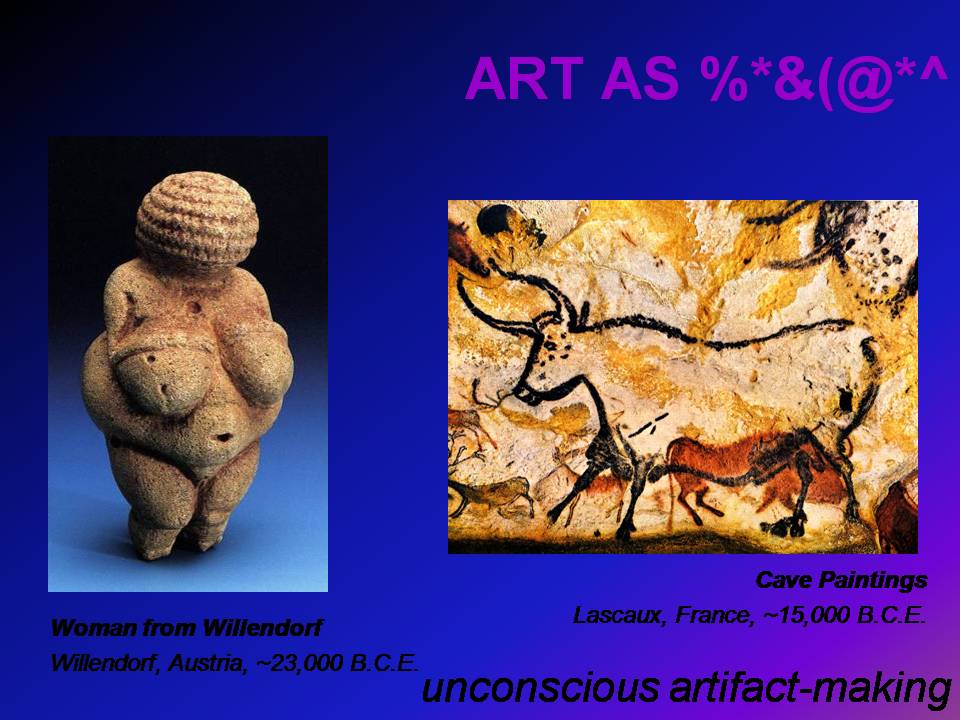
[introduce woman from willendorf]
We don’t really know what the heck they were doing, to be
honest.
This art was from so long ago, and made by a people so
different from us, that we just don't know...
Channeling Spirits?
Talking to the Gods, asking them for help?
Performing Rituals for Fertility or Hunting?
What we can guess, is that not only are these people not
aware that they’re making the artifact, they’re not even aware that they’re
making art. What we are calling art, to them was something much
more important.
Granted there is evidence that prehistoric peoples made
objects for the specific purpose of looking beautiful as a means to impress
others, or to impress their gods, it seems that most of the artifacts they left
behind were not made for their own purpose – just to make some cool thing – but
they were part of a much greater activity.
Usually, or from what we guess, the artifact is just
discarded. Once the activity – the ritual – is over, we don’t need the
art-object anymore.
|
 |
Same thing here; the art-object is discarded basically as
soon as it has been created.
The Art is only a by-product of the ritual, like a form of
worship, and so after the ritual, the artifact is gone.
Once it’s served its purpose, it’s discarded; there is no
record.
|
 |
In this case, the leftovers remain.
That’s what an artifact is.
What we call Art today, was not meant to be looked at,
it was meant to be used. [note: dreaming in temples]
[sidenote]
Just as the Greek temples were not mere structures to house
an activity, but an enchanted place, these sculptures were not mere stone; they
were the embodied spirit of the god they represented,
And as such, no mere mortal was allowed to create
them, and in some theories, the artist-creator was thought to be in a
trancelike state, possessed by either the god they were recreating, or by some
art-god, but it was not created by the actual person [the Code of
Hammurabi was actually written by Marduk, Hammurabi's hallucintory god-voice].
So, if that’s the case, are they really conscious of what
they’re doing?
[also note]
There is a disconnect here, perhaps, between the ‘performer’
of a ritual who creates an artifact as a byproduct,
And the ‘creator’ of the artifact, which is then used in
some later ritual performance.
[African masks?]
|
 |
The Art tells a story, a spiritual story, about gods and
godly creatures and godly ways…
Note that the art is no longer discarded, it is used;
and in this case it is used to tell you a story.
(Note also, the majority of the world’s population is still
illiterate at this time, hence the need for picture-stories).
Overall, this art is not meant to be looked at and
admired for its beauty – you might admire it, and a person from this time
period might have admired it, but its main purpose was to tell a story,
to communicate some spiritual idea.
|
 |
Everything changes. Perhaps the printing press, perhaps
literacy, perhaps we have fully come out of the Dark Ages.
Regardless of the reason, at this point, everything changes.
Most importantly, Science supersedes Religion.
These are now images of the real world, as it looked from
the specific visual organ of the human (not from a spiritual-metaphorical sixth
sense).
The artifact is now a visually-codified interpretation of
reality.
//
But wasn’t it real before? No. Religious stories,
mythologies, etc., did not ever really happen. They are stories that
were told by thousands of people over hundreds of years and jumbled together.
They never really happened in the way that we, today, would say that a thing
happened.
(There were no ‘eyewitnesses’ for example, and there is no
physical evidence of religious/mythological stories).
Virgin Mary, the Minotaur, some Egyptian snake-headed
god-creature – they’re all made-up, so even if they look real, they are
still a picture of an unreal thing.
Michelangelo’s pictures look realistic, but the
people in them are not real.
//
These things, however, are documented.
And, for some reason, we all seem to agree that means they really
happened.
|
 |
And now, finally, the idea of consciousness becomes
paramount.
These guys are so conscious of their art, they’re making art
– about making art! (That’s what we can call “recursive”, or “meta-”, or
“artception”.
[…MCEshcer’s Drawing Hands is a great example of
recursive-like stuff, so is the recipe for sourdough bread…]
Cavemen were not conscious of their artifact-making.
Were the Greeks or the Egyptians conscious that they were
making artifacts? Perhaps, perhaps not.
Michelangelo? Probably yes.
But for sure, these artists are conscious or their
art-making. We know because we have evidence – they were painting themselves in
their own paintings!
So it’s indisputable at this point: We are conscious.
|

 |
In the 20th century, during decimation and disruption of the
World Wars, and by the concentration of global power that proceeded, strange, strange,
things began to happen, and so, new forms of thinking were required, and
thus new kinds of art.
Let’s take a step back, to where we came from.
Where are these artifacts coming from?
Is the artist engaged in a spiritual ritual, and these are
the by-products? Perhaps.
What are these artifacts used for after they are
created? To tell stories?
Sort of: “this is how you should live your life, this is how
you should deal with your problems”
But there are no characters in these stories; the people in
the paintings, if there are any, are not the main characters
anymore.
Instead, they are about storytelling itself – about
perception and decision-making.
They are not pictures of other people doing things that we
should mimic, they are pictures of ways of mimicking ways of being.
|


 |
Eventually, all reference is gone. Definitely no more
people, no more documentation of real events – in fact, nothing at all.
Art no longer attaches outside meaning to its visual
interpretations of reality.
The picture has no connection to the outside world.
What it represents now is nothing we know from the world
outside of us, around us.
If you want, you can call this ‘the dematerialization of
reference’
|
 |
The artist is conscious of the creation of an artifact as a result
of the artist’s performance.
The cave dwellers were surely not conscious of their
activity in the same regard as Jackson Pollack; Pollack is very aware that he is
making art by dripping paint.
|
 |
The art is supposed to be like a real thing to the viewer.
In a way, it is an imaginary thing that has manifest itself
in the environment of the viewer.
Because Abstract Art got rid of the need to reference the
visual world, artists can now have the reference come from anywhere, and in
this case, the reference its making; is to the art itself. It’s not a picture
of a thing, it is the thing.
In the case of installation art, it can be seen as the art
creating itself – if the art were a real thing, it would be a thing in
mid-creation and one that is thus “creating itself” (hence ‘artifact-making
artifact’).
It also kind-of offsets the creative rights from the artist
to the object itself, which is interesting as we approach a time where the who
is becoming less important.
(Remember: who creates memes?)
|
 |
Street Art is happening in parallel to installation art.
In this case, the art is now fully embedded in its
environment (which is not a museum, by the way); it is inextricably
meshed with its surroundings, and by that extension, it becomes the real
world. So again, the art does not refer to anything, it is the thing.
(Perhaps this is a retaliation against the
dematerialization of artifact; the photograph of some Street Art piece is cool,
but it’s a lot cooler to actually come across this in your own town, to see the
real thing)
|
 |
Let’s talk about transience and ephemerality.
Goldsworthy’s work doesn’t last long, so he takes pictures.
Imagine you are walking through the woods, or some desolate
place, and you come across one of these, and a part of you, maybe a big
part of you, wants to believe that it was Nature herself who created this
beauty. There is no evidence of the artist, none whatsoever. So is it an
“artifact”? Is it artificial? Or is it natural, made by nature, and not by man?
(There is no evidence of the hand of the artist; he literally uses his own spit
to freeze together icicles that were created by Nature herself.)
The art is in that experience, that feeling of being fooled,
or of letting yourself fool yourself.
But we ask again, where is the art, physically?
Is it in the thing?
Or is it in the picture of the thing?
Does Goldsworth really get to the bottom of this, showing us
that the art, the experience of the art, and the artifact, are not the
same thing, that we must see them as separate?
If you wanted to reproduce his work, do you take a picture,
or do you have to go and make one yourself, and put it out there in the woods
for someone else to see. And if nobody sees your artifact before it disappears,
did the “art” ever exist? [if a bear shits in the woods…]
|
 |
[for those who don’t know, Mr.Z. is a high school substitute
teacher/artist who draws on the dry erase boards all over the school]
The thing is done in dry erase markers…(regarding transience
and ephemerality), enough said.
Where is the artifact? Surely we can take pictures of Mr.
Z’s work. When a work is no longer there, do the photographic reproductions then
become the primary artifacts?
Did photography cause the dematerialization of the artifact?
Perhaps.
But when we go to value one of his dry-erase masterpieces,
do we assign it more worth just because it’s so delicate, just because someone
can rub their elbow on it and destroy the whole thing? Is it more important to
us because it is so close to being wiped into non-existence?
Or, because it then barely exists in the first place?
|
|
Question: If the artifact has been dematerialized, then
where is it?
Yes, it is in our minds, the place where all
non-physical things first become real.
And meme-combinations such as this, art is more akin to the
anonymous cave-painter, in a way unconscious (but really
collectively-conscious, which is like individual-unconscious).
|
 |
[note: this presentation was intended for delivery to a high
school philosophy class on the subject of ideology.]
In conclusion, a final thought:
Art is not just an ideology; it is a lens through
which we can see the ideologies themselves; it is a thing that makes the
invisible world visible to us.
Art leaves behind evidence of our activities, and from this
we interpret the essence of the human condition at the time of its creation.
As the artifact dematerializes; as the content of the
imagery loses direct visual reference; as the artist goes from being a
god-spirit, a muse, an unconscious artist, to a very meta-conscious art-maker,
to a point when there are many artists co-creating the art; we can at least say
one thing – the human condition, and thus its ideologies, change over time.
And in the end, it is you, either individually, or
collectively, that dictate where it goes and what it will become.
[enjoyable reference]
Julian Jaynes’s Software Archeology
DANIEL
DENNETT
www.julianjaynes.org/pdf/dennett_jaynes-software-archeology.pdf
[random post script/news]
Additive manufacturing as a possible solution to fight destruction of the cultural record
phys.org, 2015 Oct
Archaeological concepts such as the real, virtual, and authentic are becoming increasingly unstable as a consequence of archaeological artefacts and assemblages being digitalised, reiterated, extended and distributed through time and space as 3D printable entities. A paper recently published in Open Archaeology argues that additive manufacturing technologies, known commonly as 3D printing, have the potential to redefine the nature of archaeological entities in the digital.
|




.jpg)


